
Cuerpos para la Reconciliación · Sala 8
Lo que nos llevamos, lo que podemos mejorar
Postales y cartas para seguir construyendo
Postales del Festival Movimiento y Patrimonios Vivos ↓Todo encuentro deja recuerdos, aprendizajes y preguntas. Esta sala reúne la retroalimentación de quienes vivieron el Festival Movimiento y Patrimonios Vivos y el diplomado Formadores en Patrimonio Vivo, Cuerpo y Paz.
Las postales del festival combinan fotografías y reflexiones sobre lo vivido. Las cartas del diplomado comparten aprendizajes, experiencias y propuestas para mejorar el proceso formativo. Son miradas personales que nos ayudan a reconocer lo que tuvo sentido, escuchar las dificultades y pensar los próximos pasos.
Recorre estas postales y cartas: cada experiencia compartida nos ayuda a cuidar lo construido y a imaginar cómo continuar.
Postales y cartas para seguir construyendo
«Más que un conjunto de propuestas aisladas, este diplomado se consolidó como un mapa de intenciones latentes, un espacio gestado desde el oficio puro, donde crear, recordar y tejer comunitariamente se transforman en un acto de permanencia y resistencia en el presente.»
«Es una semilla sembrada en el cuerpo que seguirá floreciendo en cada taller, en cada ronda de danza y en cada espacio de encuentro con los niños, jóvenes y sabedores del territorio.»
«Lo más importante que aprendí es que el patrimonio no está solamente en los lugares, los objetos o las tradiciones, sino también en nuestro cuerpo, en nuestra memoria, en las historias que contamos y en la manera como habitamos y sentimos el territorio.»
«Esto me permitirá fortalecer las prácticas, metodologías y estrategias que venimos desarrollando con las niñas, niños y mujeres de la Escuela, enriqueciendo sus procesos formativos desde el patrimonio y los saberes del territorio.»
«Que reconciliar implica escuchar, reconocer las diferencias y generar espacios de encuentro.»
«Lo más importante que aprendí fue que la reconciliación también se construye desde las pequeñas acciones y los espacios comunitarios. Aprendí a valorar más la escucha, las historias de las personas y las experiencias que cada comunidad tiene para aportar.»
«Me llevo la inspiración para seguir fortaleciendo mi trabajo, compartir estos aprendizajes con mi comunidad y entender que cuando nos encontramos desde el arte, todos tenemos algo que enseñar y algo que aprender.»
«Esperaba una capacitación más. Pero encontré un espacio para sanar mi propia historia, para aprender a enseñar desde el cuerpo y no solo desde la cabeza, y para llevarle a mi comunidad una forma diferente de hablar de lo que nos pasó.»
Postales del Festival Movimiento y Patrimonios Vivos
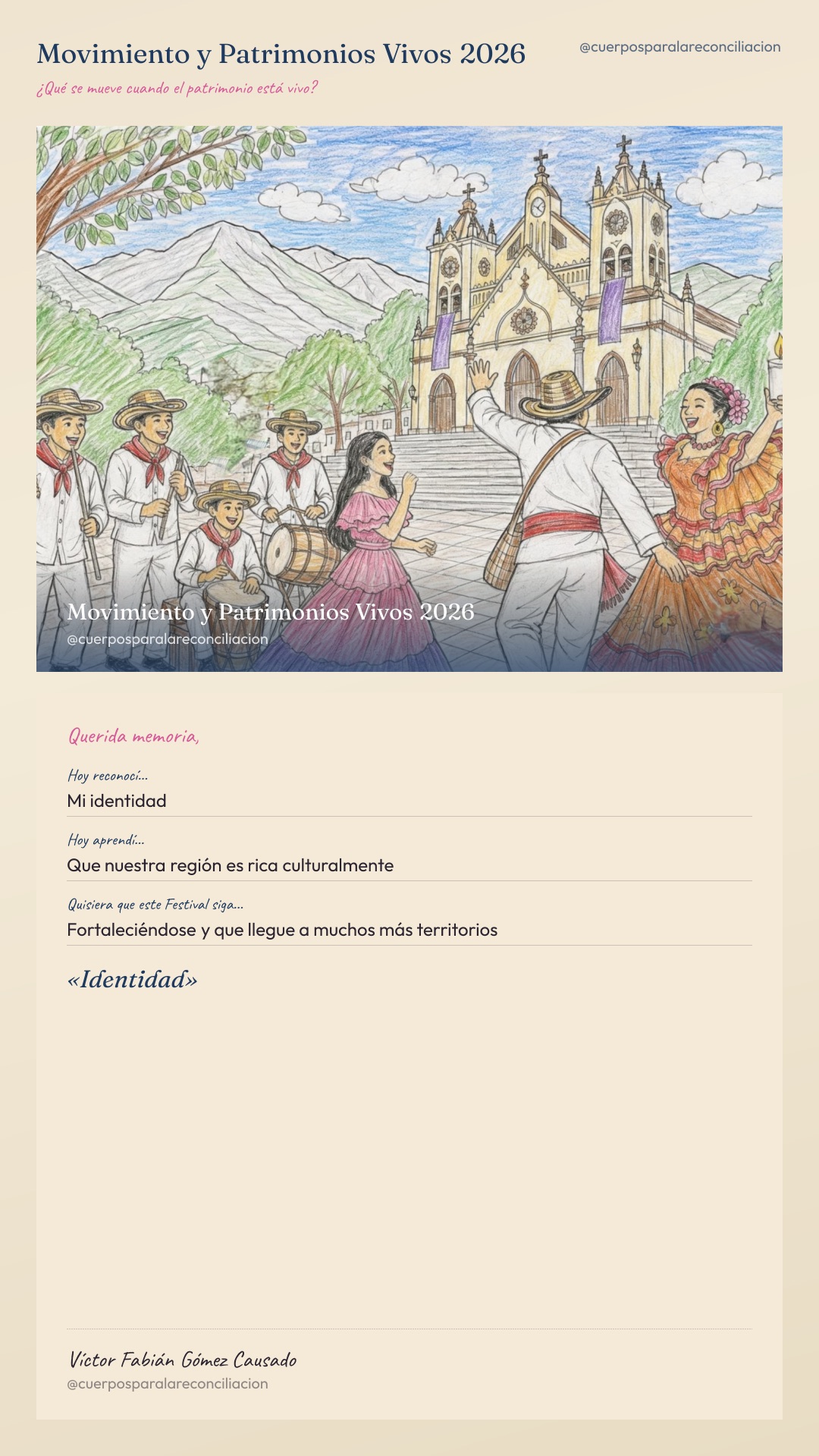 Víctor Fabián Gómez Causado
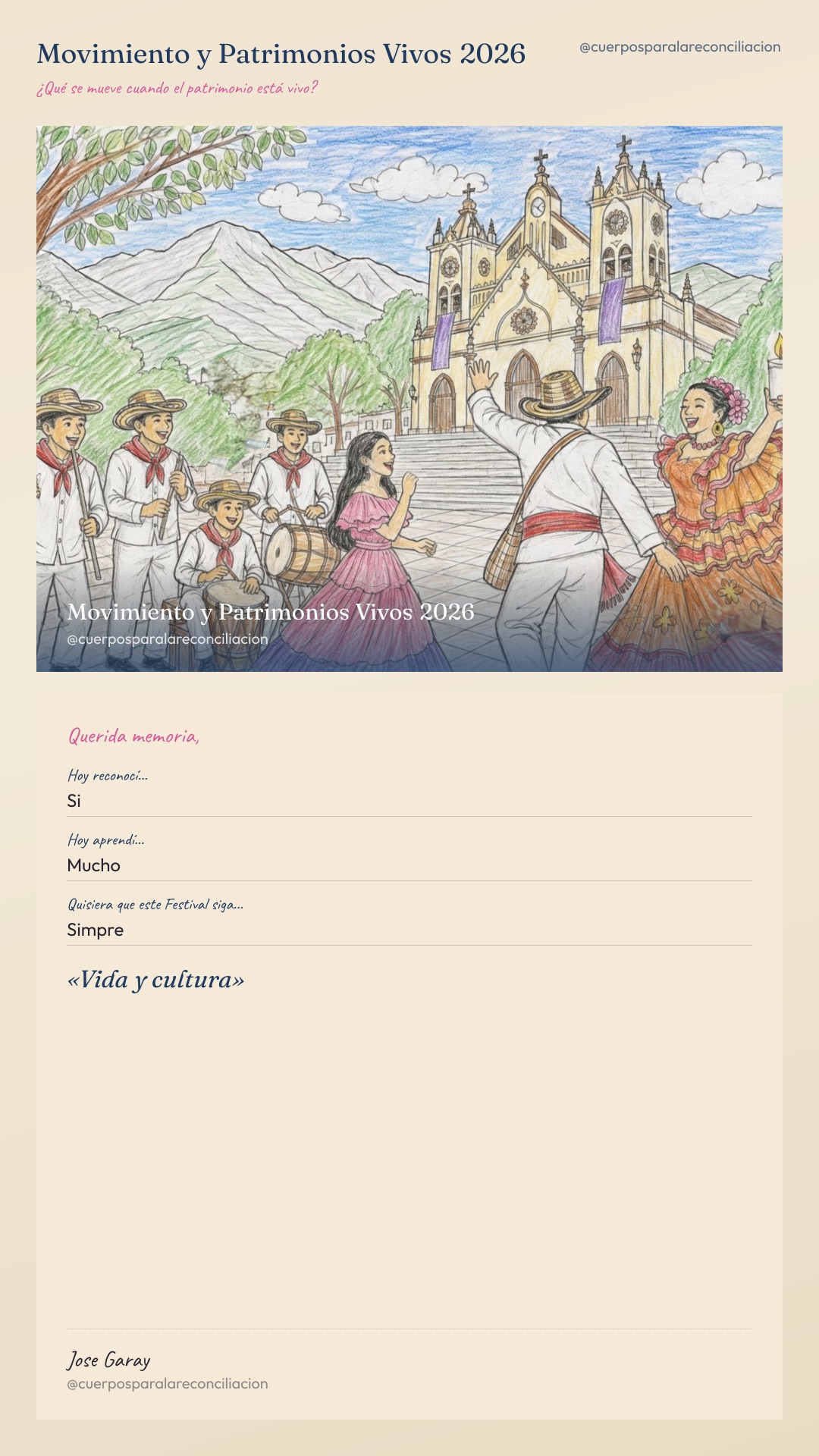 Jose Garay
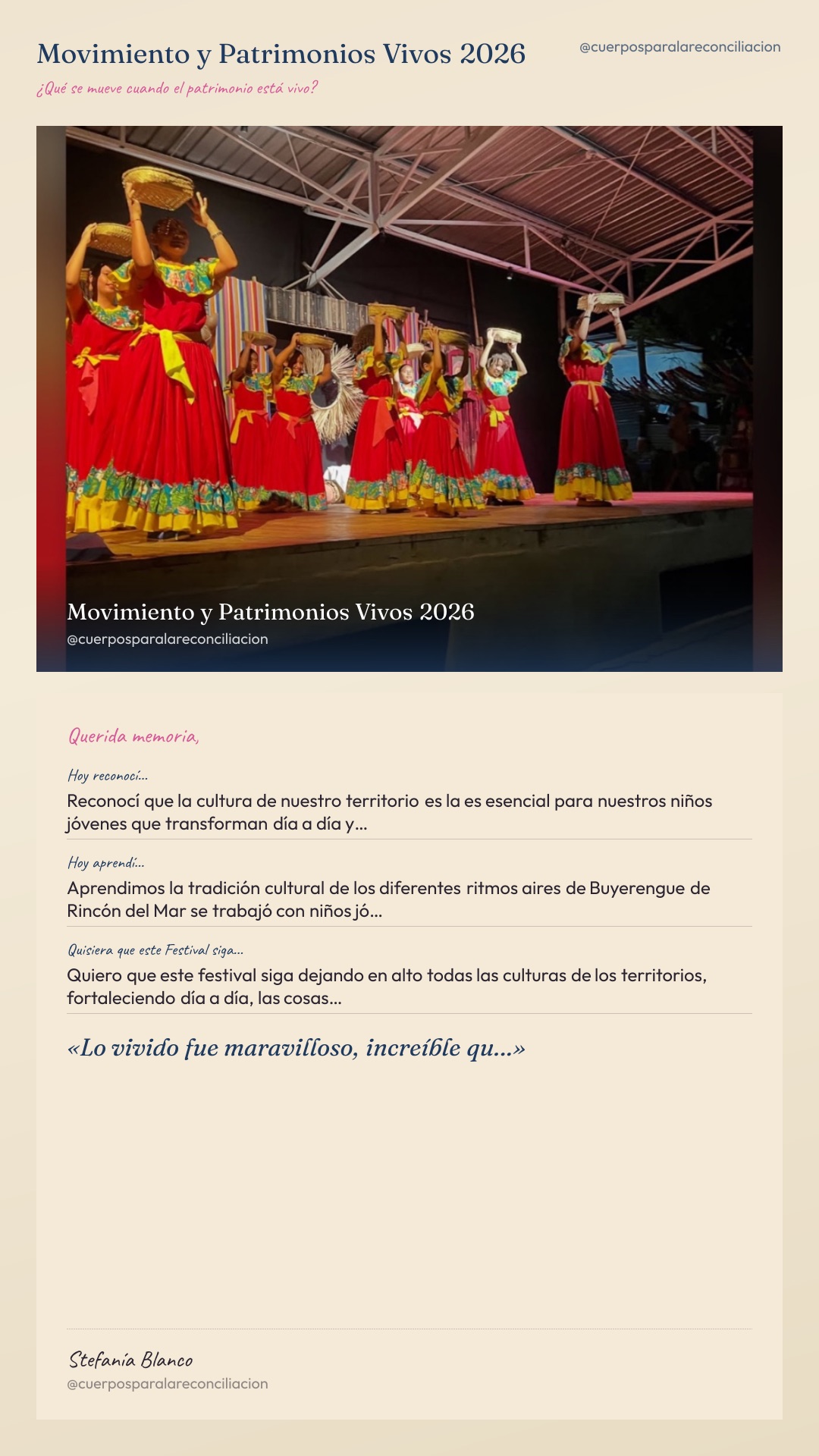 Stefanía Blanco
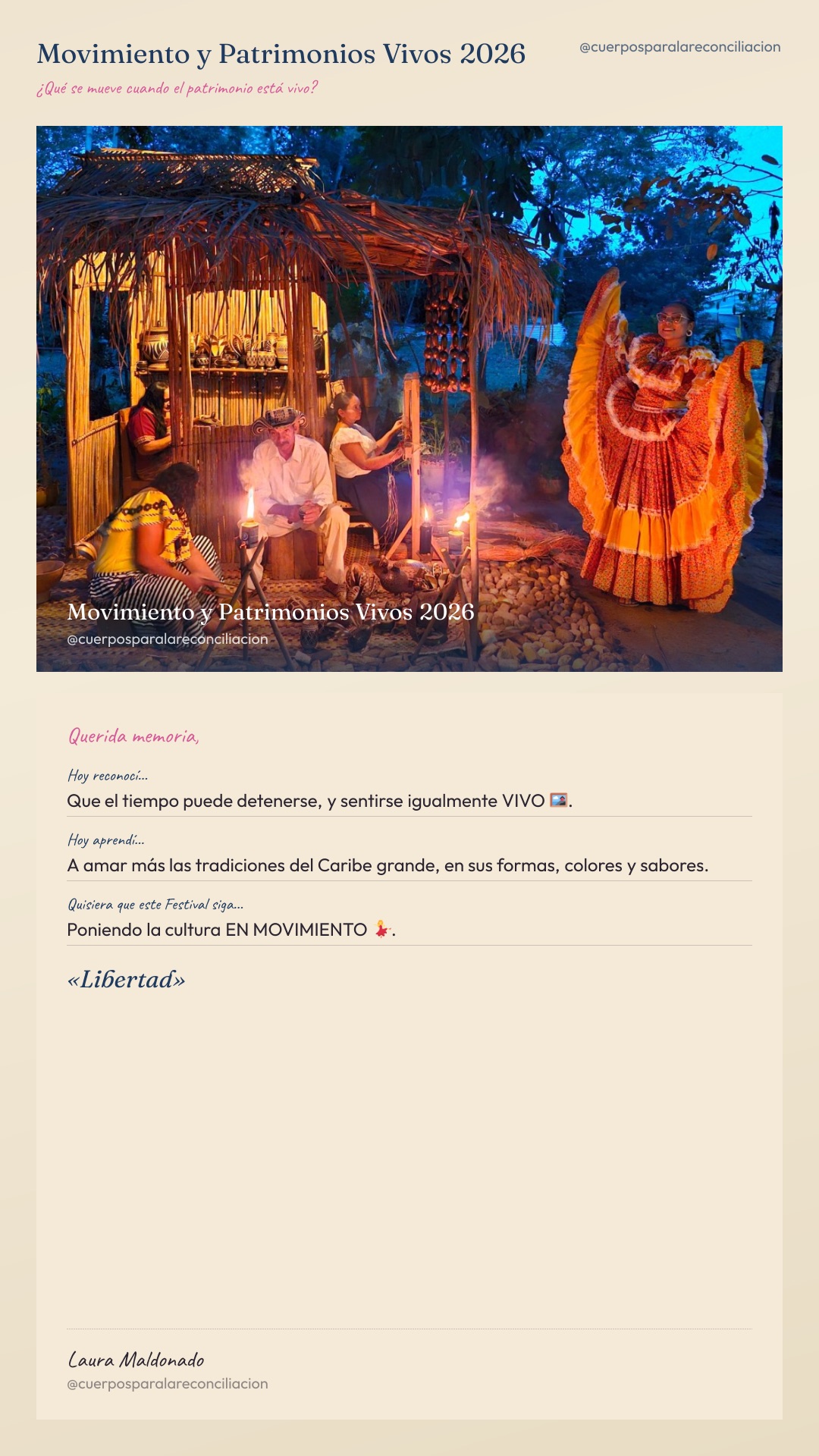 Laura Maldonado
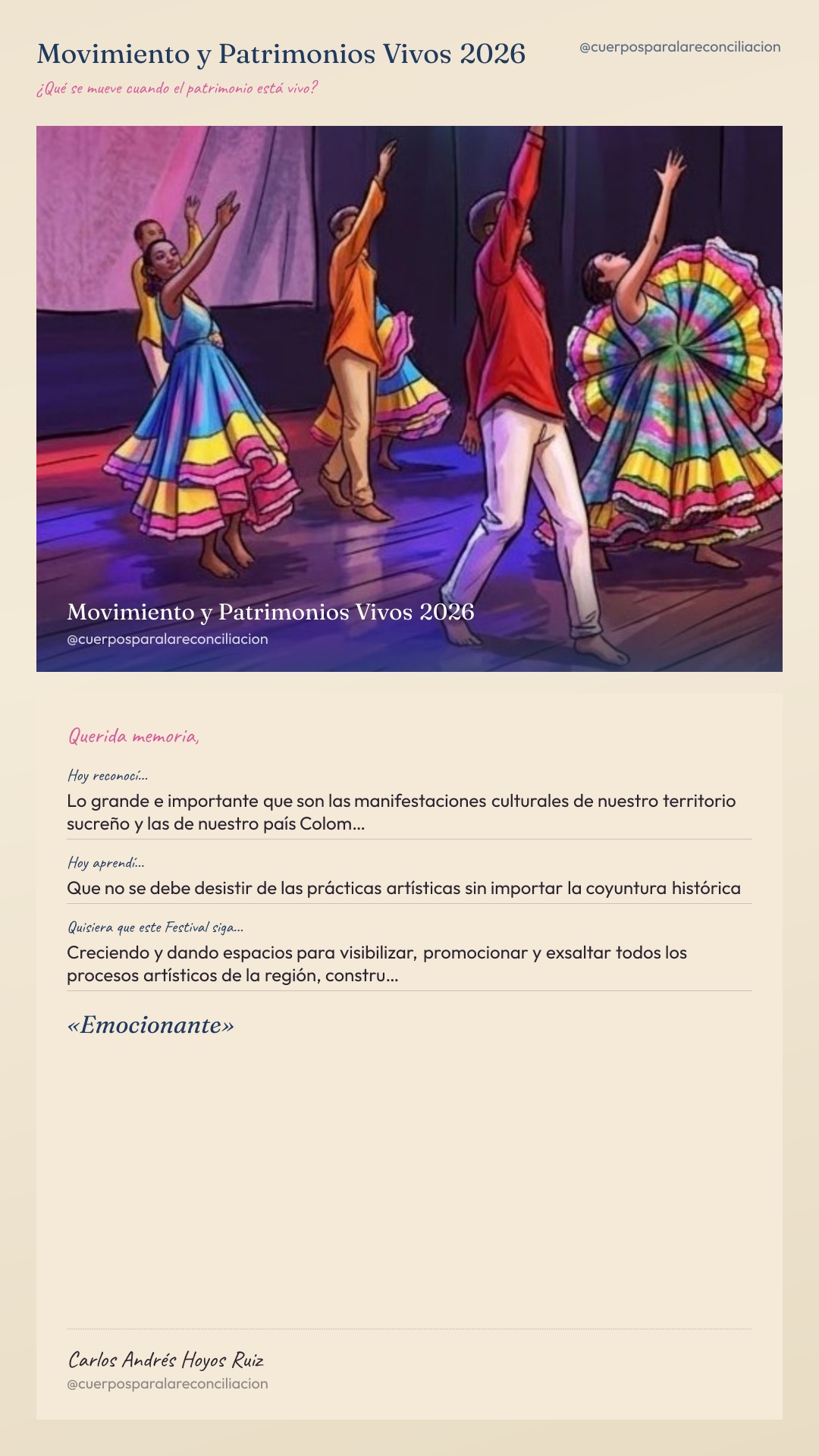 Carlos Andrés Hoyos Ruiz
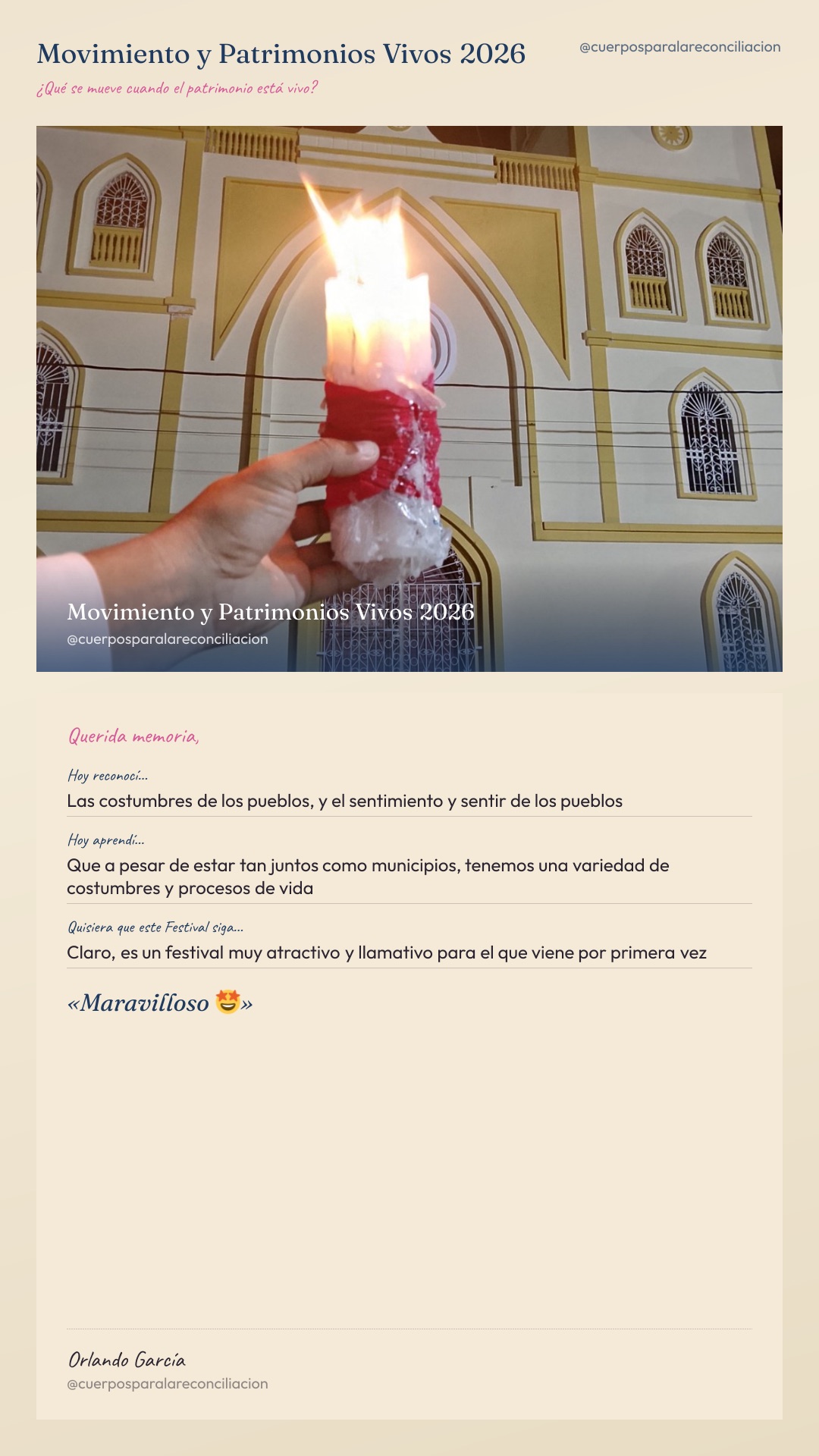 Orlando García
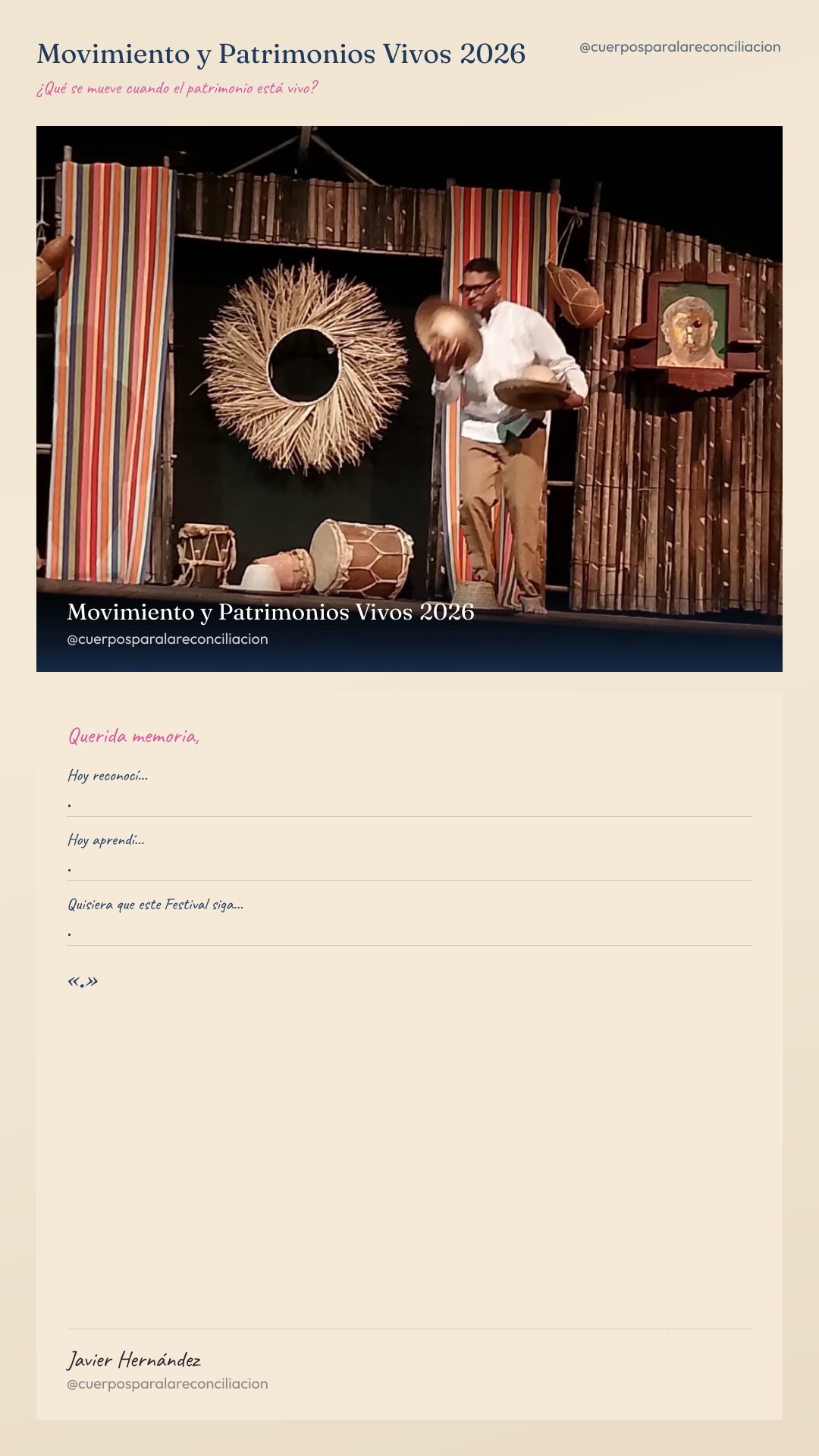 Javier Hernández
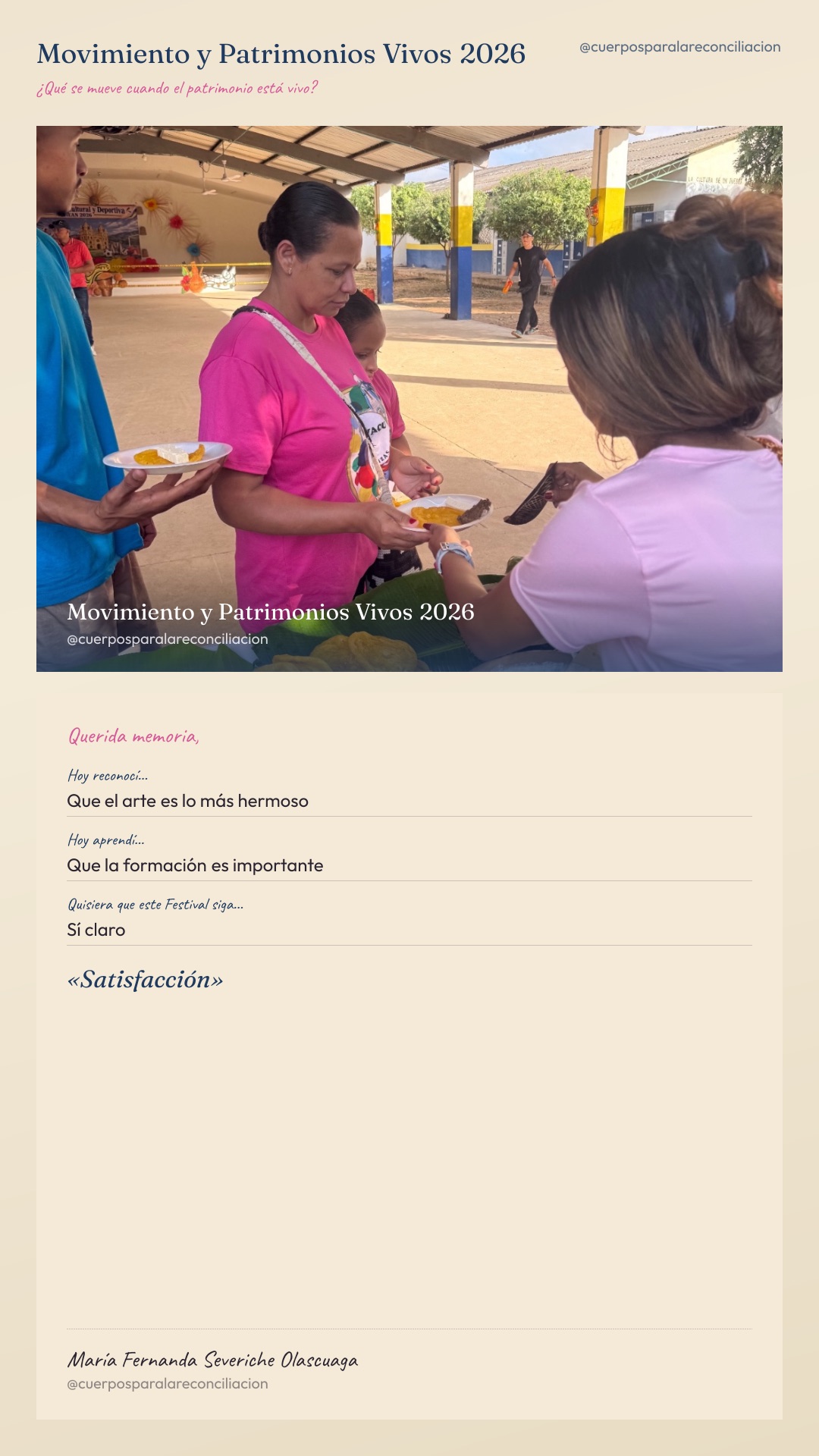 María Fernanda Severiche Olascuaga
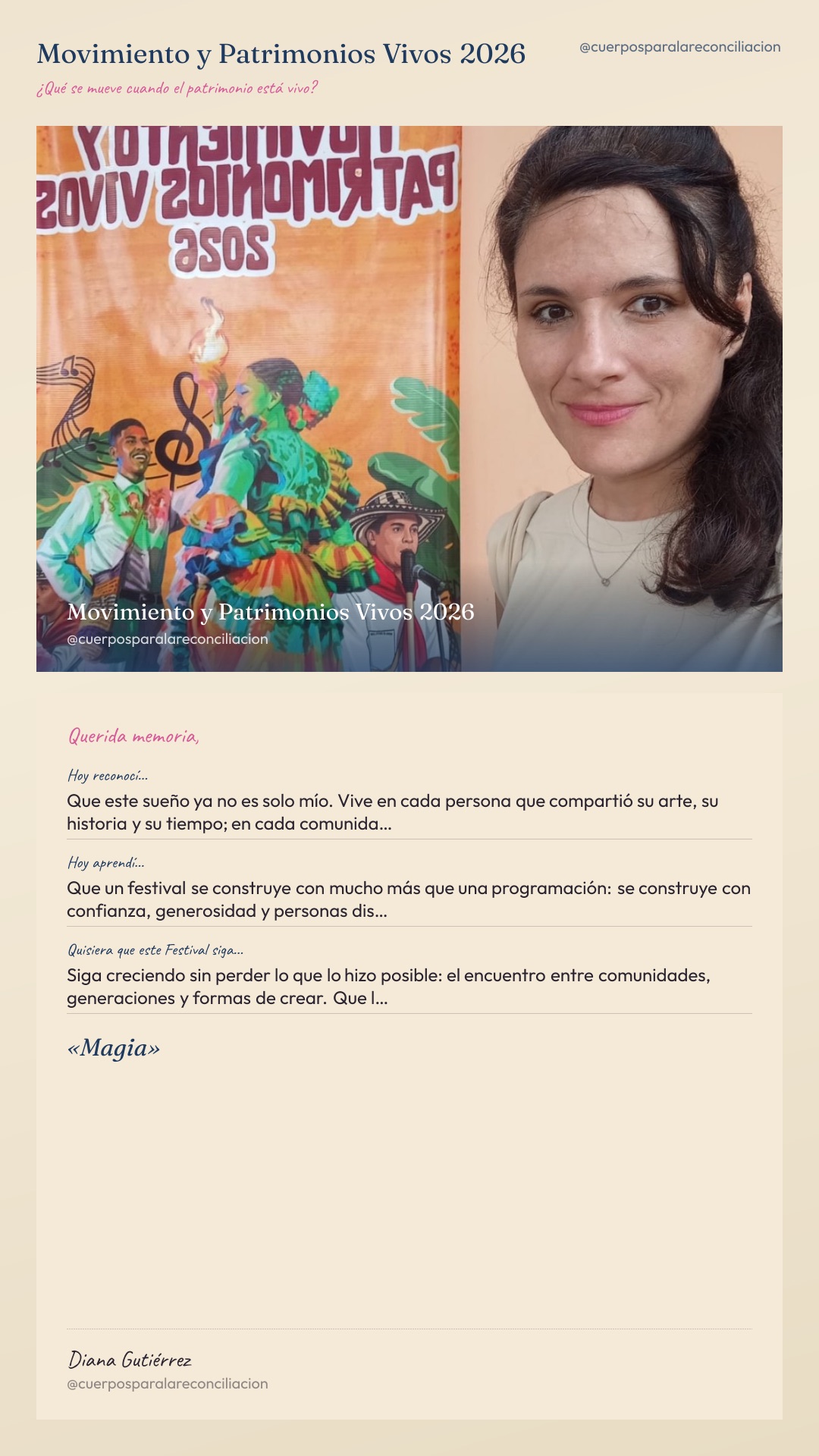 Diana Gutiérrez
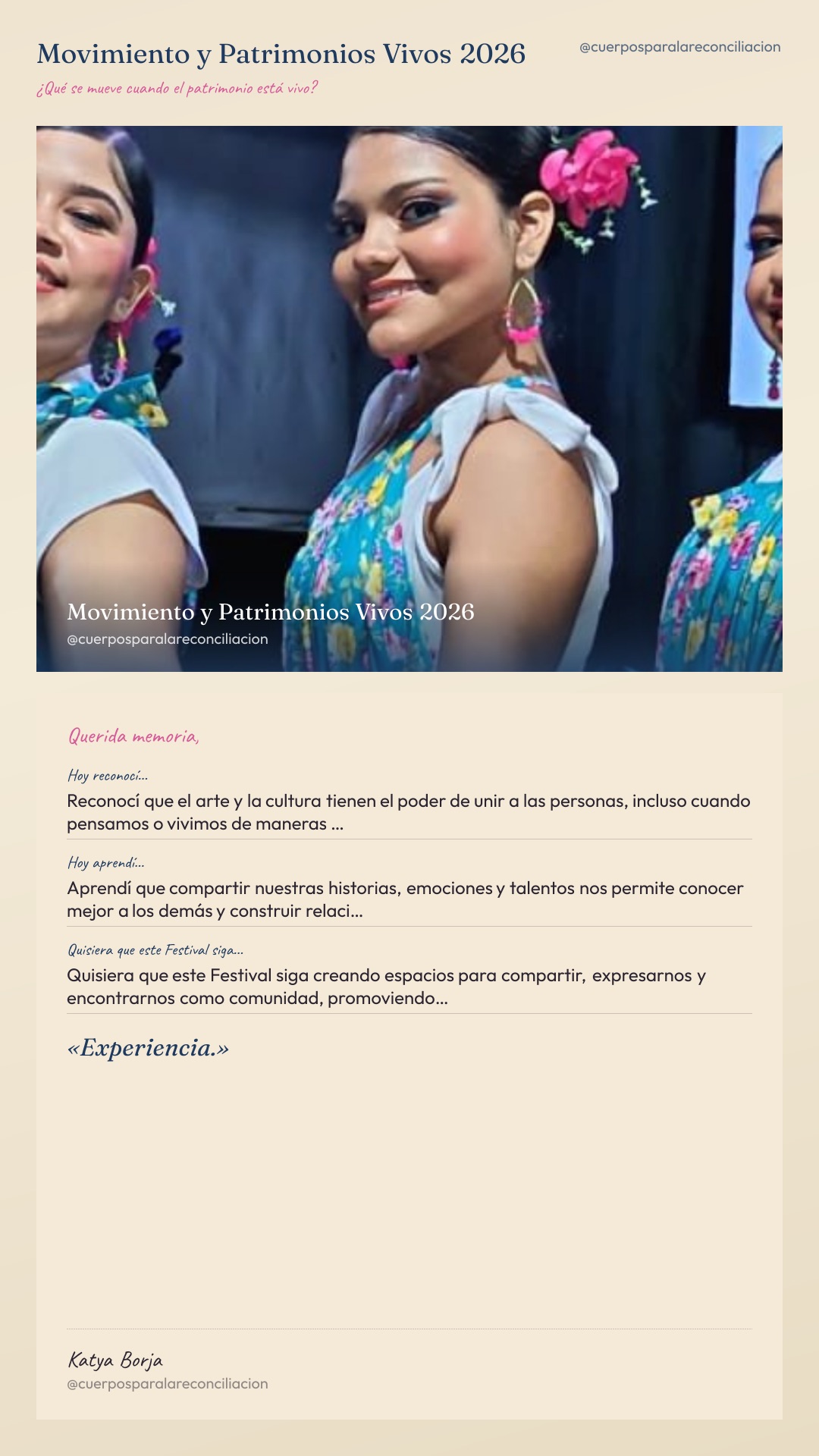 Katya Borja
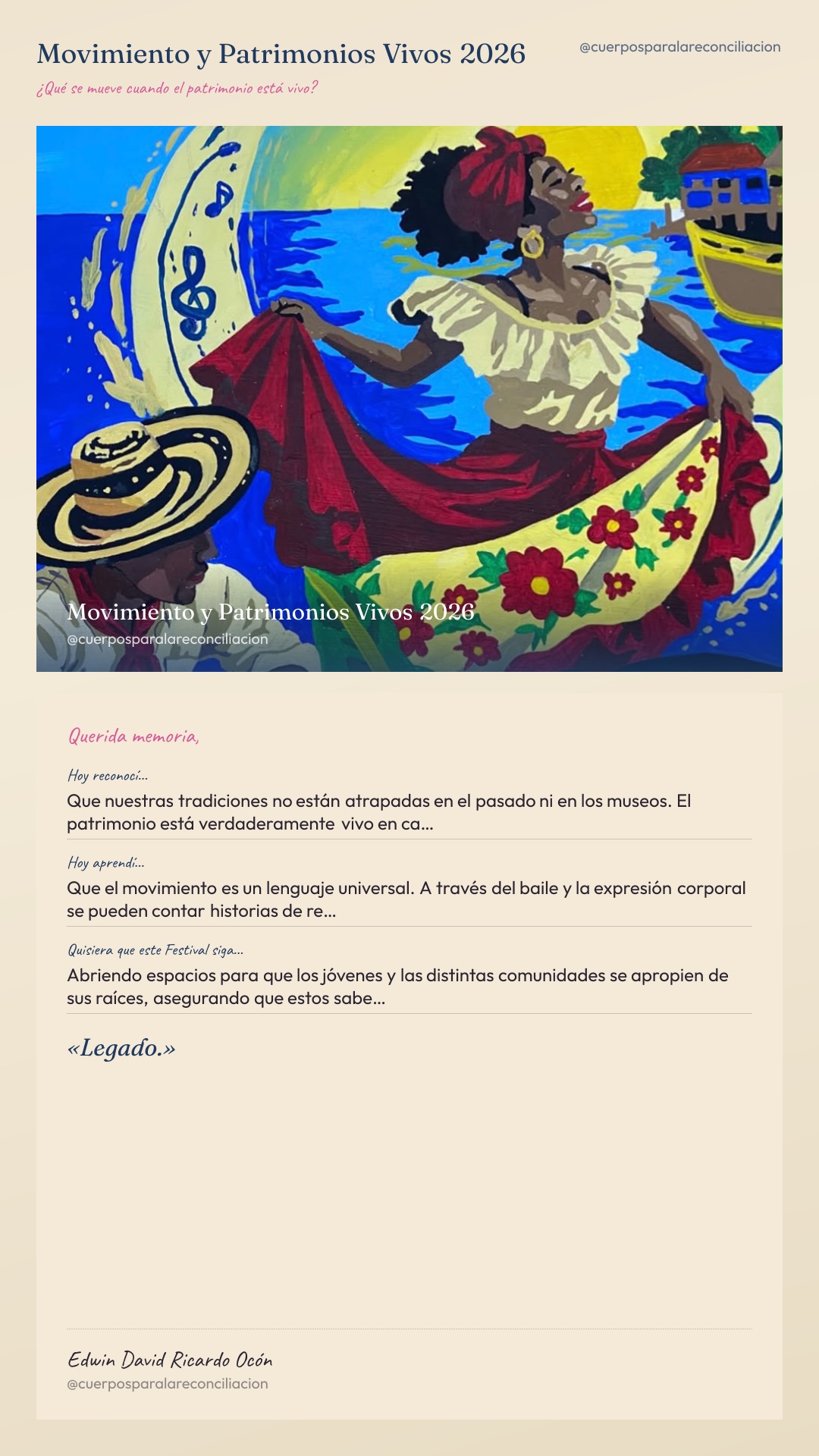 Edwin David Ricardo Ocón
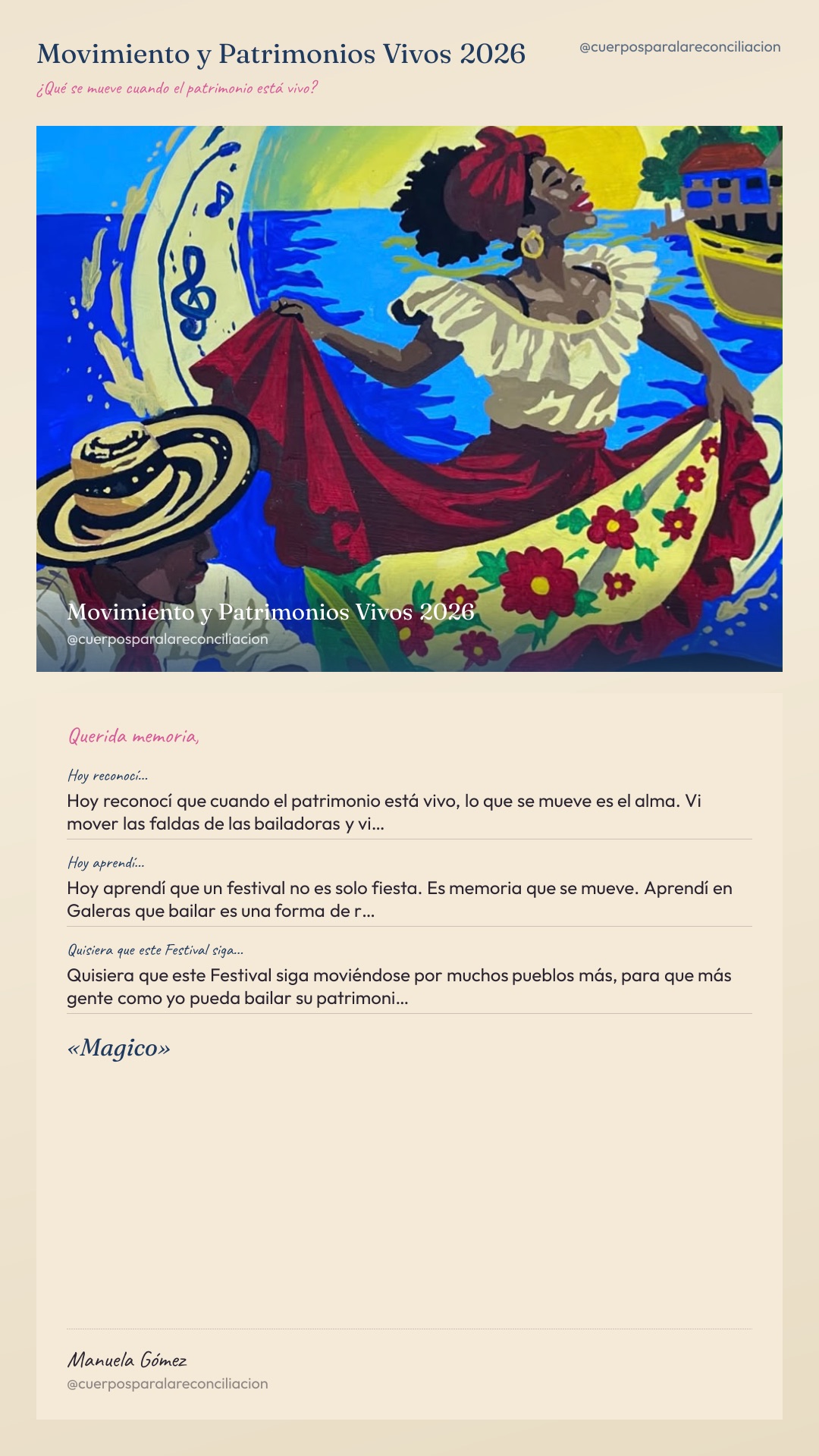 Manuela Gómez
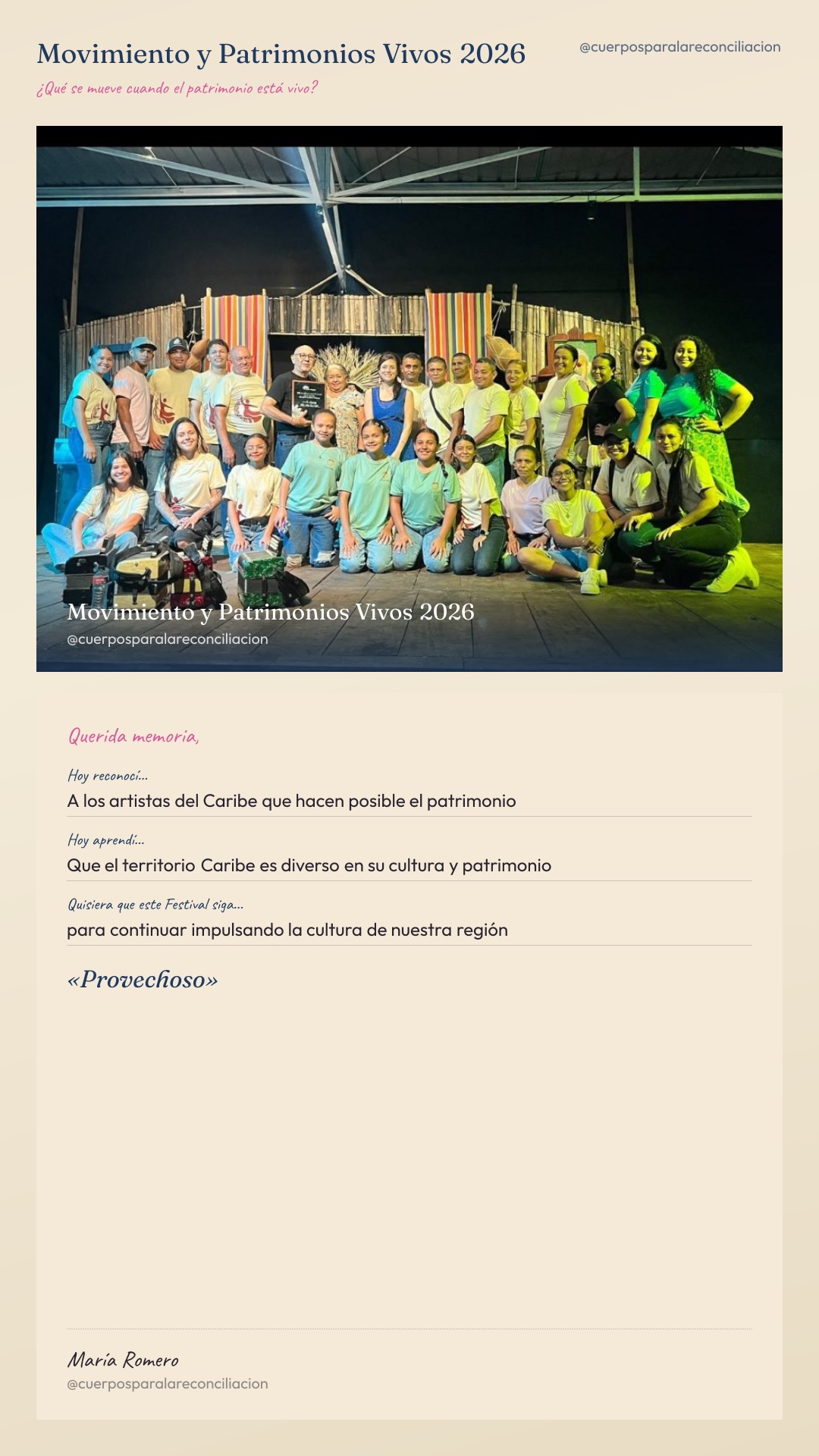 María Romero
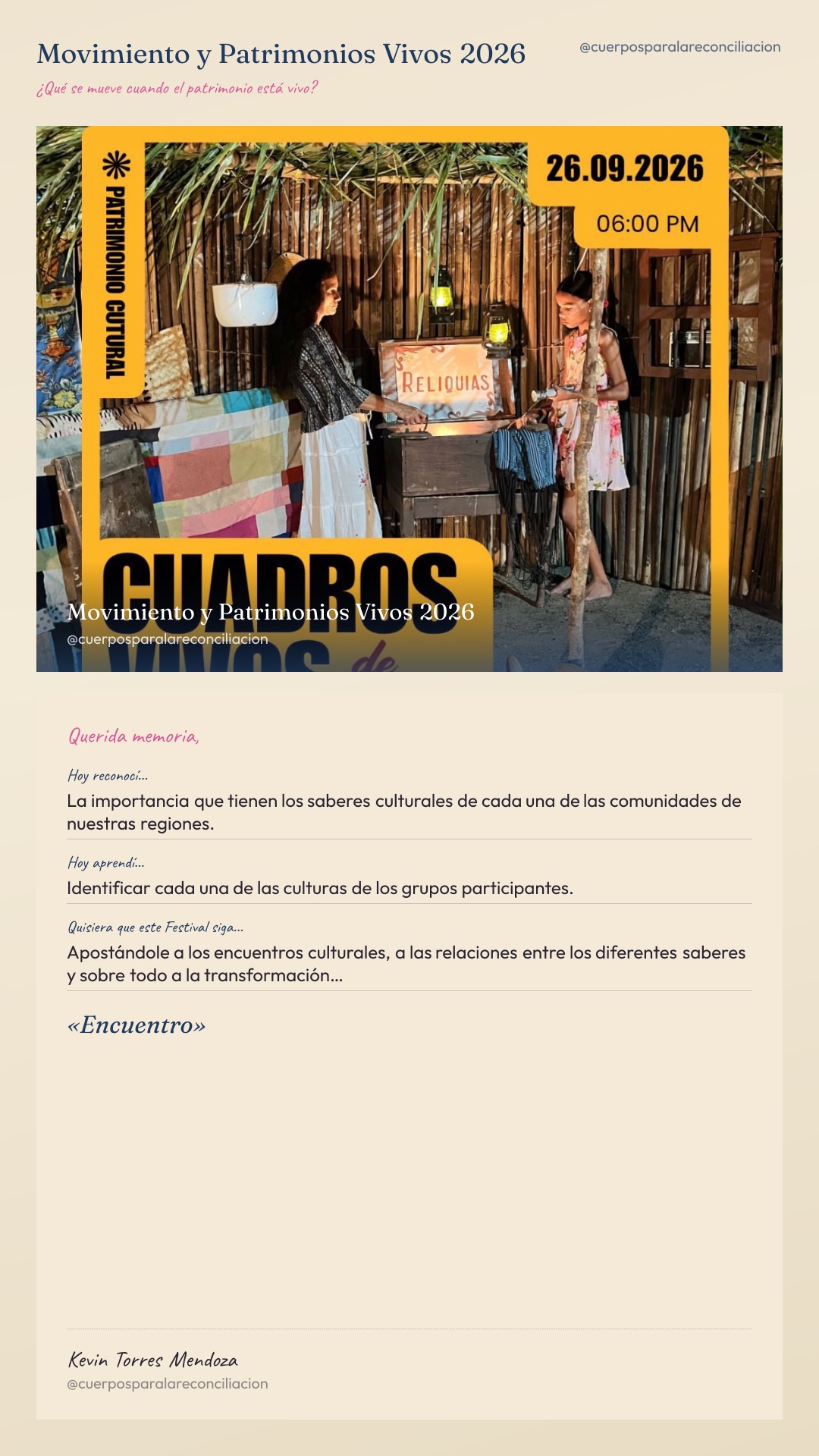 Kevin Torres Mendoza
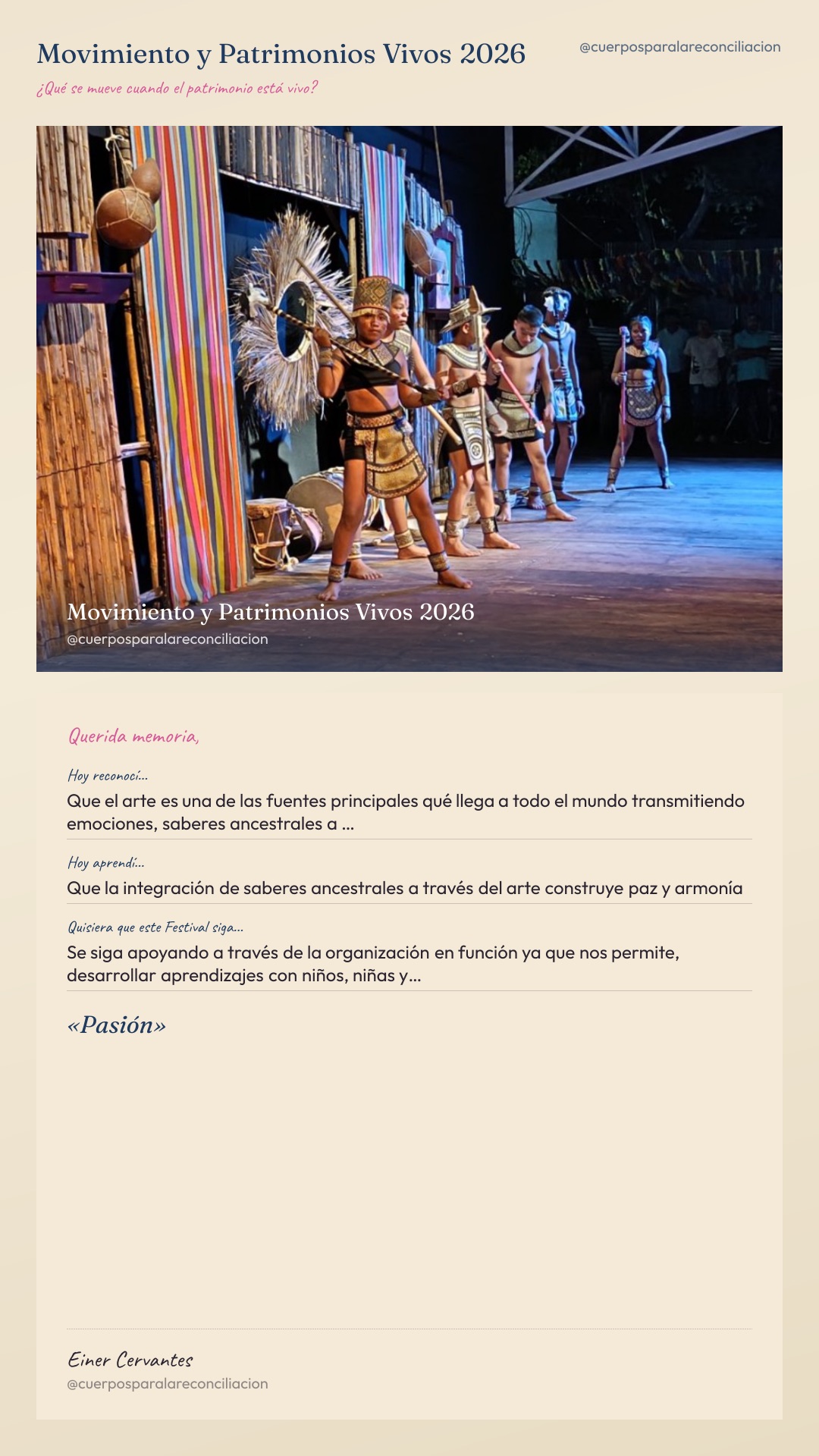 Einer Cervantes
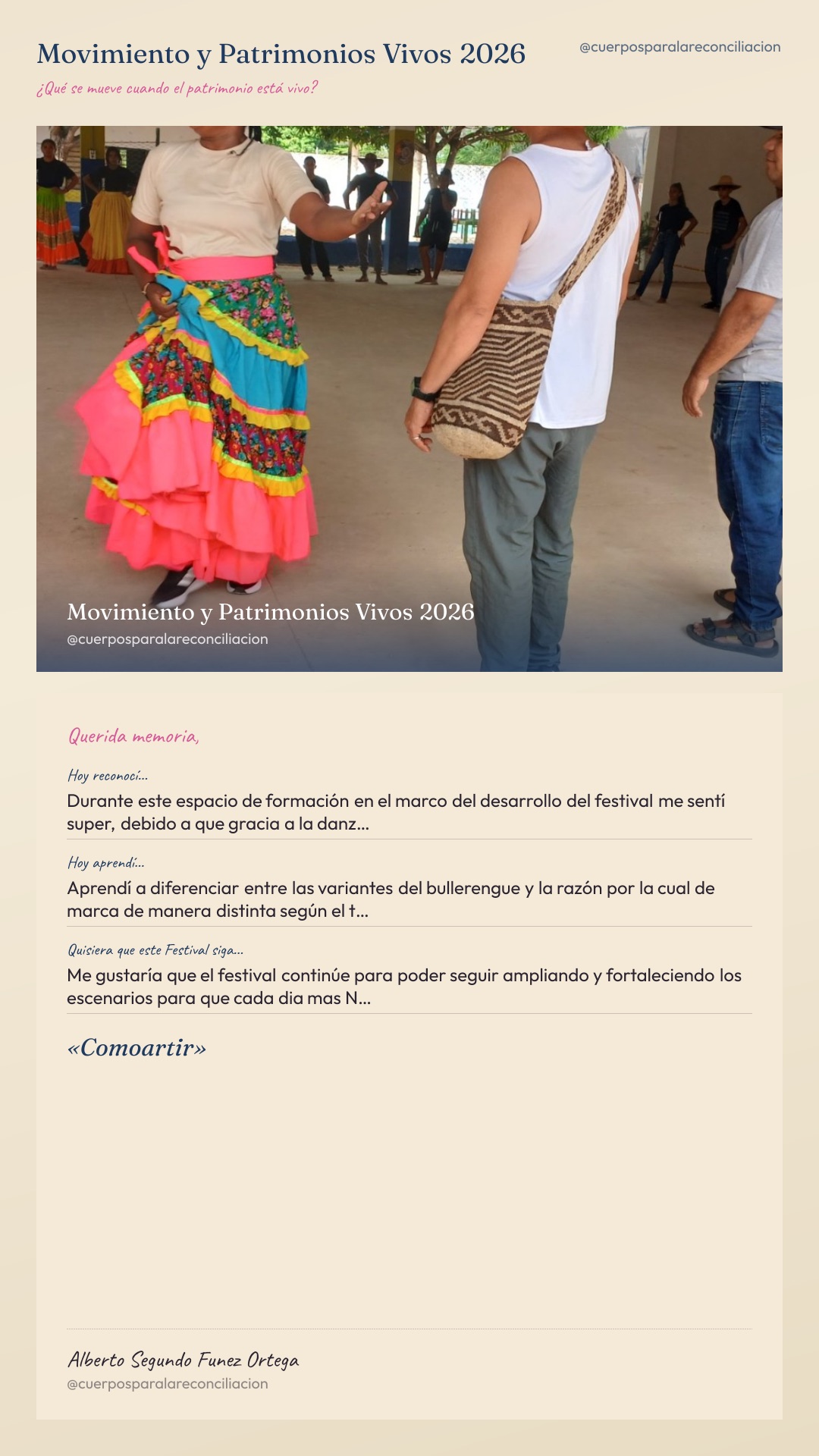 Alberto Segundo Funez Ortega
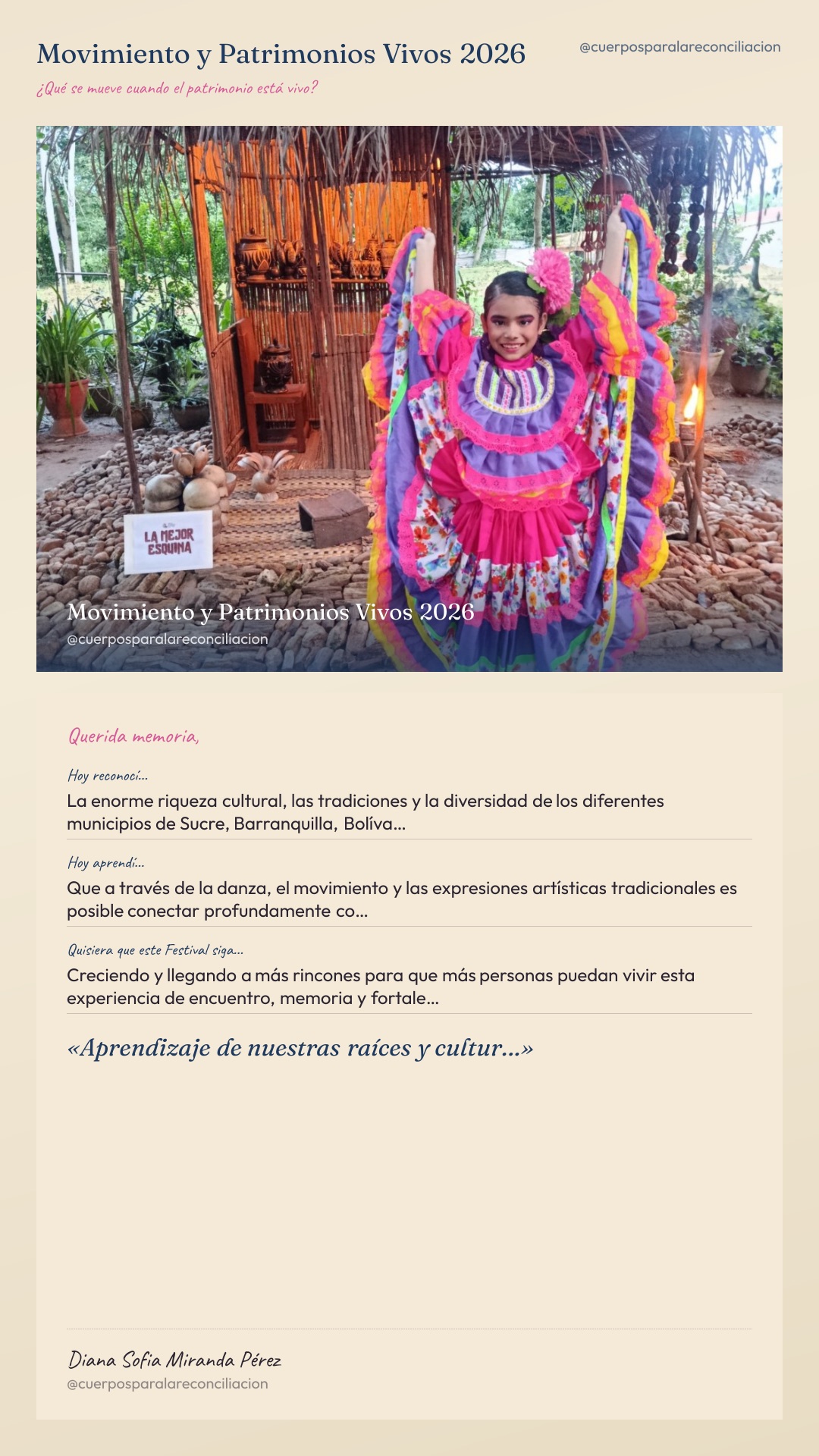 Diana Sofia Miranda Pérez
Hoy reconocí…
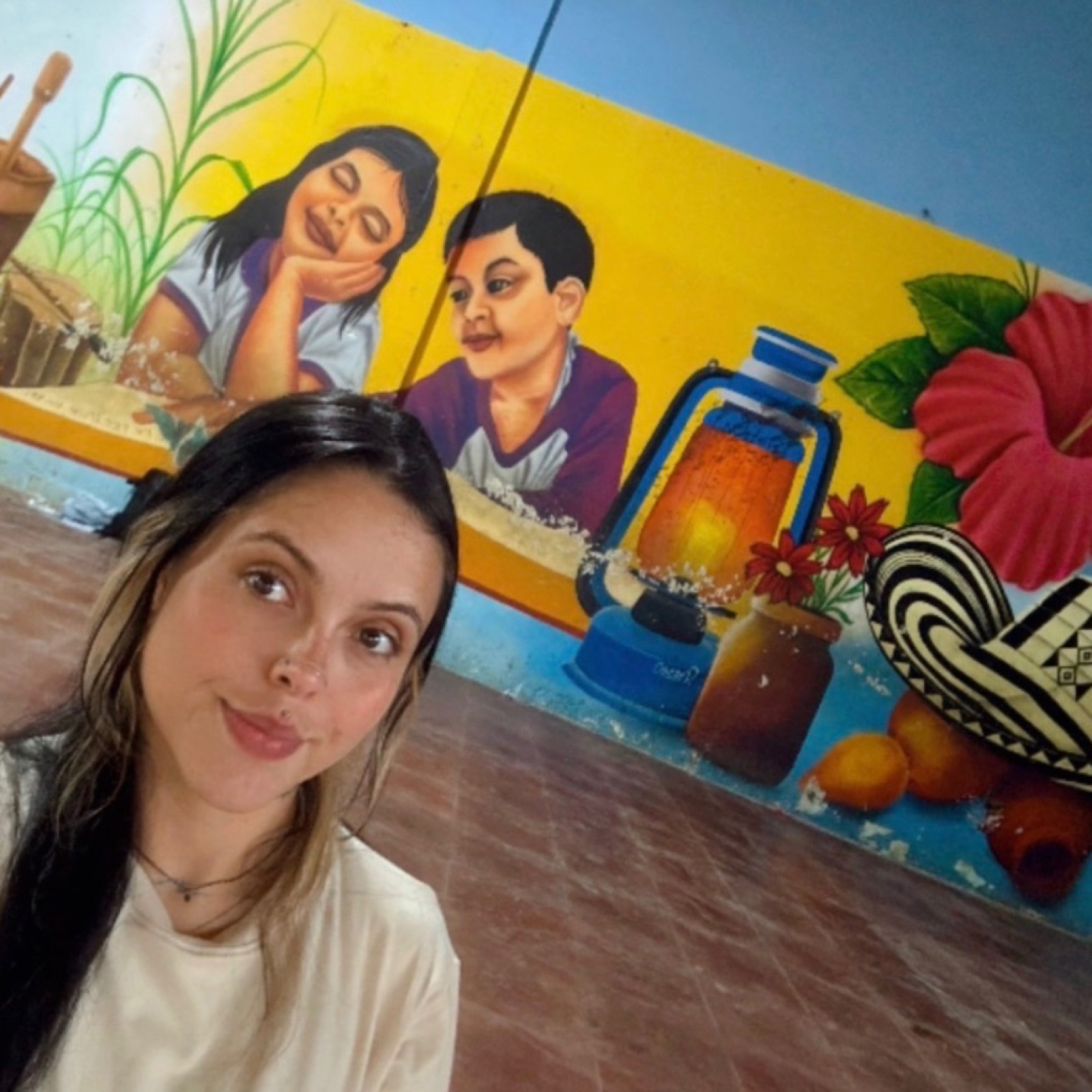
La importancia de conocer las culturas en los territorios porque hacen parte de nuestra identidad.@lauradanielamolly
Reconocí que la cultura de nuestro territorio es la es esencial para nuestros niños jóvenes que transforman día a día y trabajan desde las tradiciones y el legado ancestral que nuestros dejaron en nosotros hoy muestro al festival del territorio vivo de Galera, Sucre, a chalán un territorio azotado por la violencia que hoy en día muestra la otra cara de la moneda libre de tanta maldad y mostramos como nuestros niños y jóvenes trabajan día a día para que la cultura siga floreciendo como la luz de esperanzaStefanía Blanco
Que el tiempo puede detenerse, y sentirse igualmente VIVO 🖼.Laura Maldonado
Lo grande e importante que son las manifestaciones culturales de nuestro territorio sucreño y las de nuestro país ColombiaCarlos Andrés Hoyos Ruiz
Los 3 del Sombrero vueltiao 🤠.Luis alonso Ocon
Las costumbres de los pueblos, y el sentimiento y sentir de los pueblosOrlando García
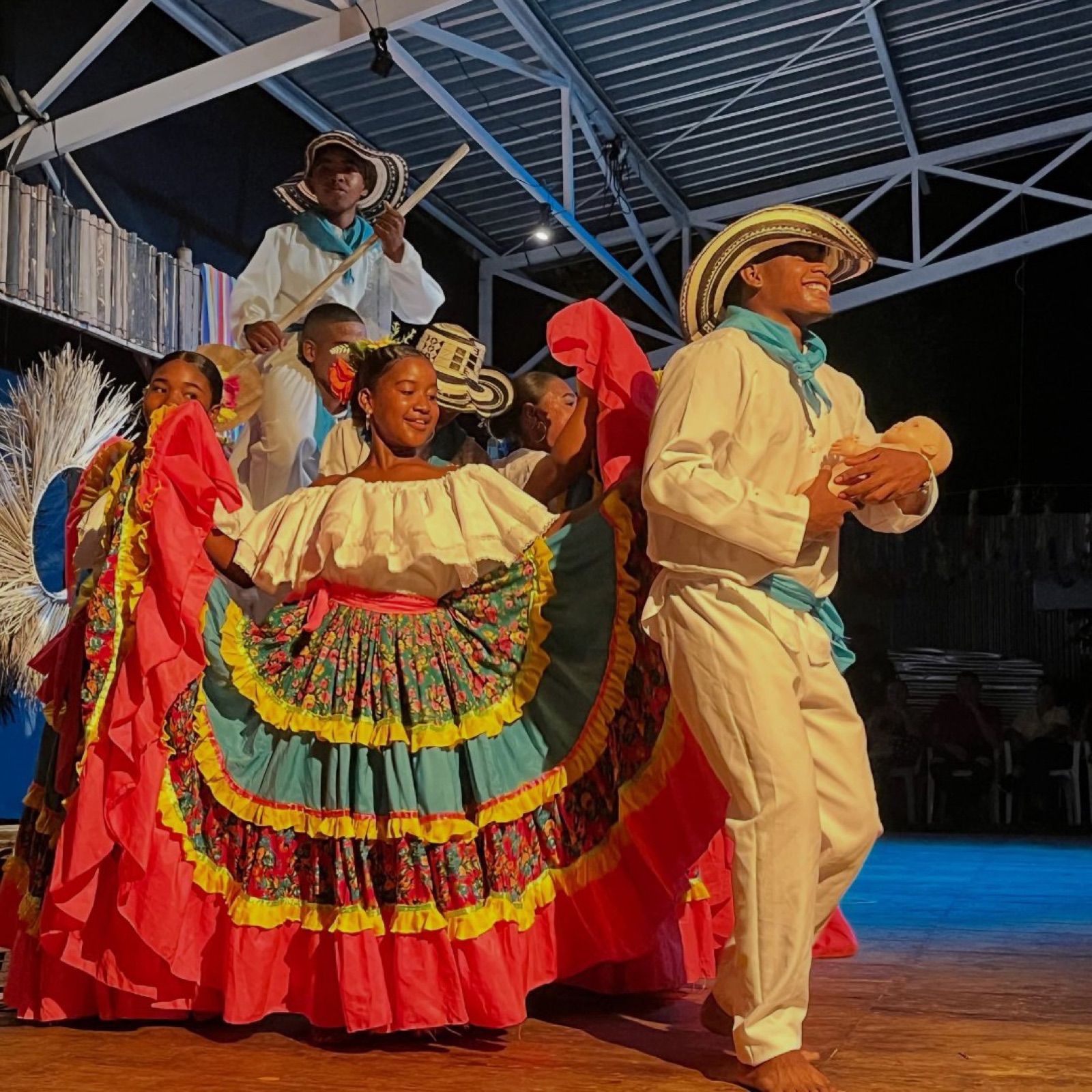
Hoy reconoci que la cultura es una forma de mantener viva nuestra identidad, nuestra memoria aprendi el valor de compartir con otras personas y reconocer sus saberes, me llevo nuevos conocimientos y valoro mucho el trabajo colectivo y la importancia que niños y jovenes sigan aprendiendo y transmitiendo nuestra tradicion.Jennifer Meza jimenez
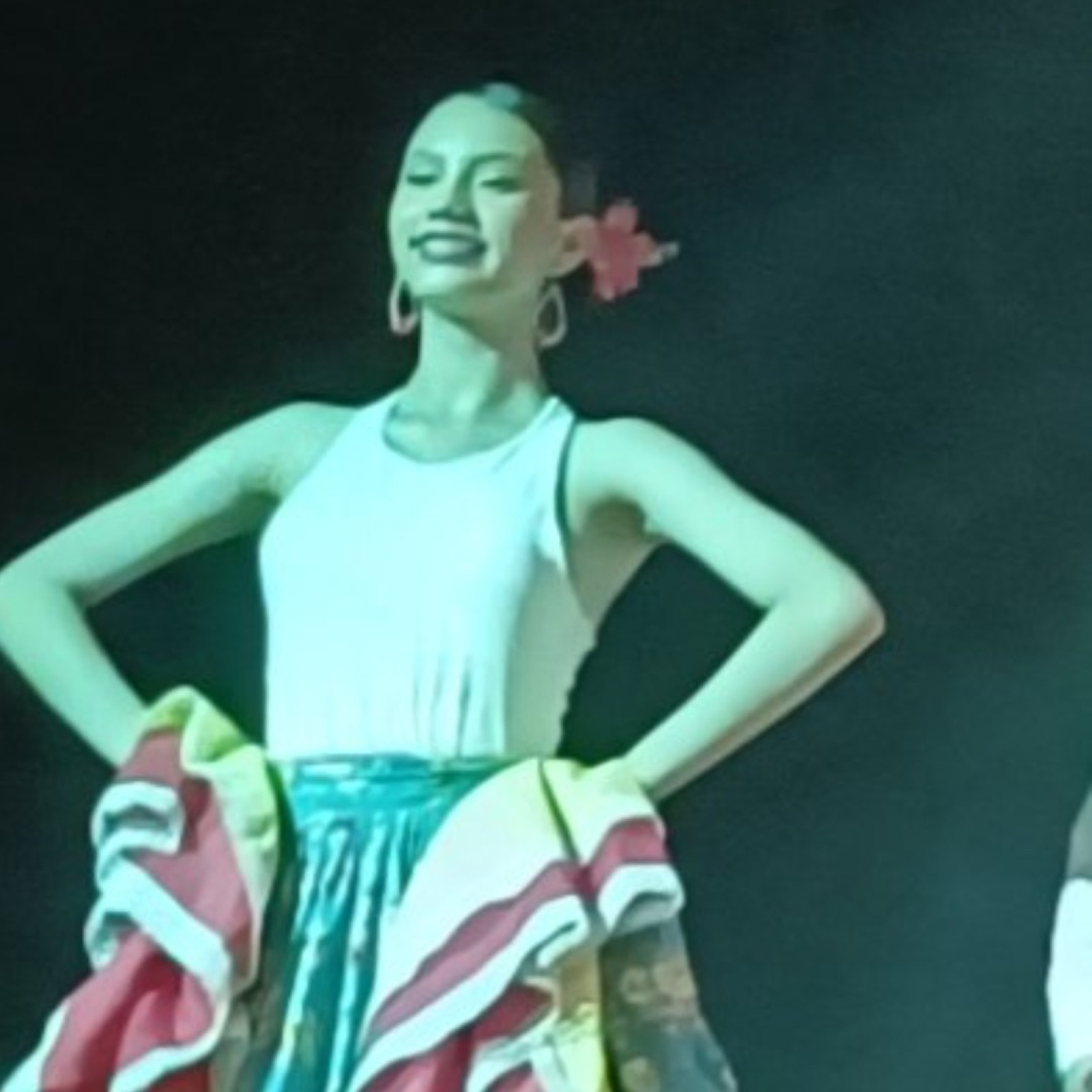
La diversidad del folclore sabanero.@imnot_bxlla
Que el arte es lo más hermosoMaría Fernanda Severiche Olascuaga
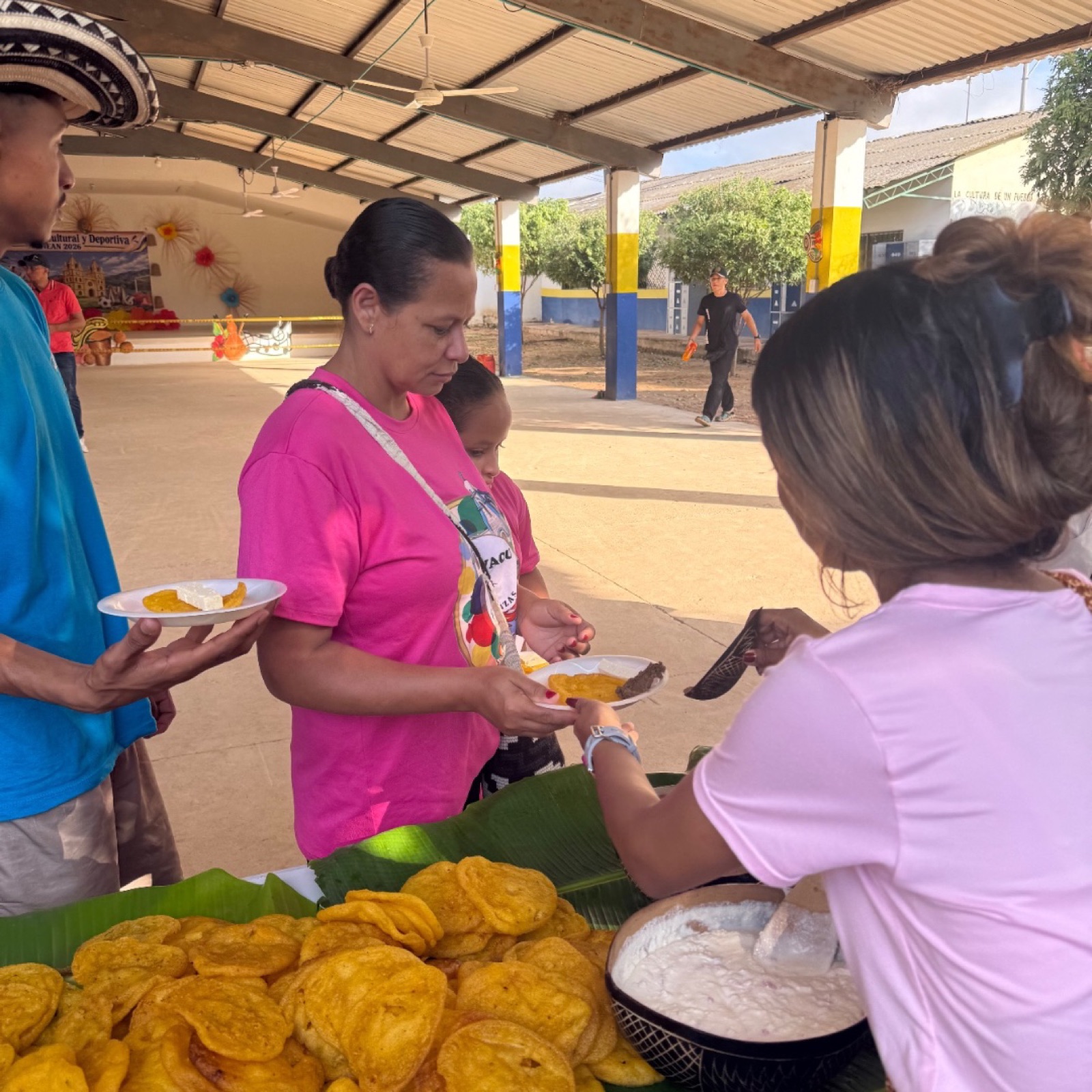
El festival y patrimonio
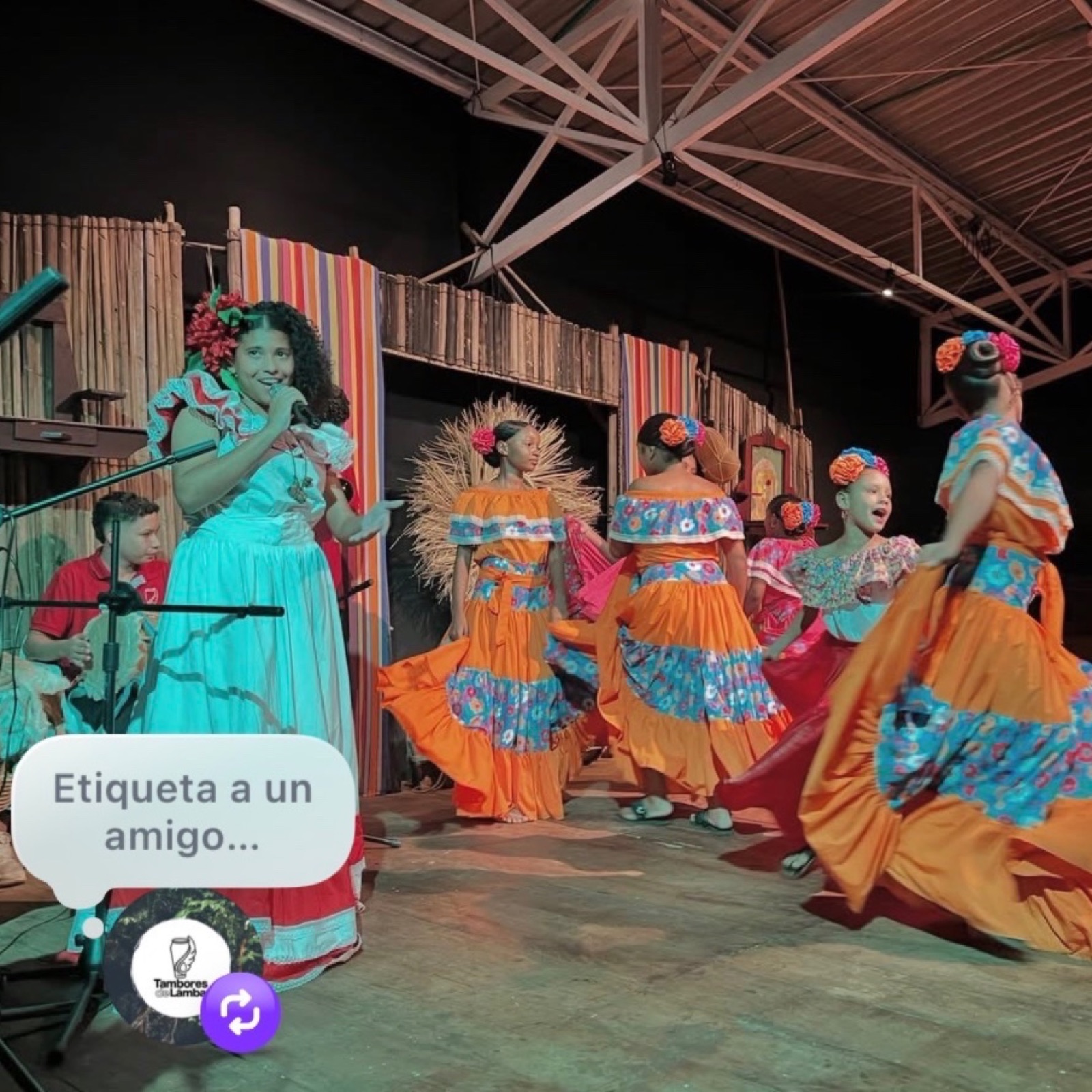
Lo importante de preservar nuestra cultura que ha sido transmitida de generación en generación.@fundacióntamboresdelamba
Que este sueño ya no es solo mío. Vive en cada persona que compartió su arte, su historia y su tiempo; en cada comunidad que nos abrió sus puertas; en cada niño, niña y joven que se atrevió a crear. Reconocí la fuerza que tenemos cuando nos encontramos y construimos juntos. Gracias por darle vida al Festival Movimiento y Patrimonios Vivos.Diana Gutiérrez
…Melanie Sofia
Hoy reconocí que el arte y el movimiento pueden expresar sentimientos que muchas veces no sabemos decir con palabras.
Hola reconocí, que las culturas y tradiciones pueden unir a las personas e igualmente a sanar muchas cosas que no mostramos.@belfran.okk
Reconocí que el arte y la cultura tienen el poder de unir a las personas, incluso cuando pensamos o vivimos de maneras diferentes.Katya Borja
Hoy recogí lo importante que es la cultura para unirnos como comunidadJamer Lozano
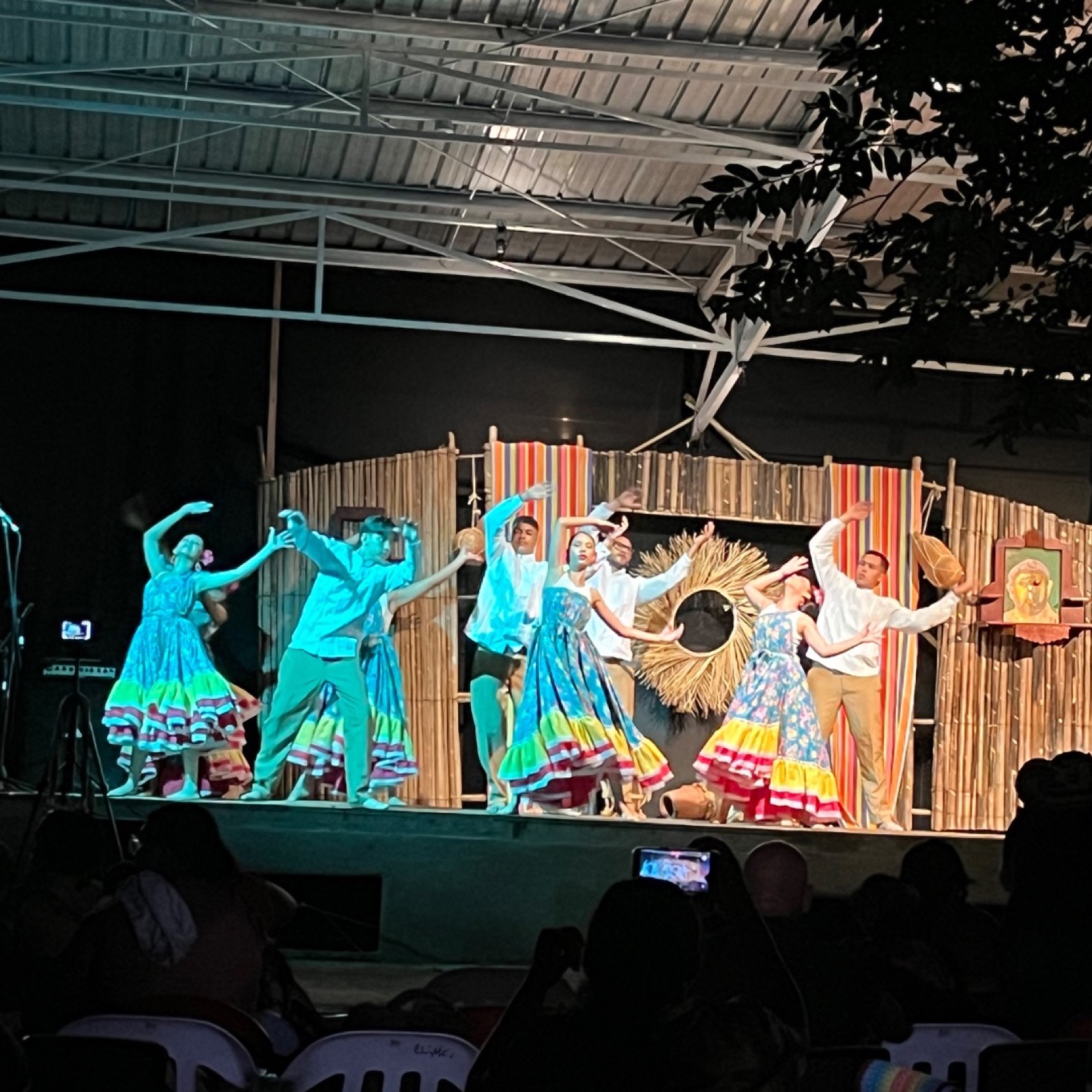
Que así como en un cuadro se expresa una vivencia o un sentimiento, lo mismo pasa con la música o el baile. Reconocí que ambos tienen eso en común que podemos expresar, sentir y transmitir.
Nuestra cultura nos identifica, quienes somos y quiénes fuimos y lo que debemos cuidar
Qué el arte es la mejor expresión cultural que podemos vivir
Que nuestras tradiciones no están atrapadas en el pasado ni en los museos. El patrimonio está verdaderamente vivo en cada paso, en cada baile y en la fuerza de los cuerpos que se mueven juntos para mantener la memoria de nuestro pueblo.Edwin David Ricardo Ocón
La importancia de no dejar que nuestra cultura se pierda y nuestro patrimonio llevarlo siempre enfrenteLuis de Jesús Palomino vecino
Hoy reconocí que cuando el patrimonio está vivo, lo que se mueve es el alma. Vi mover las faldas de las bailadoras y vi mover los colores de los cuadrosManuela Gómez
A los artistas del Caribe que hacen posible el patrimonioMaría Romero
La importancia que tienen los saberes culturales de cada una de las comunidades de nuestras regiones.Kevin Torres Mendoza
Que el arte es una de las fuentes principales qué llega a todo el mundo transmitiendo emociones, saberes ancestrales a través de la mismaEiner Cervantes
Durante este espacio de formación en el marco del desarrollo del festival me sentí super, debido a que gracia a la danza y en especial al bullerengue experimente un estado emocional de otro nivel y pude compartir con la maestra Jennifer este estado lo cual me hizo sentir extasiado.Alberto Segundo Funez Ortega
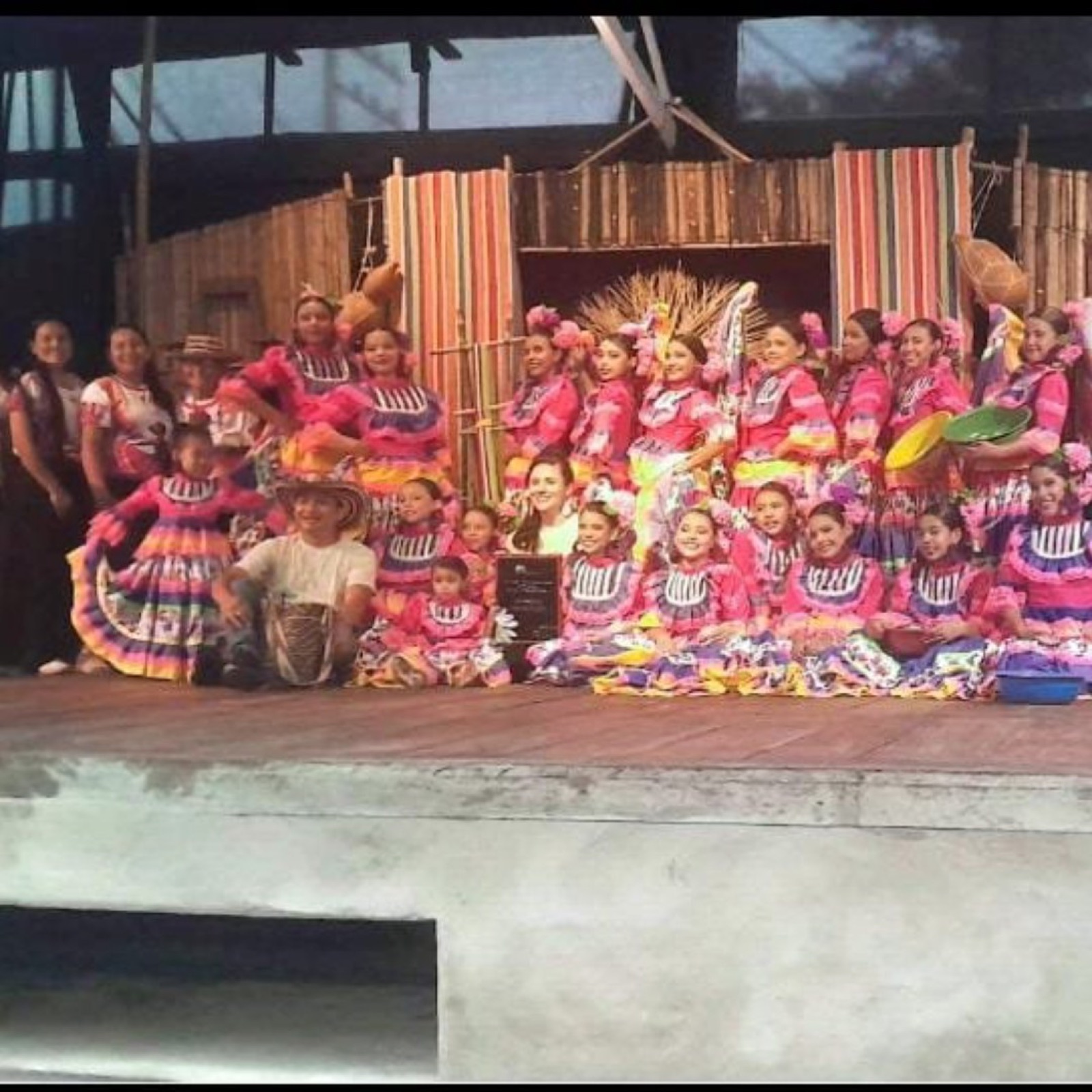
Que lo mejor de la vida es la sonrisa de mi hija y en este festival sonrió más que nunca.
La enorme riqueza cultural, las tradiciones y la diversidad de los diferentes municipios de Sucre, Barranquilla, Bolívar, Córdoba etc, que se unieron en Galeras para mostrar lo mejor de sus raíces.Diana Sofia Miranda Pérez
Hoy aprendí…
Manifestaciones artísticas que no conocía.@lauradanielamolly
Que nuestra región es rica culturalmenteVíctor Fabián Gómez Causado
Aprendimos la tradición cultural de los diferentes ritmos aires de Buyerengue de Rincón del Mar se trabajó con niños jóvenes, adultos, invitados especiales, aprendimos que el festival no solamente música también es danza, folklore, rescate de tradiciones, cuadros vivos, una remembranza y una salvaguardia de memoria cultural. Aprendí cosas nuevas y motivadoras para RyoStefanía Blanco
A amar más las tradiciones del Caribe grande, en sus formas, colores y sabores.Laura Maldonado
Que no se debe desistir de las prácticas artísticas sin importar la coyuntura históricaCarlos Andrés Hoyos Ruiz
A hacer cuadros vivosLuis alonso Ocon
Que a pesar de estar tan juntos como municipios, tenemos una variedad de costumbres y procesos de vidaOrlando García
“El arte, el movimiento y la cultura son puentes que nos permiten encontrarnos con el otro, escuchar nuestras historias, reconocer nuestras raíces y transformar nuestras diferencias en oportunidades para compartir, aprender de las demas comunidadesJennifer Meza jimenez
Nuevas maneras de expresar el arte.@imnot_bxlla
Nuevas experiencias que nos permite conoces nuevas culturas
Que la formación es importanteMaría Fernanda Severiche Olascuaga
El poder de la formación
Que la diversidad cultural de nuestra amada Colombia es inmensa pero que nos une un lenguaje universal, el arte.@fundacióntamboresdelamba
Que un festival se construye con mucho más que una programación: se construye con confianza, generosidad y personas dispuestas a compartir lo que saben y lo que son. Aprendí de cada comunidad, de cada artista y de cada niño, niña y joven que hizo suyo este sueño. Me llevo sus historias, sus abrazos y la certeza de que juntos podemos seguir haciéndolo crecerDiana Gutiérrez
Hoy aprendí que compartir con otras personas a través del arte, la danza y la cultura nos permite conocernos mejor saber de historia y culturas diferentes .Melanie Sofia
Hoy aprendí, que con el baile puedo sanar, soltar y reflejar una sonrisa que tanto me cuesta mostrar.@belfran.okk
Aprendí que compartir nuestras historias, emociones y talentos nos permite conocer mejor a los demás y construir relaciones basadas en el respeto.Katya Borja
La importancia de la culturaJamer Lozano
Que a través de la danza, el baile y la música se pueden expresar sentimientos
El arte sigue siendo una de las muestras de identidad personal más grande que existe
Qué la cultura transforma y mejora la calidad de vida de quienes lo viven
Que el movimiento es un lenguaje universal. A través del baile y la expresión corporal se pueden contar historias de resistencia y alegría que las palabras muchas veces no alcanzan a explicar.Edwin David Ricardo Ocón
Otras formas de vivir de otras comunidadesLuis de Jesús Palomino vecino
Hoy aprendí que un festival no es solo fiesta. Es memoria que se mueve. Aprendí en Galeras que bailar es una forma de recordar y de decir aquí estamos, esta es nuestra historia.Manuela Gómez
Que el territorio Caribe es diverso en su cultura y patrimonioMaría Romero
Identificar cada una de las culturas de los grupos participantes.Kevin Torres Mendoza
Que la integración de saberes ancestrales a través del arte construye paz y armoníaEiner Cervantes
Aprendí a diferenciar entre las variantes del bullerengue y la razón por la cual de marca de manera distinta según el territorio.Alberto Segundo Funez Ortega
Aprendí que los buenos momentos son cortos, pero satisfactorios.
Que a través de la danza, el movimiento y las expresiones artísticas tradicionales es posible conectar profundamente con las historias de vida y las identidades de otras comunidades.Diana Sofia Miranda Pérez
Quisiera que este Festival siga…
Construyendo país y compartiendo arte.@lauradanielamolly
Fortaleciéndose y que llegue a muchos más territoriosVíctor Fabián Gómez Causado
Quiero que este festival siga dejando en alto todas las culturas de los territorios, fortaleciendo día a día, las cosas positivas que nos dejan que nos transforma gracias cuerpo para la reconciliación por una oportunidad más para que los territorios puedan ser vistos y escuchados. Nadie es profeta en su tierra, y hoy somos profeta en la tierra de la Algarrobo, la tierra de los cuadros vivo gracias a este hermoso festival y aspiro y deseo de corazón si Dios lo permite que el festival siga al máximo para que los niños sigan siendoStefanía Blanco
Poniendo la cultura EN MOVIMIENTO 💃.Laura Maldonado
Creciendo y dando espacios para visibilizar, promocionar y exsaltar todos los procesos artísticos de la región, construyendo memoriaCarlos Andrés Hoyos Ruiz
Claro, es un festival muy atractivo y llamativo para el que viene por primera vezOrlando García
Claro quesiiii Los festivales tradicionales de danza folclórica son importantes porque mantienen viva la memoria, la identidad y las costumbres de una comunidad. A través de ellos, las nuevas generaciones pueden conocer y aprender las danzas, músicas, historias y tradiciones que dejaron sus antepasados.Jennifer Meza jimenez
También permiten:
Preservar las tradiciones y evitar que se pierdan con el paso del tiempo.
Involucrar a niños y jóvenes, para que sean quienes continúen transmitiendo la cultura.
Fortalecer la unión comunitaria, reuniendo a familias, artistas, sabedores y visitantes.
Valorar la identidad del territorio, reconociendo lo que hace única a cada comunidad.
Reconocer a los maestros y sabedores, quienes conservan conocimientos que se transmiten de generación en generación.
Promover el turismo cultural, mostrando las expresiones propias del territorio de una manera respetuosa.
Generar orgullo y sentido de pertenencia, especialmente en las nuevas generaciones.
En pocas palabras: los festivales tradicionales no son solamente espacios para bailar y celebrar; son escenarios donde la memoria de un pueblo se encuentra con su presente y se transmite hacia el futuro.
Resaltando nuestra identidad cultural.@imnot_bxlla
Quisiera que este festival siga creciendo, fortaleciéndose y siendo fuente de exportación de nuestras culturas tradicionales.@fundacióntamboresdelamba
Siga creciendo sin perder lo que lo hizo posible: el encuentro entre comunidades, generaciones y formas de crear. Que llegue a más lugares, que abra espacio a más voces y que cada año nos permita aprender de lo vivido. Sueño con que siga siendo un lugar donde el patrimonio esté vivo en las personas que lo comparten y lo transformanDiana Gutiérrez
Quisiera que este Festival siga creando espacios donde las personas puedan expresarse libremente, compartir sus culturas y talentos.Melanie Sofia
Porqué, muchas personas suelen sanar y soltar, mostrando su cultura, bailando y haciendo todo lo que aman y les gusta.@belfran.okk
Quisiera que este Festival siga creando espacios para compartir, expresarnos y encontrarnos como comunidad, promoviendo siempre la unión, la paz y la reconciliación.Katya Borja
Inspirando y creciendo para que más personas se unan y sigan apreciando y aprendiendo que a través del baile y la música podemos expresar aquello que sentimos.
El festival demuestra lo grande que es el ser humano y lo mucho que puede lograr
Qué siga para que transforme y ayude a muchos a encontrar su identidad y expresión cultural y se mantenga viva y no se pierda
Abriendo espacios para que los jóvenes y las distintas comunidades se apropien de sus raíces, asegurando que estos saberes dancísticos y culturales sigan latiendo con fuerza de generación en generación.Edwin David Ricardo Ocón
Quisiera que este Festival siga moviéndose por muchos pueblos más, para que más gente como yo pueda bailar su patrimonio, sentirlo y no dejar que se quede quieto nunca.Manuela Gómez
para continuar impulsando la cultura de nuestra regiónMaría Romero
Apostándole a los encuentros culturales, a las relaciones entre los diferentes saberes y sobre todo a la transformación social desde las artes, la cultura y el patrimonioKevin Torres Mendoza
Se siga apoyando a través de la organización en función ya que nos permite, desarrollar aprendizajes con niños, niñas y jóvenes a través del arteEiner Cervantes
Me gustaría que el festival continúe para poder seguir ampliando y fortaleciendo los escenarios para que cada dia mas NNJ y adultos puedan seguir mostrándose al mundo a través de estos espacios físicos y digitales para así desarrollar en ellos un empoderamiento hacia la dalvaguarda de los patrimonios de la región y de los territorios.Alberto Segundo Funez Ortega
Para seguir participando con el grupo y que los apoyen en su trayecto.
Creciendo y llegando a más rincones para que más personas puedan vivir esta experiencia de encuentro, memoria y fortalecimiento de nuestro tejido social.Diana Sofia Miranda Pérez
¿Cómo crees que el arte, el movimiento y la cultura pueden ayudar a las personas de distintas comunidades a encontrarse, sanar o reconciliarse?
A través de la empatía, la sensibilidad y la memoria.@lauradanielamolly
Creo que el arte transforma vidas , nos hace fuertes, más sociables, aceptarse así mismo y darle felicidad a sus vidas.Víctor Fabián Gómez Causado
Siempre he creído que el arte es una fortaleza maravillosa para no solamente los niños y los jóvenes, sino para un territorio entero. Para mí la cultura es el apoyo fundamental para sanar para reconstruir para narrar aquello que no podemos mostrarle a otras personas. Hoy me siento orgullosa de demostrar como artista formador, lo que es mi herencia, lo que es mi cultura ya que es el contraste de una tierra de encanto, llena de maravillas que de tantas oscuridad hoy muestra esa parte maravillosa que es la luz de la danza y la músicaStefanía Blanco
El cuerpo es nuestro primer archivo vivo y en él habitan los repertorios que han marcado nuestra vida. Por eso, cuando en el arte vamos mil veces al cuerpo, tenemos mil oportunidades para resignoficar cada parte de nuestra vida que necesite ser resignificada.Laura Maldonado
Las juntanzas ayudan a resolver discrepancias, a expresar lo malo y lo bueno, a reír, llorar, gritar, hablar y estar en silencio, el movimiento nos permite hablar sin decir una palabra y el arte es el colchón que todo lo anterior soporta. Sanas cuando expresas, ríes, lloras, gritas, hablas y te quedas en silencio luego de haberte movido tanto que te sientes en paz.Carlos Andrés Hoyos Ruiz
Por qué crean espacios donde pueden expresar lo que sienten a partir de sus historias y reconocer lo que tienen en común.Luis alonso Ocon
Pues que por medio del arte se alejan a los niños y jóvenes de cosas que los distraen y pueden llevar a cosas que no le convienenOrlando García
El arte, el movimiento y la cultura pueden ayudar a las personas de distintas comunidades a encontrarse, escucharse y construir vínculos, porque crean espacios donde todos pueden expresarse más allá de las diferencias.Jennifer Meza jimenez
El arte permite expresar emociones e historias que a veces son difíciles de decir con palabras.
El movimiento y la danza ayudan a conectar el cuerpo con las emociones, generando espacios de confianza, alegría y libertad.
La cultura fortalece la identidad y el sentido de pertenencia, haciendo que las personas reconozcan el valor de su comunidad y de otras comunidades.
El encuentro artístico puede favorecer procesos de bienestar y reconstrucción de vínculos, especialmente cuando se realiza desde la escucha, el respeto y el reconocimiento de las experiencias de cada persona.
Los niños y jóvenes pueden encontrar nuevas formas de participar, aprender de los mayores y convertirse en portadores de la memoria cultural.
Una frase que puede servirte para un proyecto o exposición:
“El arte, el movimiento y la cultura son puentes que nos permiten encontrarnos con el otro, escuchar nuestras historias, reconocer nuestras raíces y transformar nuestras diferencias en oportunidades para compartir, aprender y construir juntos.”
Porque el arte sana, transforma, fortalece y construye mejores seres humanos.@imnot_bxlla
Pueden transformar vidas, encontrándose asi mismos
En los intercambios interculturalesMaría Fernanda Severiche Olascuaga
Por medio de los intercambios
El arte sana almas, abre caminos, abre espacios de reconciliación, de paz y sobre todo sana el corazón.@fundacióntamboresdelamba
Creo que el arte, el movimiento y la cultura nos transforman porque nos permiten expresar lo que a veces no sabemos decir con palabras. Al bailar, crear y compartir nuestras historias, podemos escuchar al otro, reconocer nuestras heridas y descubrir lo que tenemos en común. Sanar y reconciliarnos lleva tiempo, pero cada encuentro nos ayuda a recuperar la confianza y a imaginar juntos una forma distinta de convivir.Diana Gutiérrez
Creo que pueden ayudar porque permiten que las personas se expresen, compartan sus historias y conozcan las experiencias de los demás por medio del respeto y la convivencia.Melanie Sofia
Reflejándose en ello, no solo es mostrar lo que sabemos hacer, solo hay que dejarlo sentir.@belfran.okk
Creo que pueden ayudar porque permiten expresar sentimientos y experiencias de una manera diferente. A través de la música, la danza, el teatro y otras expresiones artísticas, las personas pueden compartir sus historias, comprender a los demás y dejar atrás algunas diferencias. Así, el arte puede convertirse en un puente para encontrarnos, sanar y construir una convivencia más pacífica.Katya Borja
Siii es una forma de reconcilioJamer Lozano
Encontrándose en un mismo escenario. Ver como bailan jóvenes adultos niños. Cómo se unen para presentar todo aquello que aman y como las otras perdonas se interesan por aprender su cultura o como se baila la música típica.
Puede ayudar unificando nuestras distintas culturas para darnos cuenta que tenemos algo similar en todos los aspectos
integrándolos a todas las actividades culturales a jóvenes y adultos qué les guste dicha manifestación
El arte y el movimiento nos permiten conectar desde la empatía antes que desde la diferencia. Cuando bailamos o compartimos una manifestación cultural compartida, dejamos de lado los prejuicios y el dolor. El movimiento corporal colectivo genera un ritmo común que sana heridas profundas, recordándonos que compartimos una misma identidad y un mismo territorio vivo.Edwin David Ricardo Ocón
Elaborando mas festivales como estosLuis de Jesús Palomino vecino
Creo que el arte y el movimiento son un lenguaje que no necesita traducción. Cuando bailamos juntos, sin importar de qué pueblo seamos, nos encontramos. La cultura sana porque nos recuerda quiénes somos y nos une en vez de dividirnos.Manuela Gómez
Magico
Creo que el arte, el movimiento y la cultura son espacios que permiten encontrarnos desde nuestras diferencias, compartir historias y reconocer aquello que tenemos en común. A través de ellos podemos expresar emociones, sanar experiencias, recuperar la memoria y generar diálogos que ayuden a construir confianza, empatía y reconciliación entre las comunidades.María Romero
Claro que si, un encuentro entre culturas hace que se piense en como seguir salvaguardando esta, y sobre todo a no olvidar nuestra memoria, sin memoria no habría reconciliación,Kevin Torres Mendoza
Desarrollando actividades que promuevan el arte y la cultura para construcción de paz y armoníaEiner Cervantes
El arte nos ayuda a encontrar espacios para estar en paz y también nos posibilita la creación mediante la cual podemos transformar a sociedades enteres si así lo deseamos por que es precisamente en estos procesos donde se logra cambiar de maneras de pensar , actuar y de ver las cosas con una mirada siempre aterrizada y en busca de la felicidad.Alberto Segundo Funez Ortega
Es uno de los espacios de sana convivencia más especiales que existen y de integración.
El arte y el movimiento actúan como un lenguaje universal que trasciende las palabras; permiten expresar emociones profundas, perdonar y sanar heridas del pasado al compartir espacios de respeto, empatía y celebración de nuestra identidad común.Diana Sofia Miranda Pérez
Un momento del Festival
Hay muchos momentos especiales en mi territorio Ovejas, pero sin duda alguna llevar un pedacito de la cultura ovejera a Tuchin Córdoba fue demasiado especial para miVíctor Fabián Gómez Causado
Uno de los momentos maravillosos que me pareció festival aparte de las danzas y todo lo que presentaron fue los cuadros vivosStefanía Blanco
Presentaciones de los diferentes gruposOrlando García
Puesta en escena de la Corporación Cultural Incluarte.@imnot_bxlla
Nuestra muestra folclórica
Integración de los gruposMaría Fernanda Severiche Olascuaga
Me cuesta escoger uno. Cada actividad de la programación aportó algo único. Pero guardo especialmente las franjas de formación: reunir a participantes de distintos municipios del Caribe convirtió el festival en un laboratorio abierto y mágico. Allí compartimos saberes, probamos ideas y aprendimos unos de otros. Ver cómo empezaban a tejerse esos vínculos fue, para mí, uno de los recuerdos más hermosos.Diana Gutiérrez
Un momento que me gustó fue poder compartir con otras personas, observar diferentes expresiones artísticas y sentir que, aunque todos Venimos de diferentes lugares podemos encontrarnos y disfrutar juntos a través del arte y la cultura.Melanie Sofia
La galería de cuadros vivoosJamer Lozano
Ver bailar en un mismo escenario a diferentes personas, de diferentes edades y diferentes culturas o costumbres.
la construcción de cuadros vivos y toda manifestación tradicional siga vinculando a más personas del territorio y se sigan sumando día a día la cultura siempre será la mejor manera de salir del conflicto de comunidades y poblaciones vulnerables
El instante en que personas de todas las edades se unieron en un solo círculo de danza, compartiendo la misma energía y demostrando que la cultura nos une sin importar el origen.Edwin David Ricardo Ocón
apreciar las puestas en escenas de cada una de las delegaciones, desde allí se aprende mucho.Kevin Torres Mendoza
Una pareja de bailarinesEiner Cervantes
El taller fue espectacular porque mi hija lo disfrutó al máximo.
Ver la alegría y la unión de las personas compartiendo las muestras culturales y dancísticas durante las jornadas del evento en Galeras.Diana Sofia Miranda Pérez
Antes y después de un camino compartido
 Tatiana Narvaez Pineda
 Maria Fernanda Severiche Olascuaga
 Eva Sandrith Pérez Castro
 Einer Cervantes
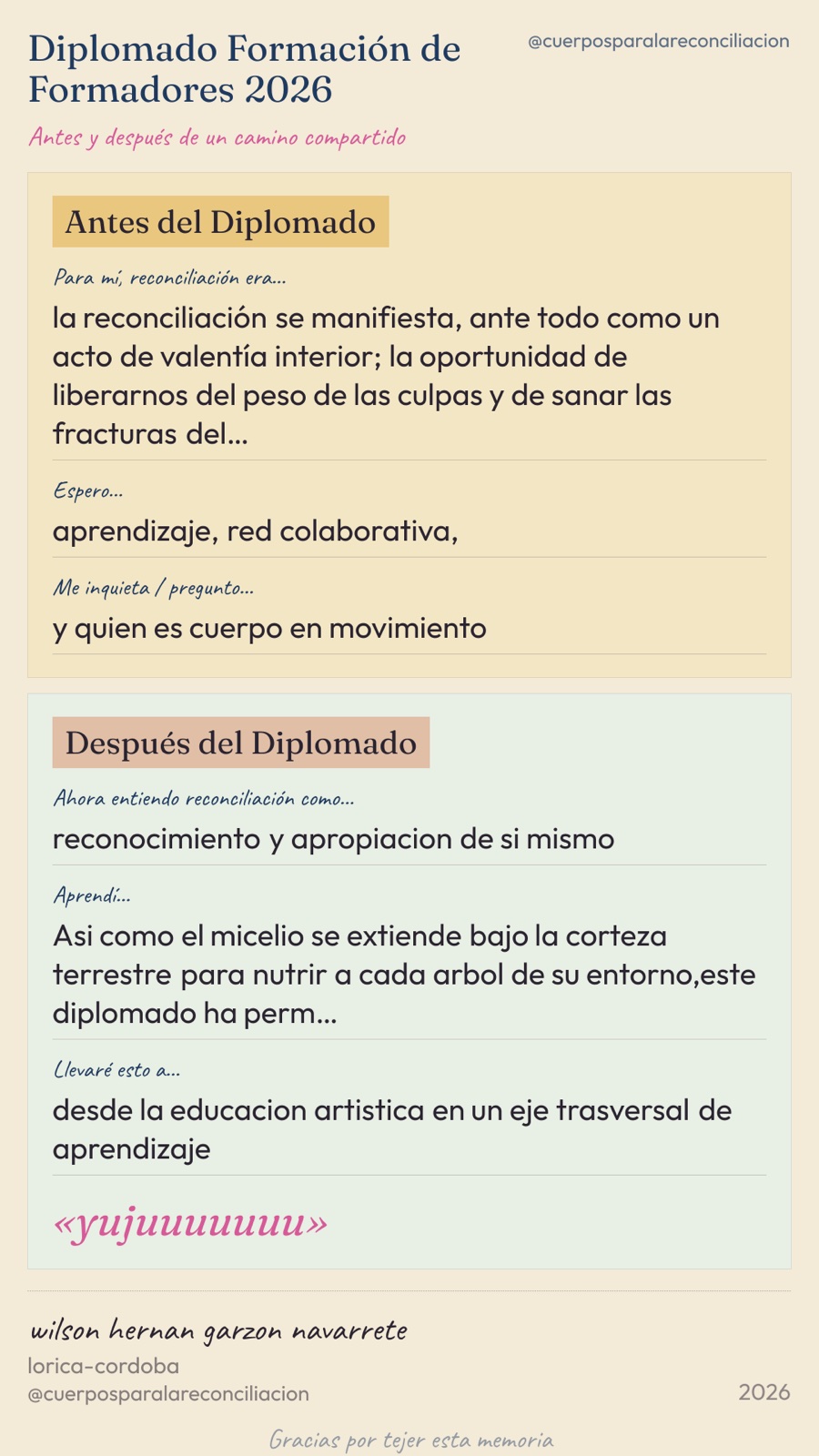 Wilson Hernan Garzon Navarrete
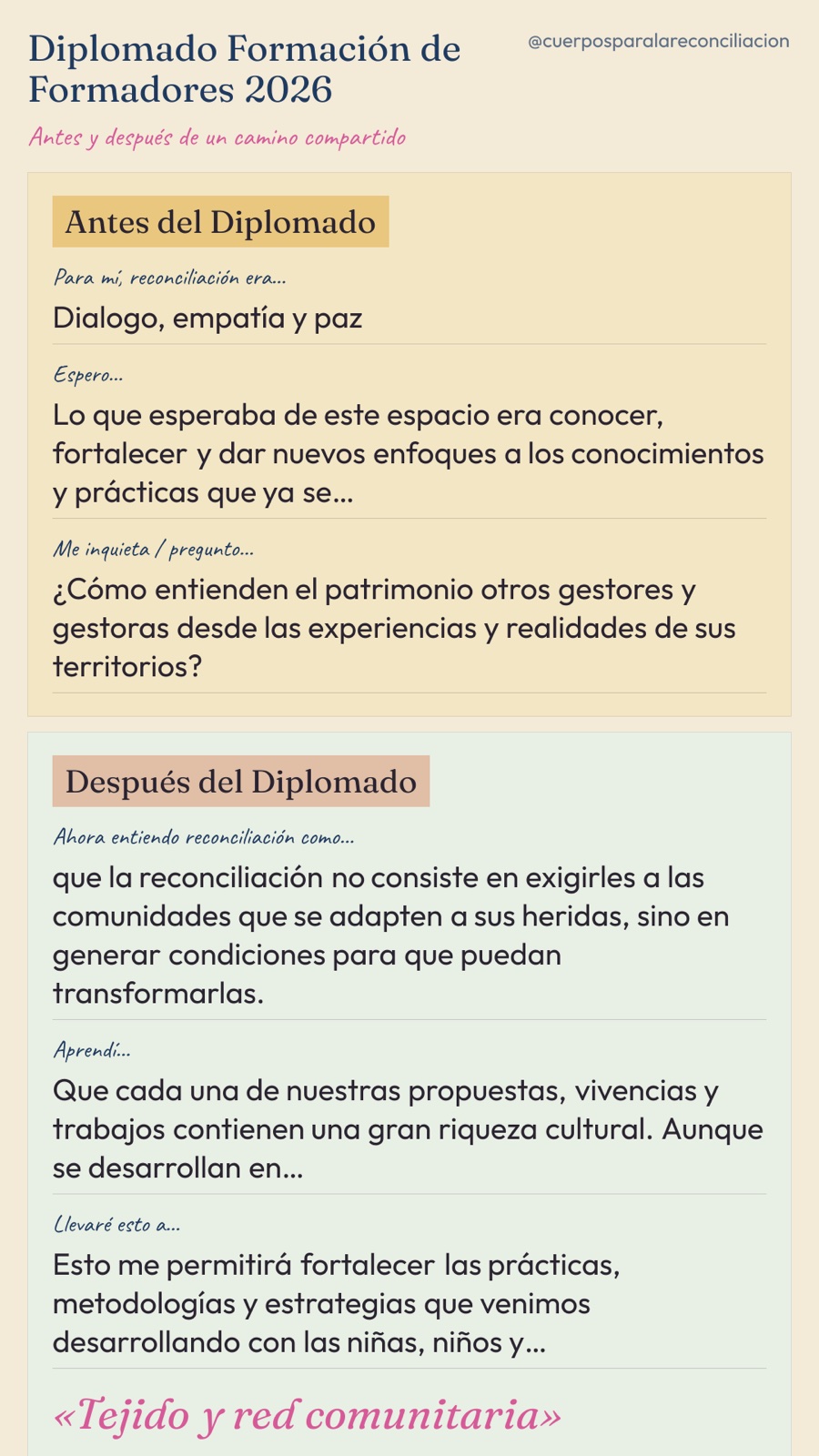 Maria Angelica Carranza Lineros
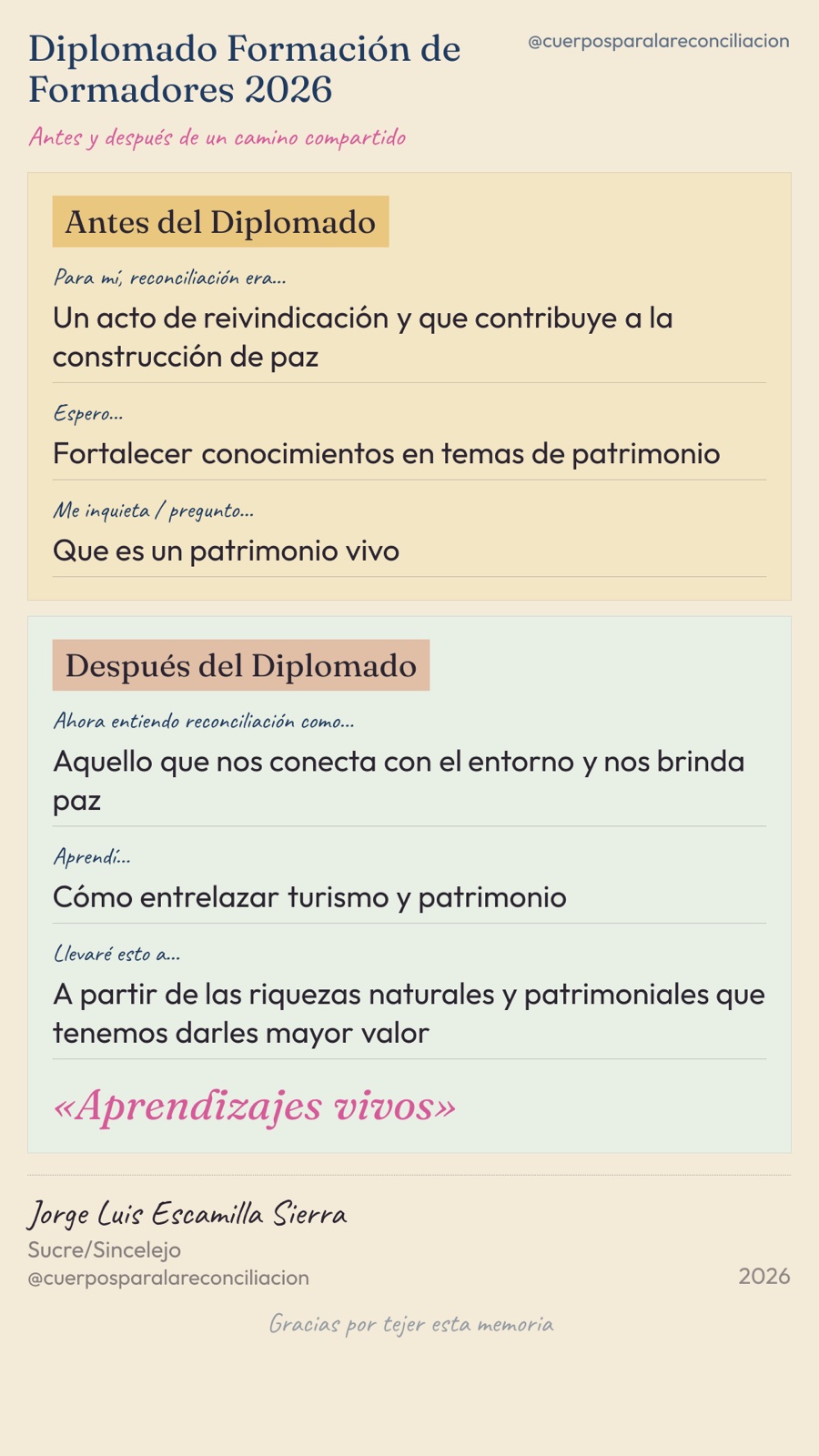 Jorge Luis Escamilla Sierra
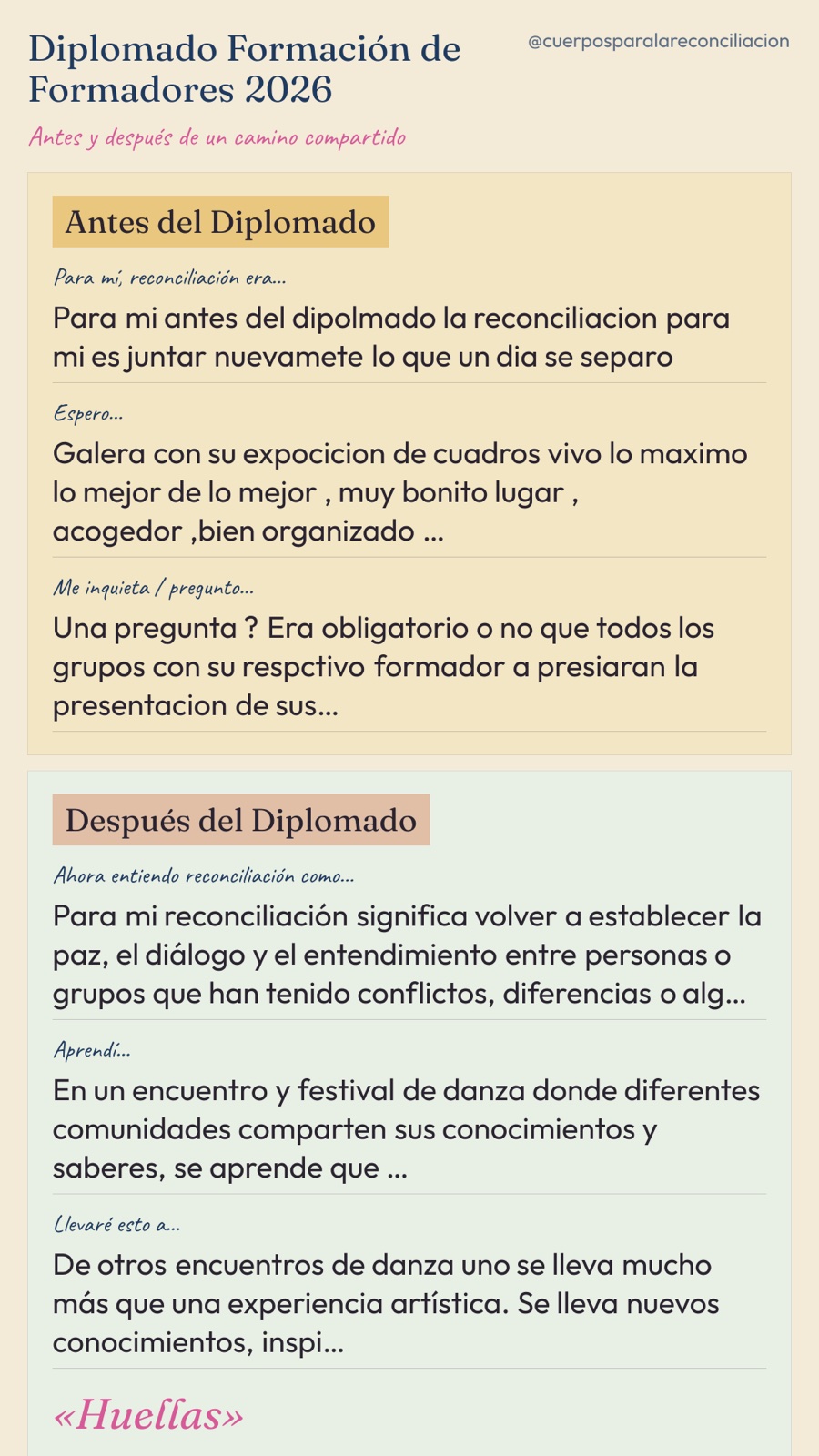 Jennifer Meza Jimenez
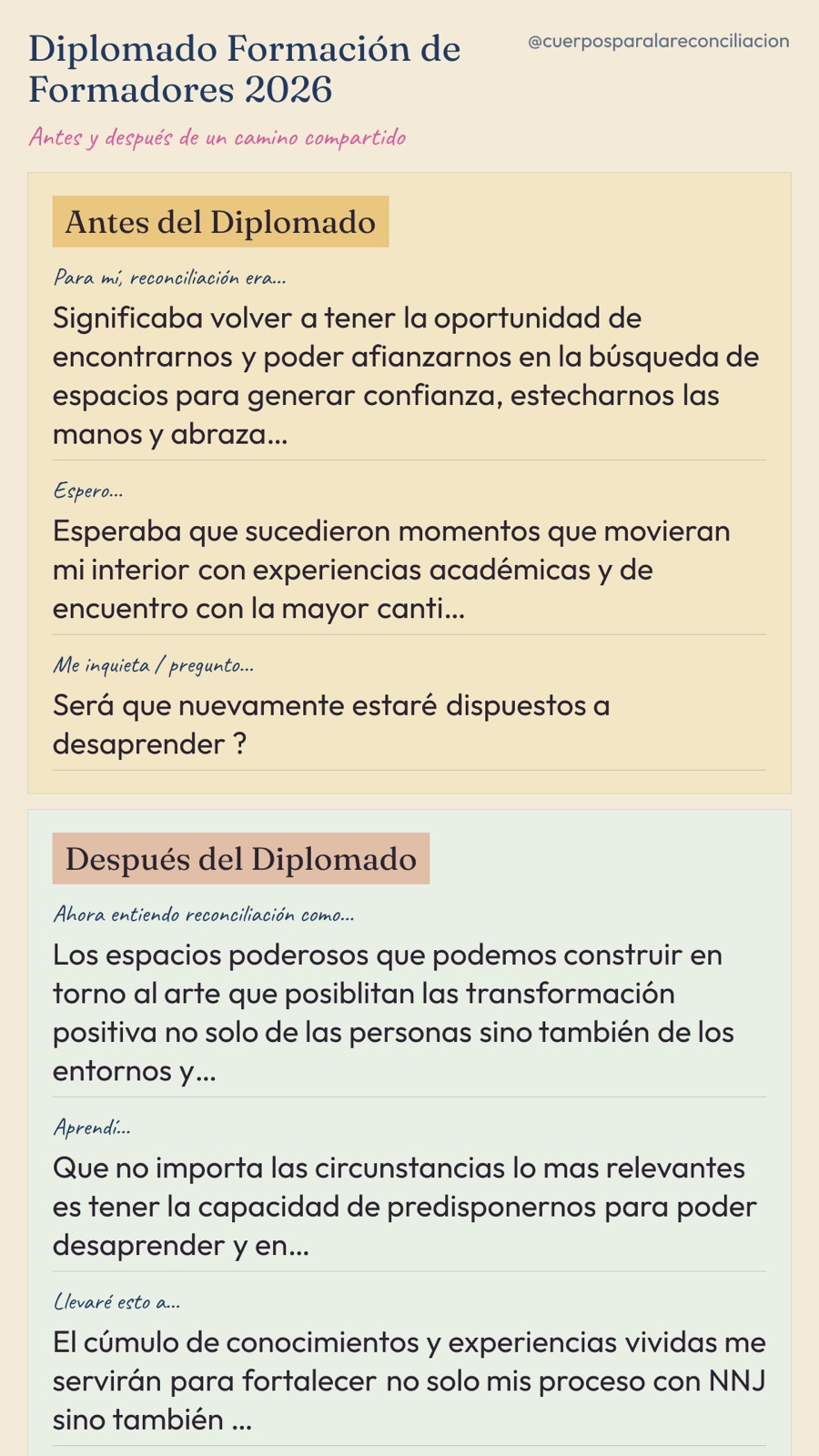 Alberto Segundo Funez Ortega
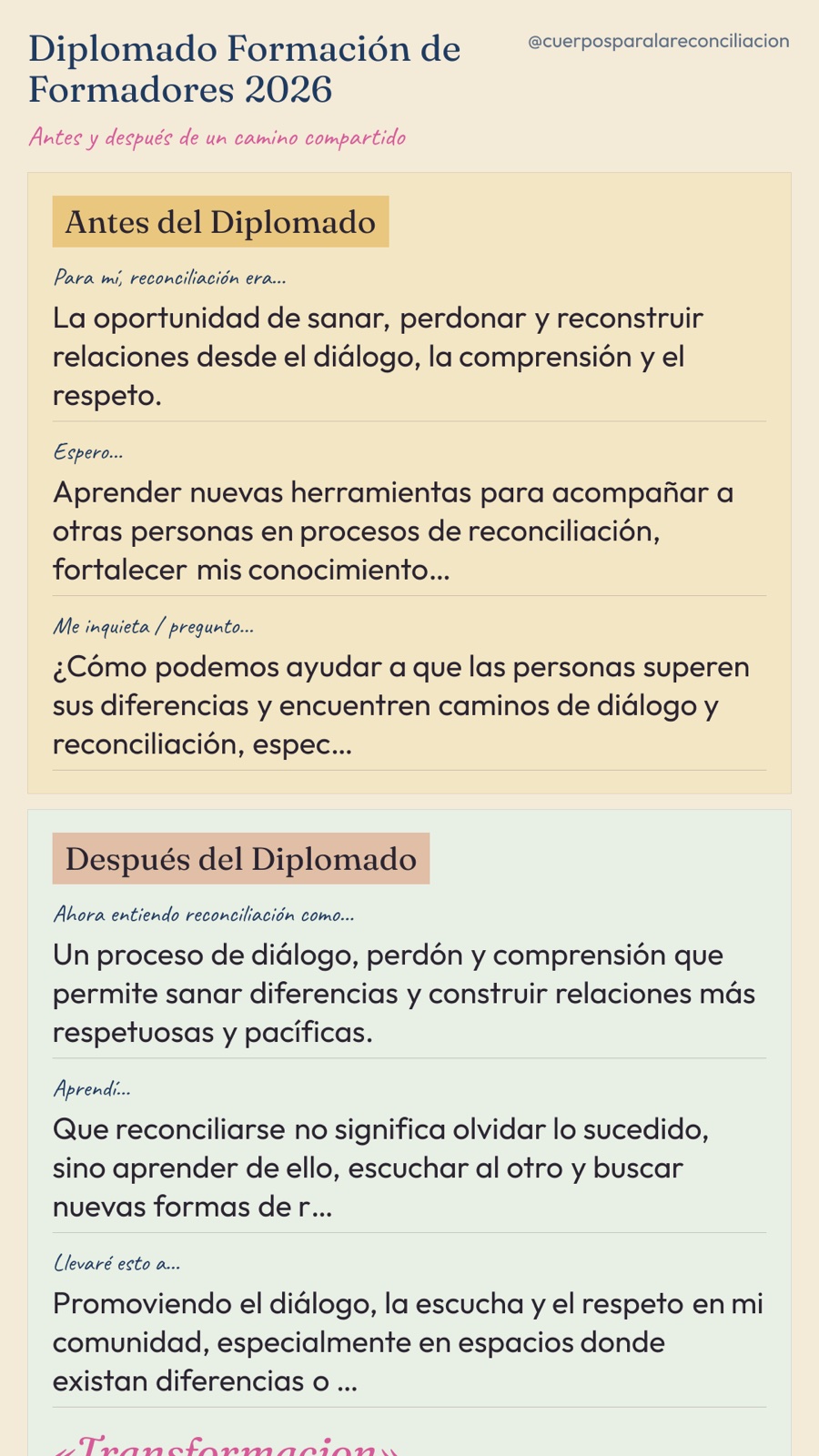 Melanys Arrieta
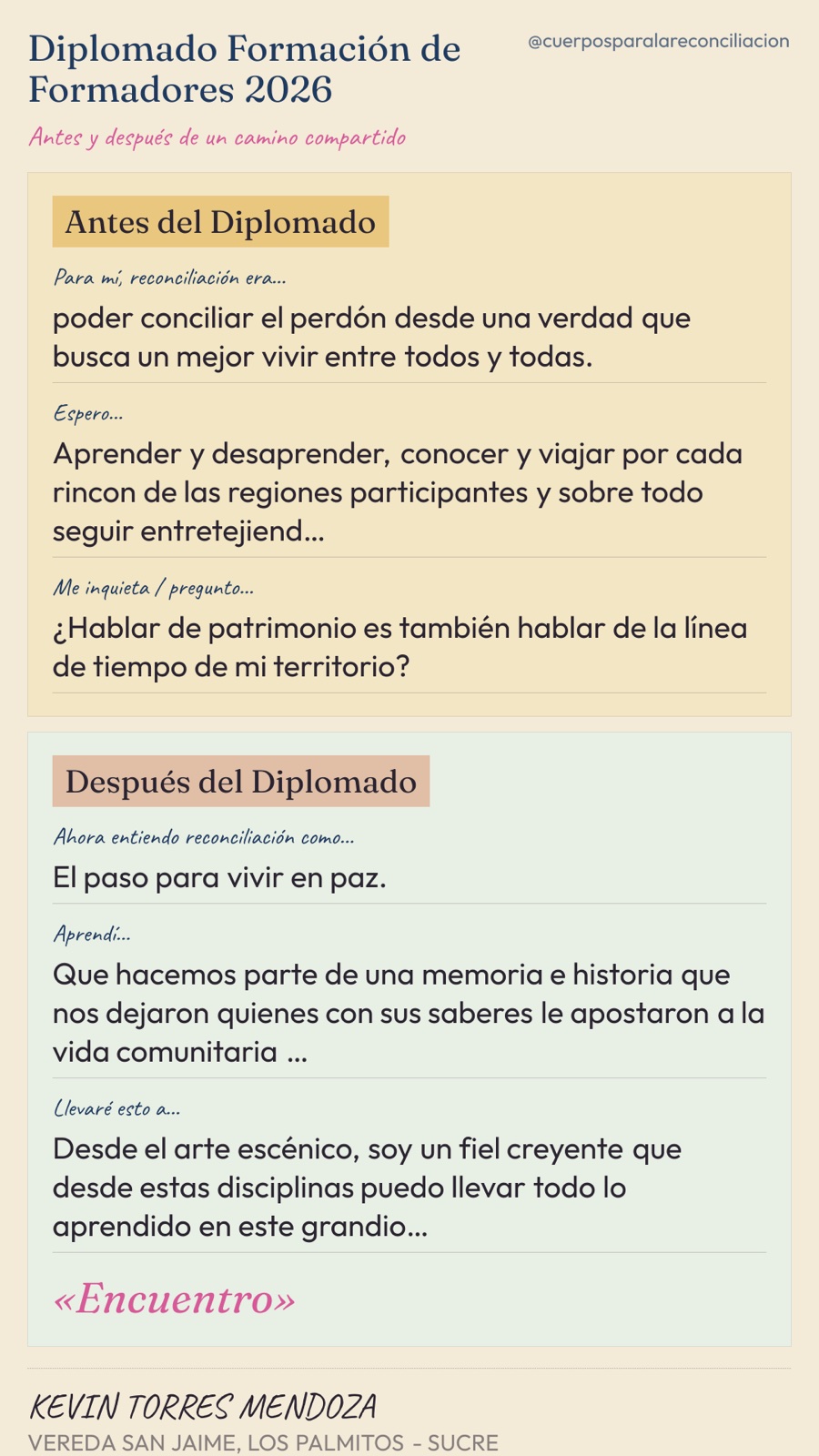 Kevin Torres Mendoza
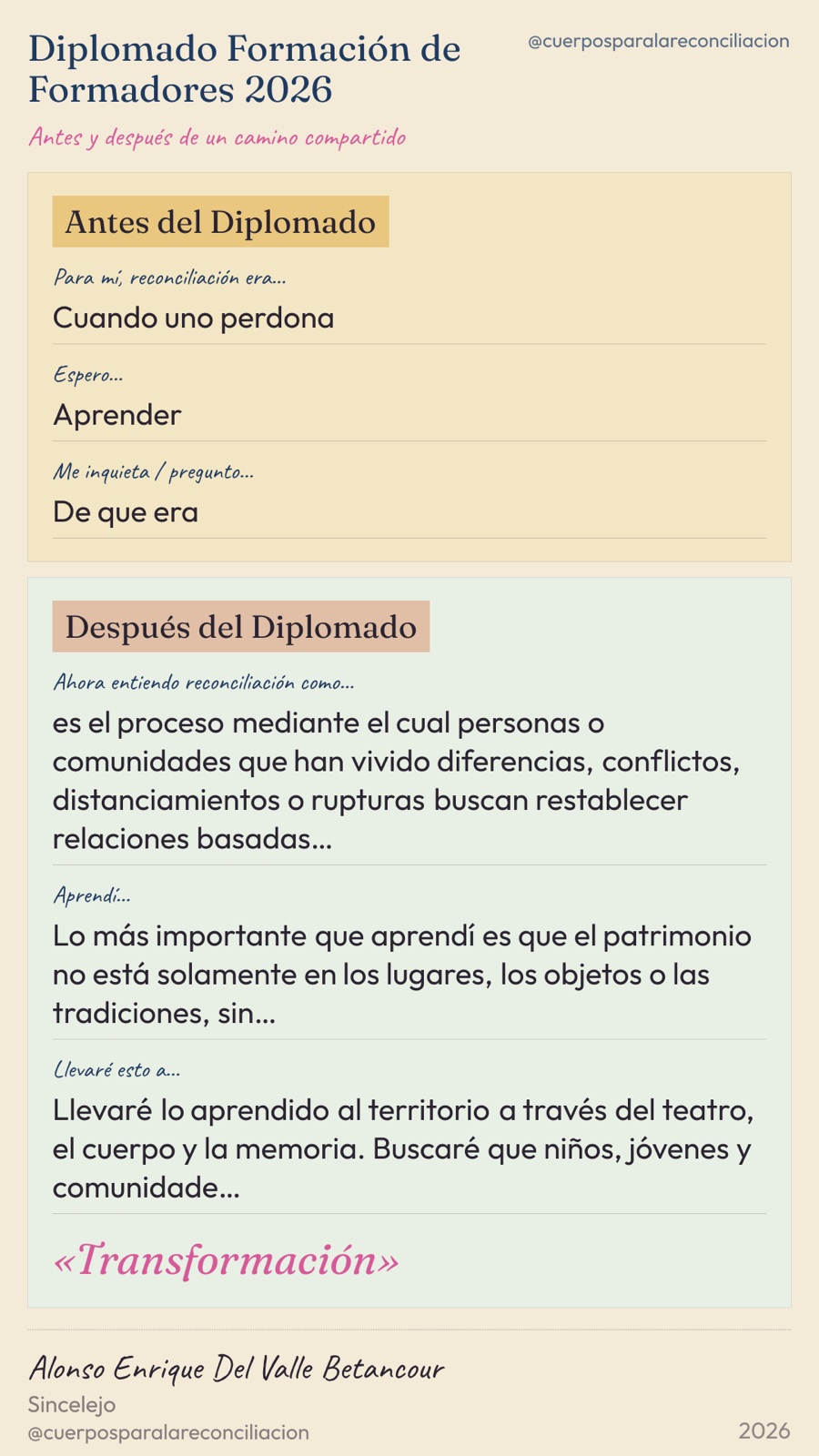 Alonso Enrique Del Valle Betancour
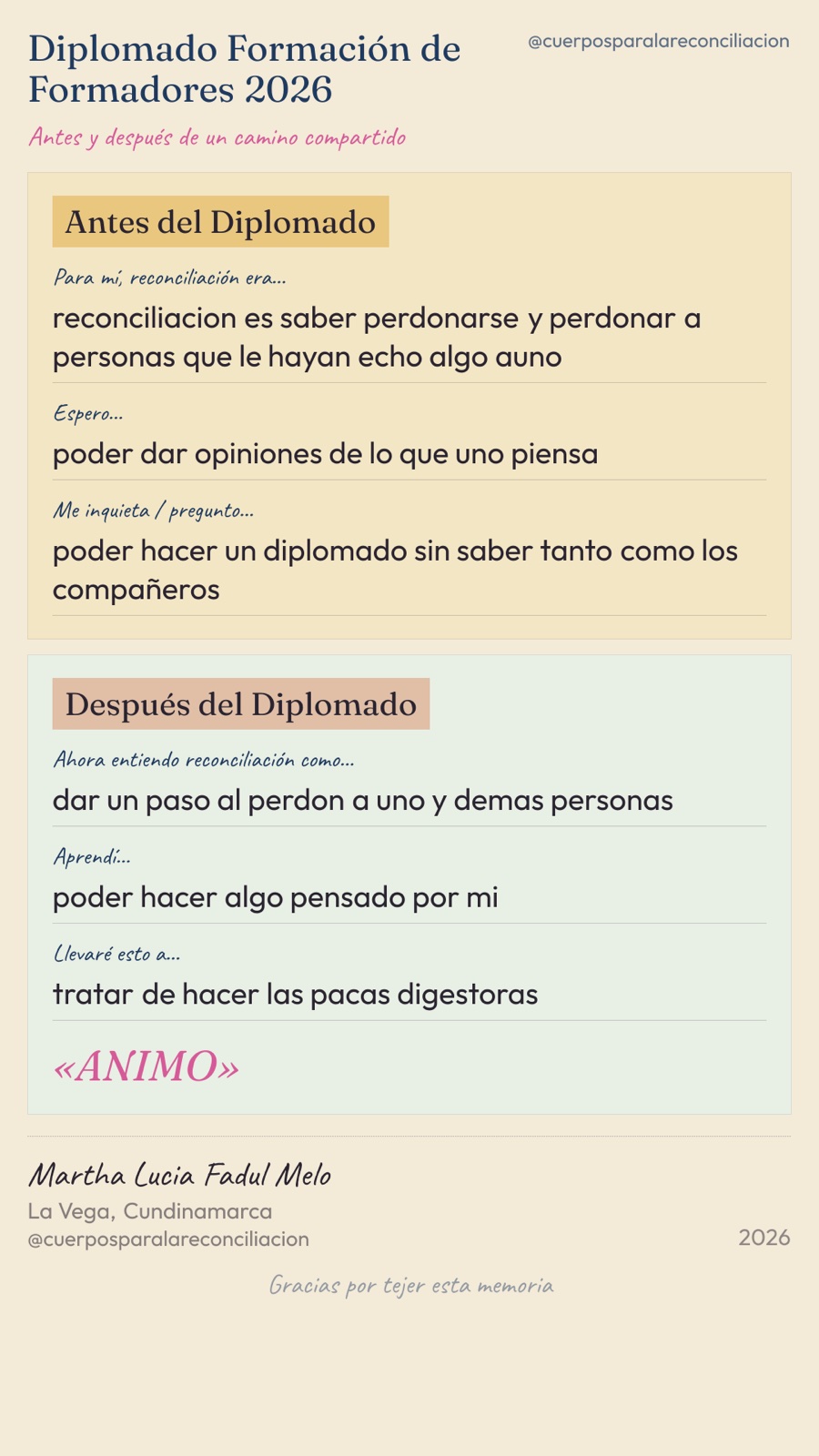 Martha Lucia Fadul Melo
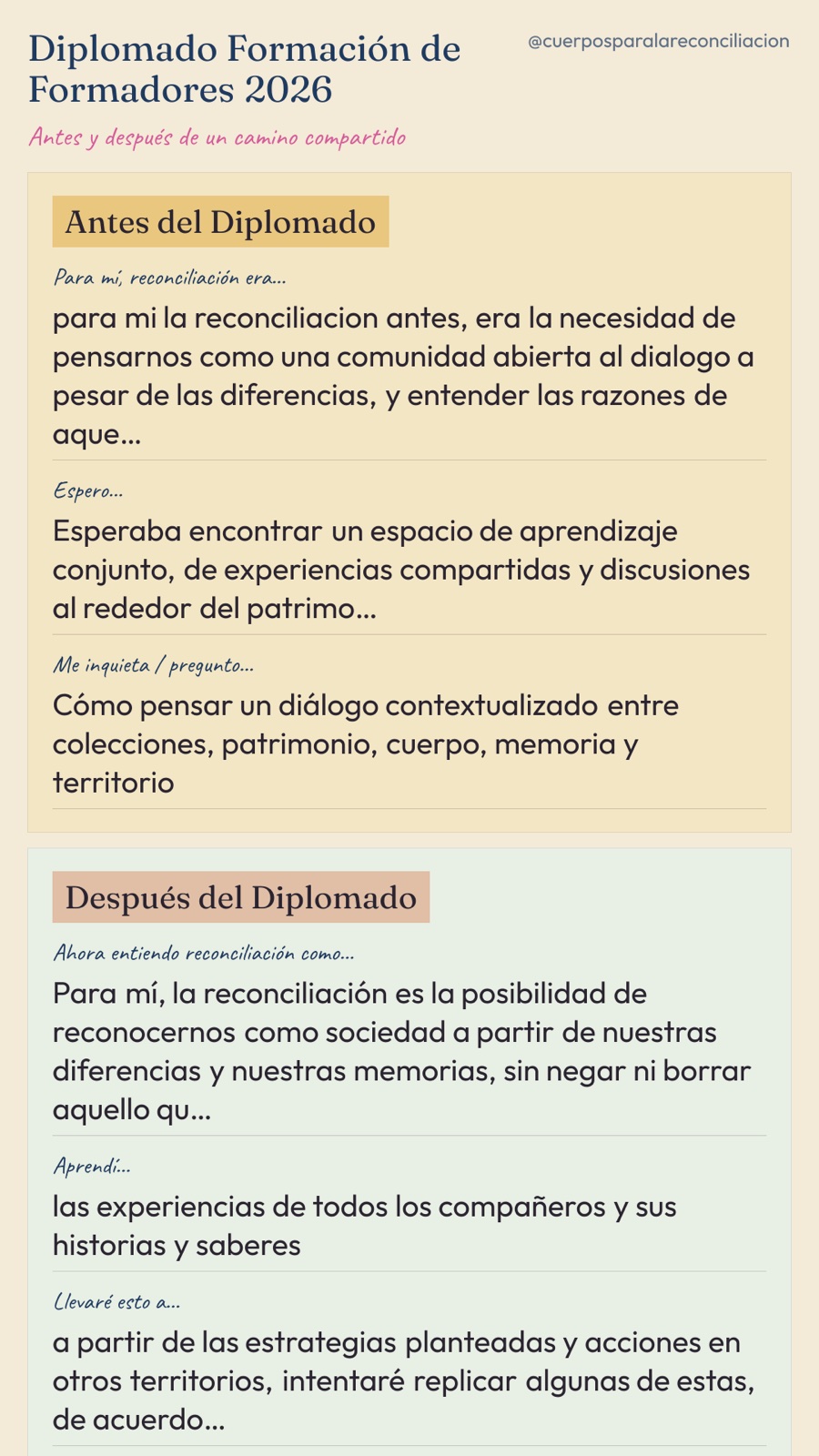 Kelly Johanna Acuña
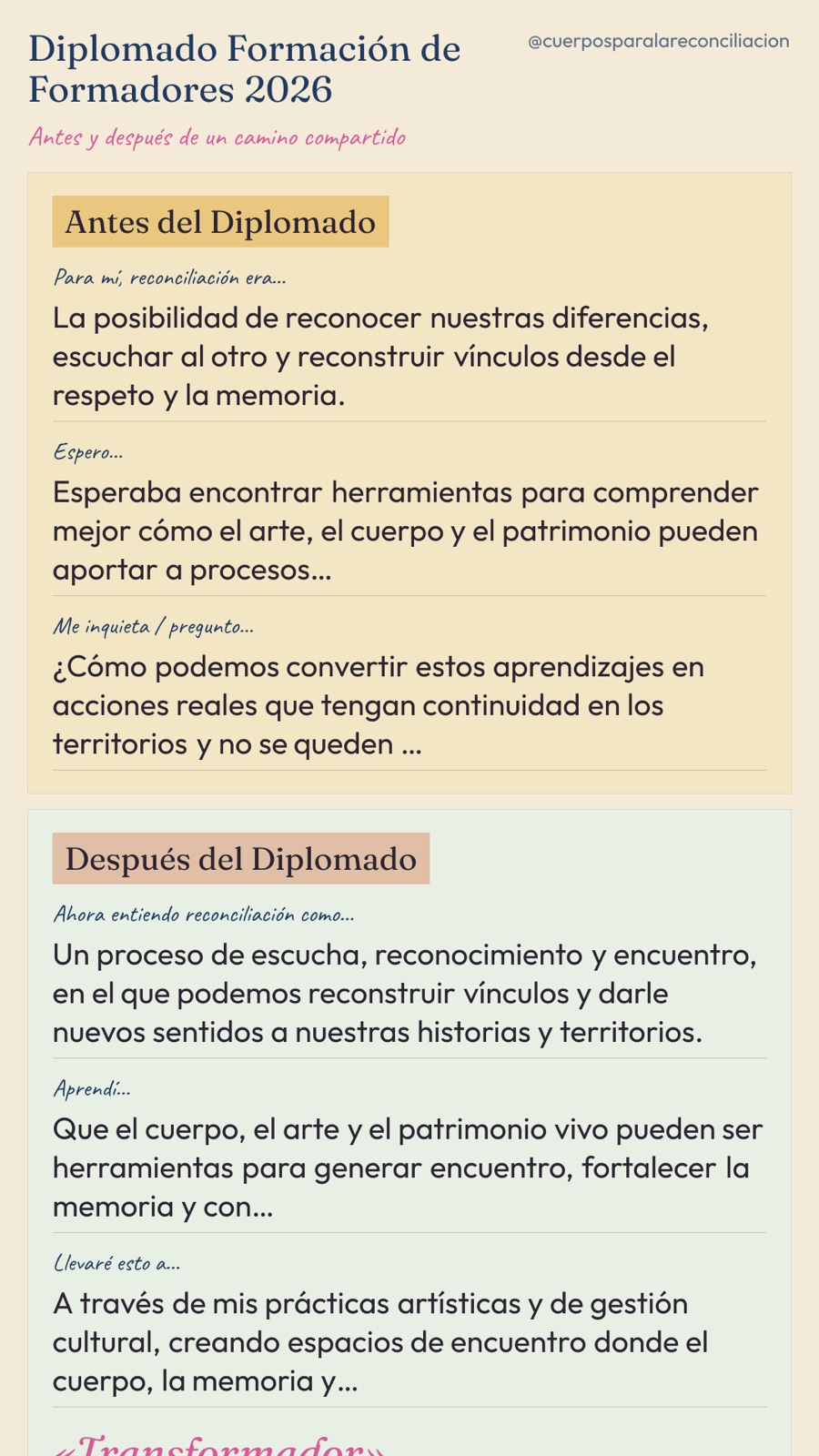 Laura Daniela Molano Guarin
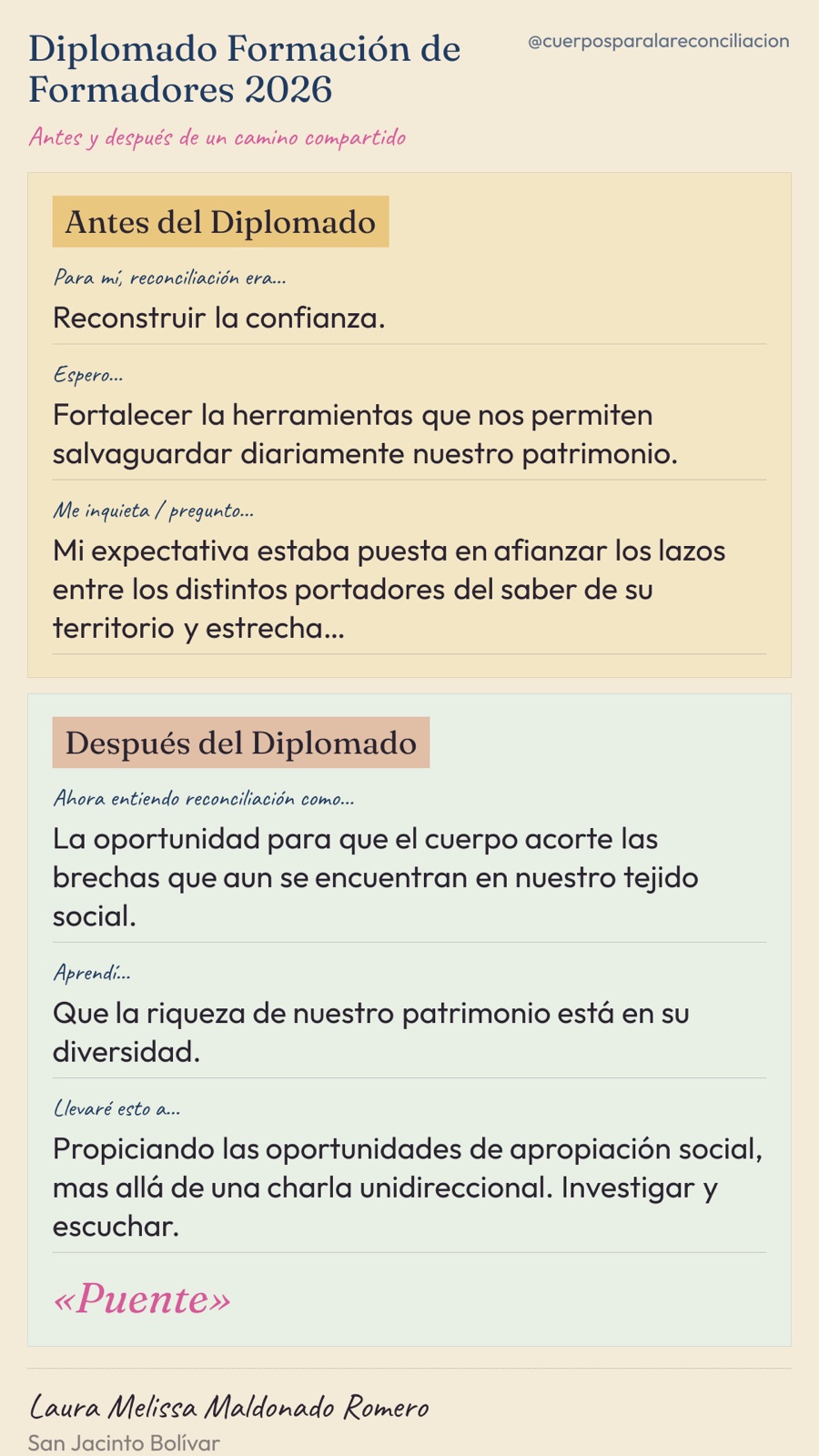 Laura Melissa Maldonado Romero
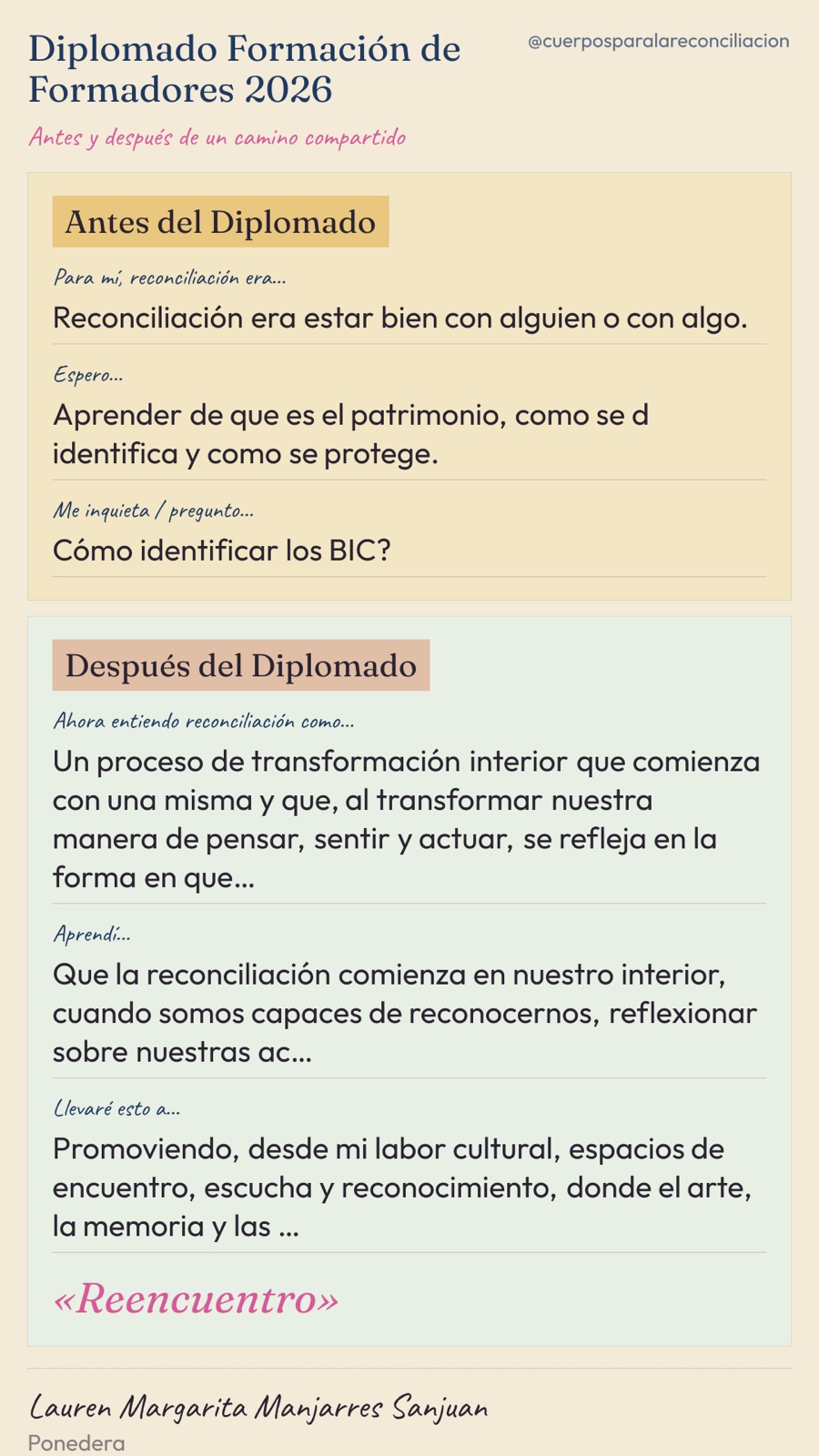 Lauren Margarita Manjarres Sanjuan
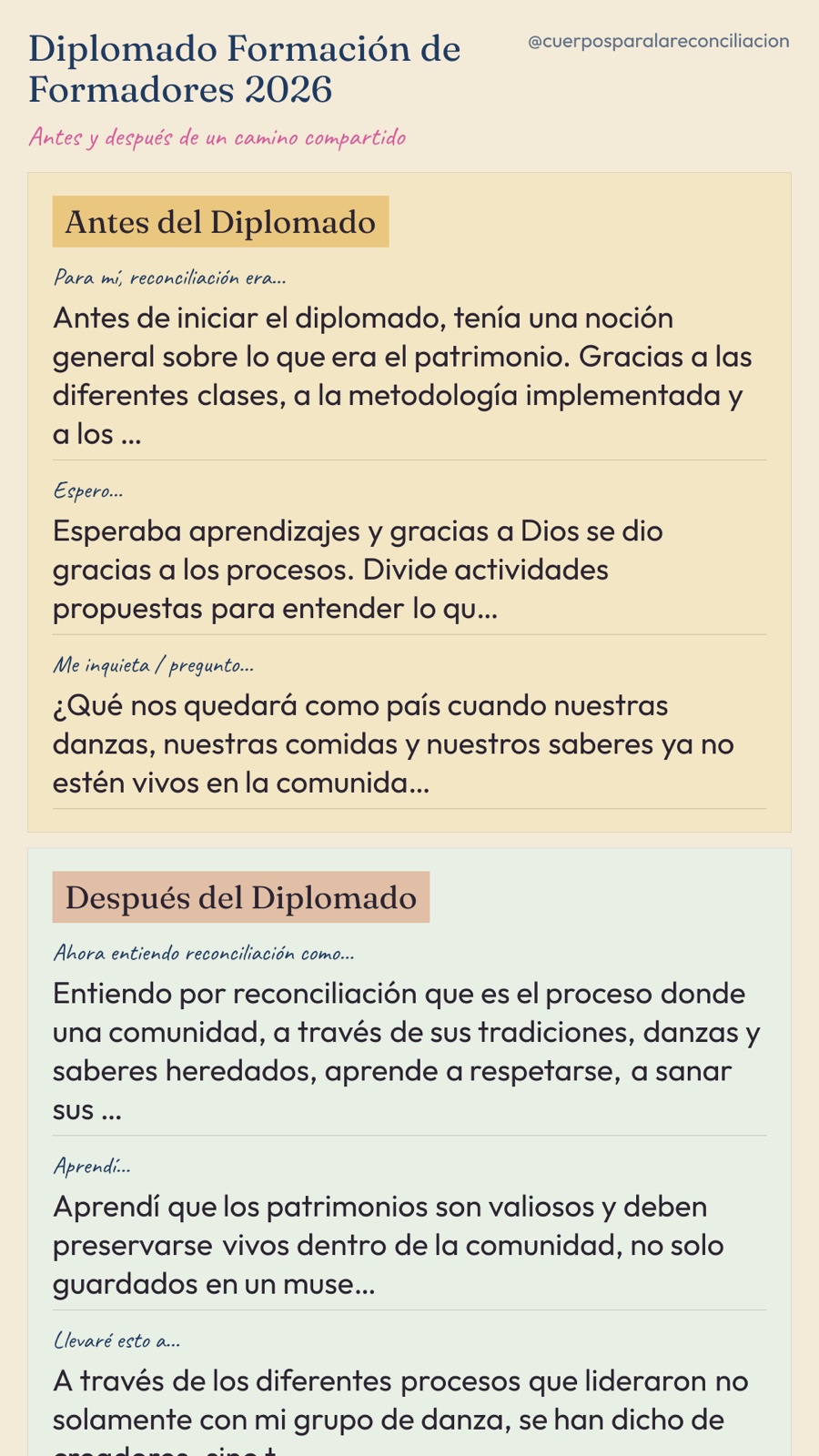 María Alejandra Iriarte Manjarrés
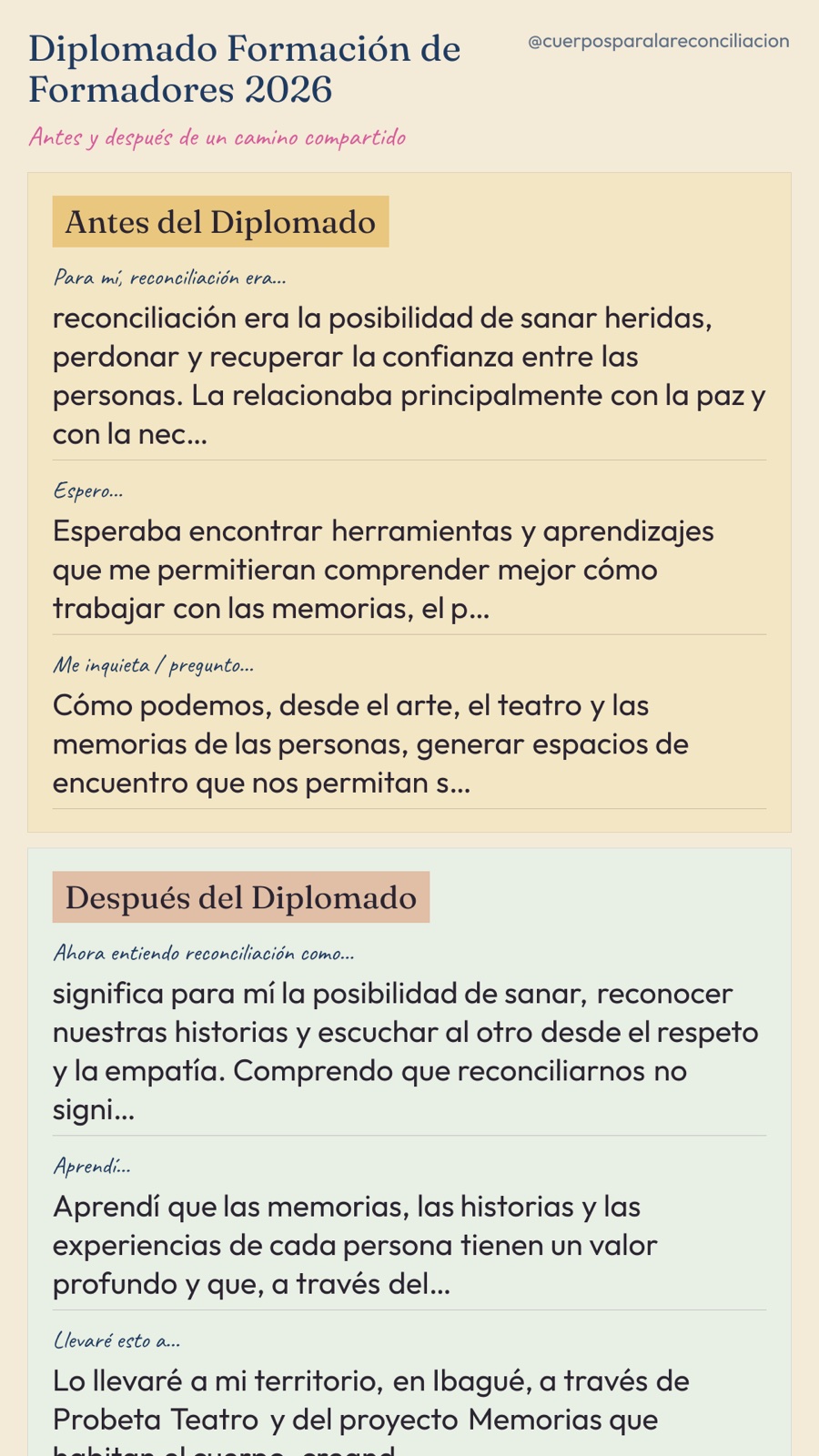 Lyda Milena Ramirez Rodriguez
Antes del Diplomado
Para mí, reconciliación era…Antes pensaba que era perdonar y olvidar. Hoy entiendo que es volver a tejer juntos aunque el hilo esté enredado. Es poder sentarme con el que pensaba diferente a hacer una hamaca sin miedo.
Era una palabra lejana del gobierno. Ahora es lo que pasa cuando en Morroa nos reconocemos como víctimas y como fuerza que resiste.
Después del Diplomado
Ahora entiendo reconciliación como…Ahora entiendo reconciliación como… volver a confiar. No es borrar el pasado, es tejer futuro juntos desde el cuerpo, la memoria y el territorio.
Leer la carta completa
Esperaba una capacitación más. Pero encontré un espacio para sanar mi propia historia, para aprender a enseñar desde el cuerpo y no solo desde la cabeza, y para llevarle a mi comunidad una forma diferente de hablar de lo que nos pasó.
Esperaba herramientas para formar a otros. Quiero llevarme cómo convertir el telar en una escuela de paz para los jóvenes de Morroa.
¿Cómo enseño reconciliación a jóvenes que no vivieron la guerra pero viven la desconfianza?
¿Cómo hago que el cuerpo hable cuando las palabras duelen todavía?
¿Cómo puedo ser formador si yo mismo aún tengo hilos sueltos por amarrar?
¿La reconciliación empieza por mí?
Lo más importante que aprendí… que el cuerpo guarda lo que la palabra no dice, y que para formar a otros primero tengo que reconciliarme con mi propio cuerpo.
Cómo lo llevaré a mi territorio / práctica…Cómo lo llevaré a mi territorio / práctica… a través del telar en Morroa. Usaré el tejido de hamaca como herramienta pedagógica para que las víctimas y jóvenes aprendan que reconciliar es volver a entrelazar hilos rotos con respeto y paciencia.
Antes del Diplomado
Para mí, reconciliación era…Empatía
Después del Diplomado
Ahora entiendo reconciliación como…Se construye a partir de reconocer la memoria, tradición, costumbres y cultura de cada uno de los territorios de mi país y como esto enriquece mi manera de ver el mundo.
Leer la carta completa
Apropiar conocimiento sobre el patrimonio para generar proyectos culturales en pro a la construcción de puentes a la construcción de paz.
Una pregunta o inquietud que traía…¿Qué patrimonio vivo se identifican en una ciudad tan grande como Bogotá?
La manera en que día a día y desde la cotidianidad aporto a la construcción de patrimonio vivo en mi territorio
Cómo lo llevaré a mi territorio / práctica…Desde canales creativos y artísticos que permitan que cualquier persona, desde cualquier lugar, pueda comprender y ser parte de el. En este caso, por medio de "Cuentos que no son cuentos" Podcast de microhistorias
Antes del Diplomado
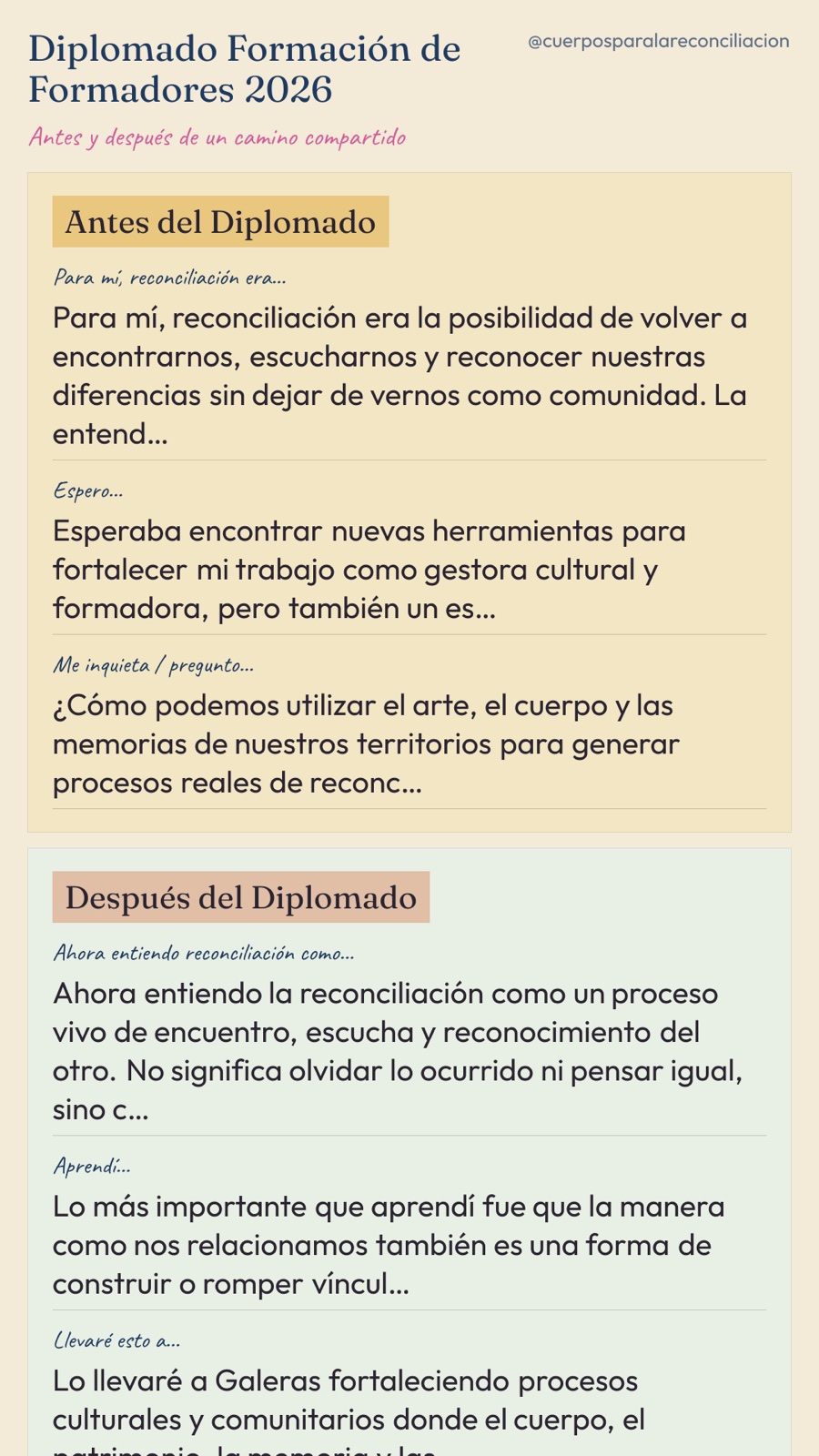
Para mí, reconciliación era…Para mí, reconciliación era la posibilidad de volver a encontrarnos, escucharnos y reconocer nuestras diferencias sin dejar de vernos como comunidad. La entendía principalmente como un proceso relacionado con sanar heridas y construir paz, pero llego con la inquietud de comprender cómo también puede ocurrir desde el cuerpo, el arte, la memoria y las prácticas culturales que nos permiten reconocernos y relacionarnos de otra manera.
Después del Diplomado
Ahora entiendo reconciliación como…Ahora entiendo la reconciliación como un proceso vivo de encuentro, escucha y reconocimiento del otro. No significa olvidar lo ocurrido ni pensar igual, sino crear condiciones para conversar, reconocer las diferencias y reconstruir vínculos. Comprendí que el cuerpo, el arte, la memoria y las prácticas culturales pueden abrir espacios seguros para encontrarnos y transformar nuestras maneras de relacionarnos.
Leer la carta completa
Esperaba encontrar nuevas herramientas para fortalecer mi trabajo como gestora cultural y formadora, pero también un espacio para cuestionar mis propias formas de relacionarme con las comunidades. Quería aprender a trabajar la memoria y el patrimonio no solamente como contenidos culturales, sino como posibilidades para generar encuentros, escuchar otras voces y construir procesos de transformación desde el territorio.
Una pregunta o inquietud que traía…¿Cómo podemos utilizar el arte, el cuerpo y las memorias de nuestros territorios para generar procesos reales de reconciliación, sin imponer nuestras propias formas de entender la historia, sino permitiendo que sean las comunidades quienes cuenten, resignifiquen y transformen sus propias experiencias?
Lo más importante que aprendí fue que la manera como nos relacionamos también es una forma de construir o romper vínculos. Aprendí a escuchar con mayor atención, a reconocer los saberes que existen en las comunidades y a entender la mediación como una herramienta para generar encuentros, preguntas y participación, en lugar de limitarme a transmitir contenidos.
Cómo lo llevaré a mi territorio / práctica…Lo llevaré a Galeras fortaleciendo procesos culturales y comunitarios donde el cuerpo, el patrimonio, la memoria y las voces de sus protagonistas sean herramientas para encontrarnos. Quiero incorporar estas metodologías en los procesos de formación y mediación cultural, especialmente alrededor de los Cuadros Vivos y otros saberes del territorio, procurando que las comunidades sean protagonistas de sus propios relatos.
Antes del Diplomado
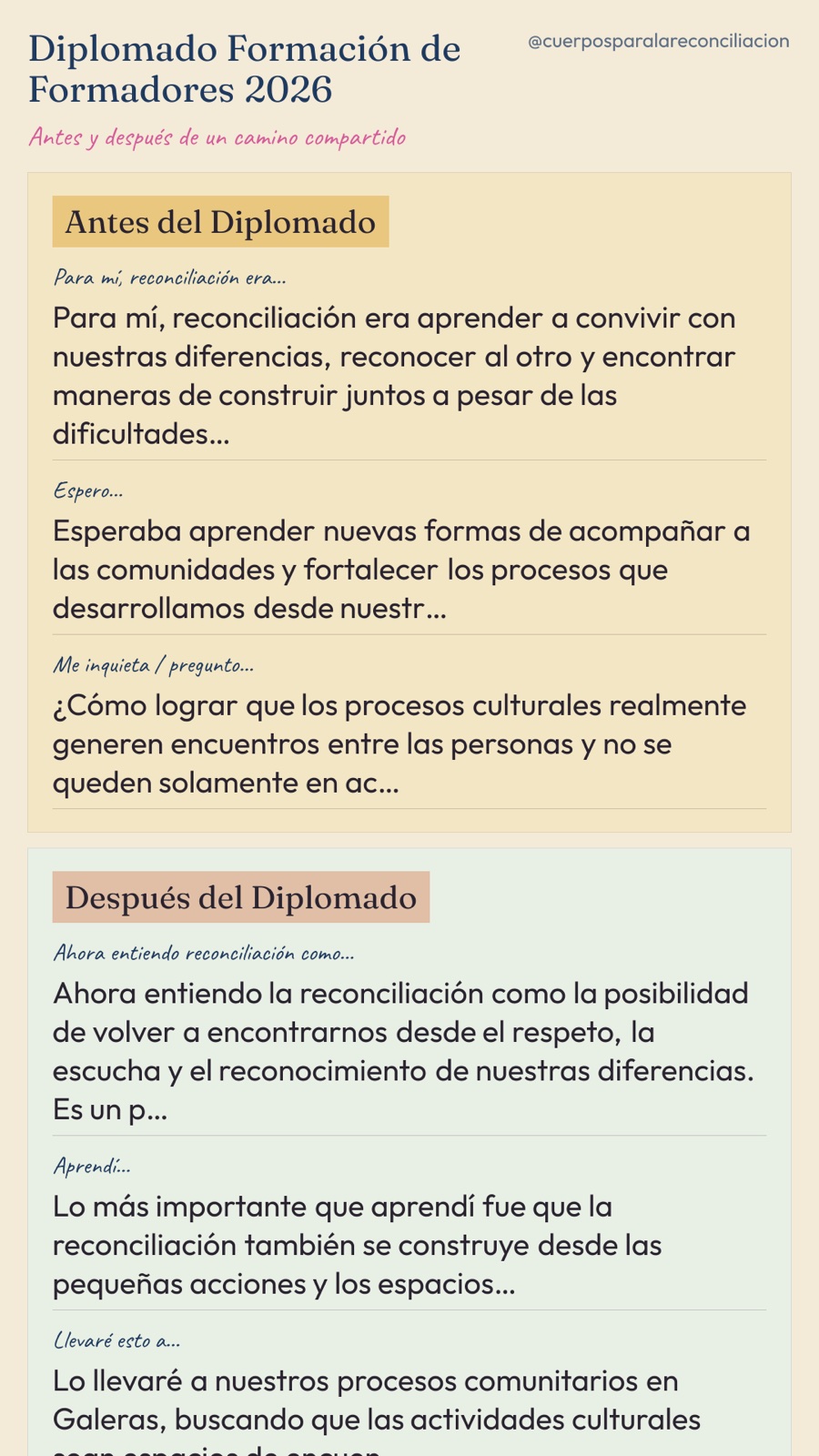
Para mí, reconciliación era…Para mí, reconciliación era aprender a convivir con nuestras diferencias, reconocer al otro y encontrar maneras de construir juntos a pesar de las dificultades. La relacionaba con la paz y con sanar como comunidad, pero no había pensado profundamente en cómo los procesos culturales, las historias familiares y los espacios donde nos encontramos pueden ayudarnos a reconstruir vínculos.
Después del Diplomado
Ahora entiendo reconciliación como…Ahora entiendo la reconciliación como la posibilidad de volver a encontrarnos desde el respeto, la escucha y el reconocimiento de nuestras diferencias. Es un proceso que se construye en lo cotidiano, en la manera como nos relacionamos con otras personas y en la capacidad de generar espacios donde cada voz pueda ser escuchada y valorada.
Leer la carta completa
Esperaba aprender nuevas formas de acompañar a las comunidades y fortalecer los procesos que desarrollamos desde nuestro territorio. Quería conocer herramientas que nos permitieran escuchar mejor a las personas, reconocer sus historias y generar espacios donde la cultura no sea solamente una actividad, sino una oportunidad para encontrarnos, dialogar y construir confianza.
Una pregunta o inquietud que traía…¿Cómo lograr que los procesos culturales realmente generen encuentros entre las personas y no se queden solamente en actividades? Me preguntaba cómo podemos hacer que una práctica artística, una historia o una memoria compartida pueda abrir conversaciones, sanar relaciones y fortalecer los vínculos de una comunidad.
Lo más importante que aprendí fue que la reconciliación también se construye desde las pequeñas acciones y los espacios comunitarios. Aprendí a valorar más la escucha, las historias de las personas y las experiencias que cada comunidad tiene para aportar. También comprendí que la cultura puede ser un puente para acercarnos y fortalecer la confianza.
Cómo lo llevaré a mi territorio / práctica…Lo llevaré a nuestros procesos comunitarios en Galeras, buscando que las actividades culturales sean espacios de encuentro y diálogo, no solamente de participación. Quiero fortalecer las iniciativas que desarrollamos con la comunidad para que las personas puedan compartir sus historias, reconocer sus saberes y construir colectivamente nuevas formas de relacionarse y cuidar nuestro patrimonio.
Antes del Diplomado
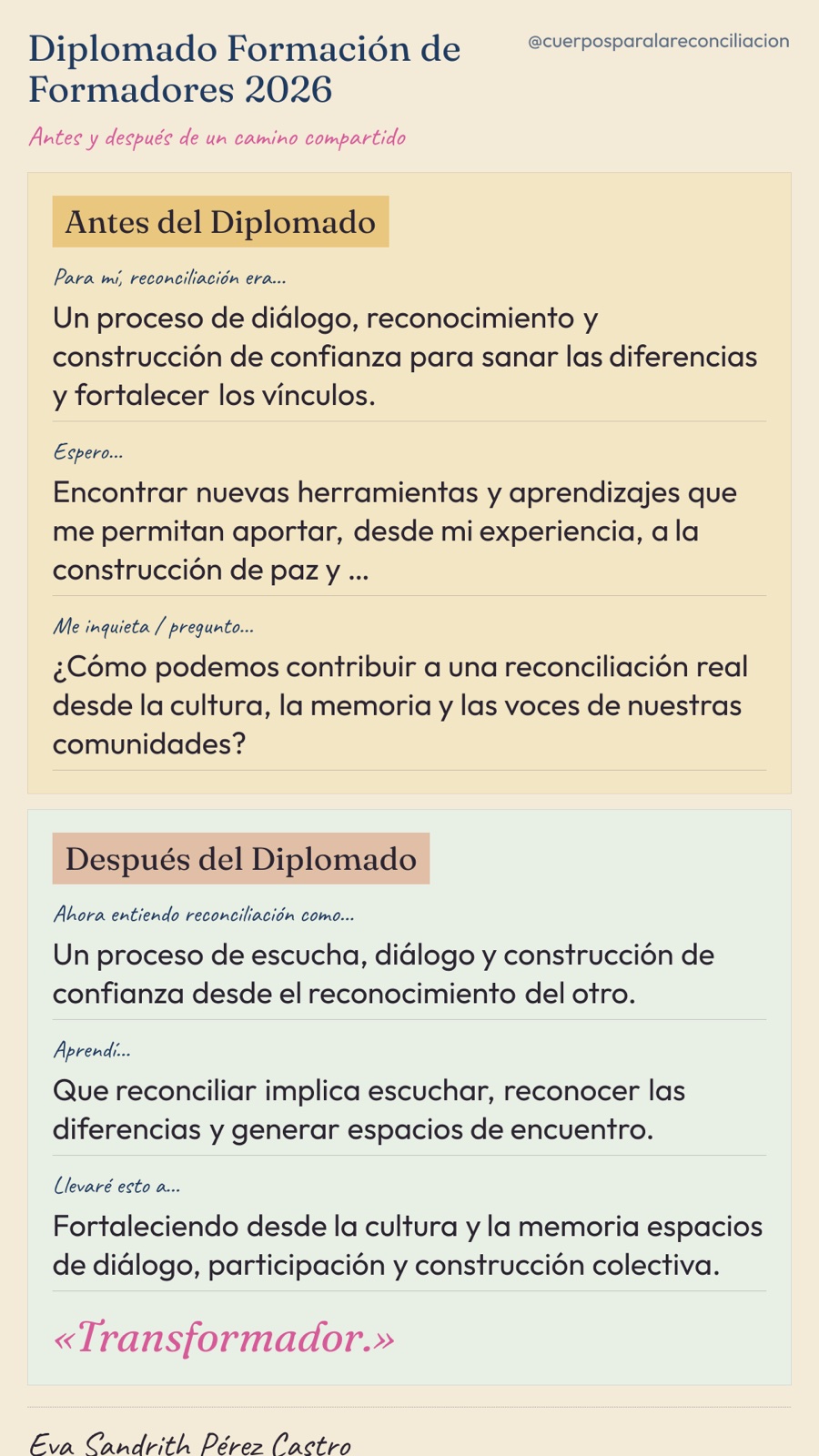
Para mí, reconciliación era…Un proceso de diálogo, reconocimiento y construcción de confianza para sanar las diferencias y fortalecer los vínculos.
Después del Diplomado
Ahora entiendo reconciliación como…Un proceso de escucha, diálogo y construcción de confianza desde el reconocimiento del otro.
Leer la carta completa
Encontrar nuevas herramientas y aprendizajes que me permitan aportar, desde mi experiencia, a la construcción de paz y reconciliación en mi comunidad.
Una pregunta o inquietud que traía…¿Cómo podemos contribuir a una reconciliación real desde la cultura, la memoria y las voces de nuestras comunidades?
Que reconciliar implica escuchar, reconocer las diferencias y generar espacios de encuentro.
Cómo lo llevaré a mi territorio / práctica…Fortaleciendo desde la cultura y la memoria espacios de diálogo, participación y construcción colectiva.
Antes del Diplomado
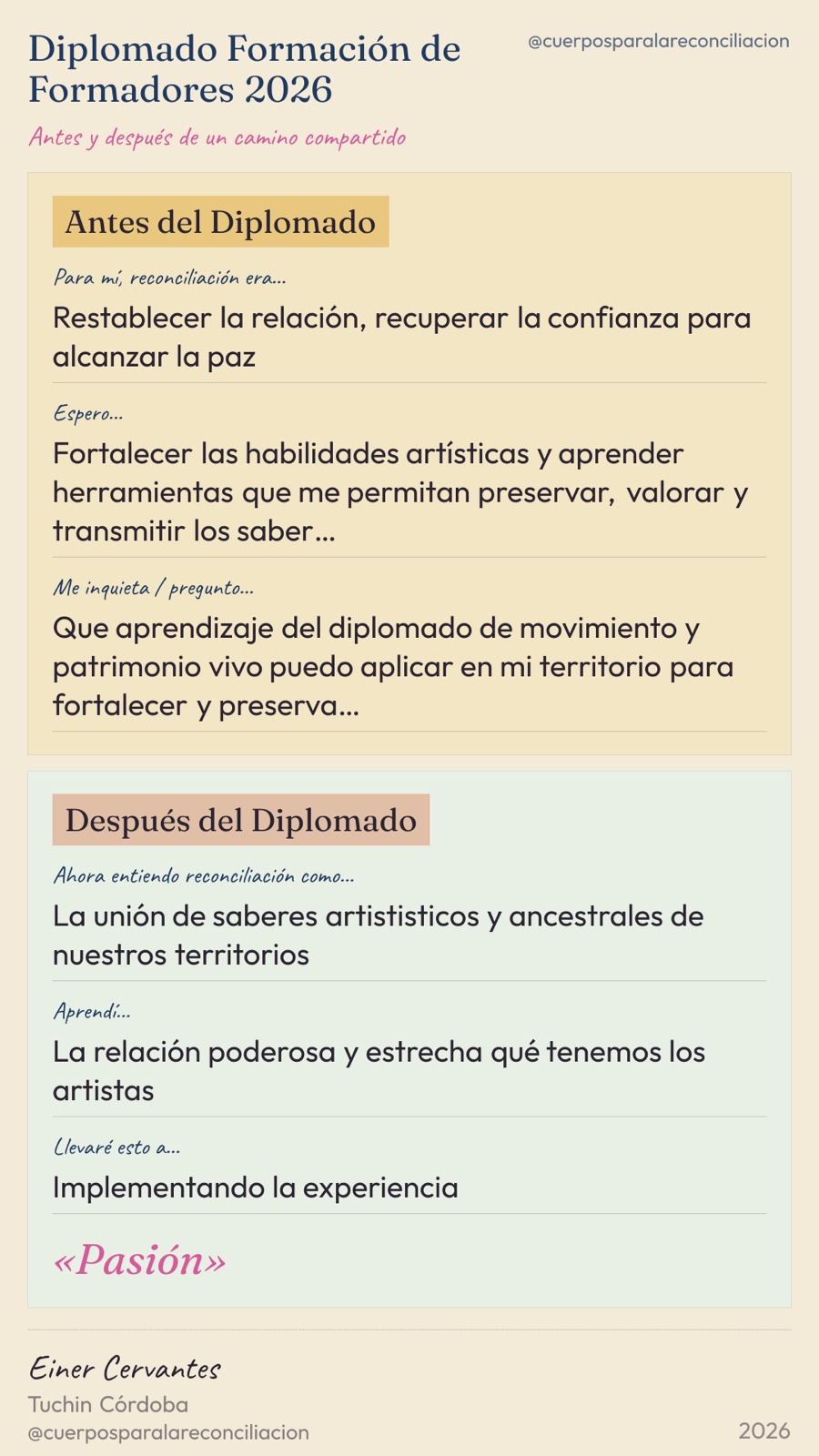
Para mí, reconciliación era…Restablecer la relación, recuperar la confianza para alcanzar la paz
Después del Diplomado
Ahora entiendo reconciliación como…La unión de saberes artististicos y ancestrales de nuestros territorios
Leer la carta completa
Fortalecer las habilidades artísticas y aprender herramientas que me permitan preservar, valorar y transmitir los saberes culturales de mi territorio
Una pregunta o inquietud que traía…Que aprendizaje del diplomado de movimiento y patrimonio vivo puedo aplicar en mi territorio para fortalecer y preservar nuestra cultura
La relación poderosa y estrecha qué tenemos los artistas
Cómo lo llevaré a mi territorio / práctica…Implementando la experiencia
Antes del Diplomado
Para mí, reconciliación era…la reconciliación se manifiesta, ante todo como un acto de valentía interior; la oportunidad de liberarnos del peso de las culpas y de sanar las fracturas del pasado. Más que un acuerdo con el entorno, constituye un ejercicio de introspección que nos invita revisar nuestras heridas profundas sin juzgarlas, a través d este proceso no solo soltamos las cargas emocionales que limitan nuestro presente,si no que tambien restauramos la paz con nuestra propia historia
Después del Diplomado
Ahora entiendo reconciliación como…reconocimiento y apropiacion de si mismo
Leer la carta completa
aprendizaje, red colaborativa,
Una pregunta o inquietud que traía…y quien es cuerpo en movimiento
Asi como el micelio se extiende bajo la corteza terrestre para nutrir a cada arbol de su entorno,este diplomado ha permitido expandir una red subterranea de conocimientos y saberes ,Sin embargo en este tejido la vida ya no florece en forma de arboles,sino de seres humanos que trasforman y habitan concientemente su territorio
Cómo lo llevaré a mi territorio / práctica…desde la educacion artistica en un eje trasversal de aprendizaje
Antes del Diplomado
Para mí, reconciliación era…Dialogo, empatía y paz
Después del Diplomado
Ahora entiendo reconciliación como…que la reconciliación no consiste en exigirles a las comunidades que se adapten a sus heridas, sino en generar condiciones para que puedan transformarlas.
Leer la carta completa
Lo que esperaba de este espacio era conocer, fortalecer y dar nuevos enfoques a los conocimientos y prácticas que ya se vienen desarrollando en los diferentes territorios. También esperaba compartir experiencias y aprendizajes para fortalecer redes entre los procesos y territorios, reconociendo lo que nos une y potenciando el trabajo colectivo.
Una pregunta o inquietud que traía…¿Cómo entienden el patrimonio otros gestores y gestoras desde las experiencias y realidades de sus territorios?
Que cada una de nuestras propuestas, vivencias y trabajos contienen una gran riqueza cultural. Aunque se desarrollan en diferentes territorios y desde distintas realidades, compartimos un mismo propósito: fortalecer y mantener vivos nuestros saberes, prácticas y patrimonio
Cómo lo llevaré a mi territorio / práctica…Esto me permitirá fortalecer las prácticas, metodologías y estrategias que venimos desarrollando con las niñas, niños y mujeres de la Escuela, enriqueciendo sus procesos formativos desde el patrimonio y los saberes del territorio.
Antes del Diplomado
Para mí, reconciliación era…Un acto de reivindicación y que contribuye a la construcción de paz
Después del Diplomado
Ahora entiendo reconciliación como…Aquello que nos conecta con el entorno y nos brinda paz
Leer la carta completa
Fortalecer conocimientos en temas de patrimonio
Una pregunta o inquietud que traía…Que es un patrimonio vivo
Cómo entrelazar turismo y patrimonio
Cómo lo llevaré a mi territorio / práctica…A partir de las riquezas naturales y patrimoniales que tenemos darles mayor valor
Antes del Diplomado
Para mí, reconciliación era…Para mi antes del dipolmado la reconciliacion para mi es juntar nuevamete lo que un dia se separo
Después del Diplomado
Ahora entiendo reconciliación como…Para mi reconciliación significa volver a establecer la paz, el diálogo y el entendimiento entre personas o grupos que han tenido conflictos, diferencias o algún distanciamiento.
En el contexto de la danza y el arte la reconciliación puede entenderse como crear espacios donde las personas se escuchen, expresen lo que sienten, reconozcan sus diferencias y encuentren formas de convivir y trabajar juntas.
Una frase sencilla sería:
“La reconciliación es encontrarnos nuevamente desde el respeto, escuchar al otro y construir juntos un camino de paz.”
Leer la carta completa
Galera con su expocicion de cuadros vivo lo maximo lo mejor de lo mejor , muy bonito lugar , acogedor ,bien organizado y escelente tarima pero pen se que las muestra y propuestas culturales y ban hacer un espacio mucho mas habierto ejemplo parque principal.
Una pregunta o inquietud que traía…Una pregunta ? Era obligatorio o no que todos los grupos con su respctivo formador a presiaran la presentacion de sus compañeros.
Lo pregunto porque ya ban dos veces que nueatro compañero victor a contado con la dicha que su grupo tiene la oportunidad de presentarse en los primeros momento y luego seba i no espera en ver lo que trae su compañero de otra comunidad i me parece una falta de respeto , si por casualidad el otro año existe la posibilidad continuar seguir realizando estas juntansas dejar todo claro desde el principio
En un encuentro y festival de danza donde diferentes comunidades comparten sus conocimientos y saberes, se aprende que la danza es una forma de encontrarnos, reconocer nuestras raíces y valorar la diversidad cultural.
Se aprende principalmente:
A valorar los saberes tradicionales que cada comunidad conserva y transmite de generación en generación.
A compartir conocimientos, aprendiendo de las experiencias, técnicas y formas de expresión de otros grupos.
A reconocer la diversidad cultural, entendiendo que cada territorio tiene una manera particular de bailar, sentir y contar su historia.
A fortalecer la identidad y el sentido de pertenencia por nuestras comunidades y tradiciones.
A trabajar en colectivo, desde el respeto, la escucha, la solidaridad y el intercambio.
A mejorar las habilidades artísticas y escénicas, observando y aprendiendo de las diferentes puestas en escena.
A generar vínculos entre comunidades, creando nuevas amistades y posibilidades de colaboración.
A comprender que el arte puede unirnos, permitiendo que diferentes territorios se encuentren y compartan sus historias a través del cuerpo y el movimiento.
En conclusión: un festival de danza no es solamente un espacio para mostrar lo que sabemos hacer; es un lugar para aprender de otros, reconocer nuestros saberes, fortalecer nuestra cultura y construir comunidad a través del arte.
De otros encuentros de danza uno se lleva mucho más que una experiencia artística. Se lleva nuevos conocimientos, inspiración y aprendizajes de las demás comunidades para compartirlos y fortalecer el trabajo en el propio territorio.
Puedes expresarlo así:
“De este encuentro me llevo los saberes, las experiencias y las enseñanzas que cada comunidad comparte a través de la danza. Aprendo nuevas formas de trabajar el cuerpo, el ritmo, la expresión y la puesta en escena, pero también aprendo a valorar las historias, las tradiciones y las raíces de otros territorios. Me llevo la inspiración para seguir fortaleciendo mi trabajo, compartir estos aprendizajes con mi comunidad y entender que cuando nos encontramos desde el arte, todos tenemos algo que enseñar y algo que aprender.”
Antes del Diplomado
Para mí, reconciliación era…Significaba volver a tener la oportunidad de encontrarnos y poder afianzarnos en la búsqueda de espacios para generar confianza, estecharnos las manos y abrazarnos desde el alma a través del arte.
Después del Diplomado
Ahora entiendo reconciliación como…Los espacios poderosos que podemos construir en torno al arte que posiblitan las transformación positiva no solo de las personas sino también de los entornos y de la sociedad entera.
Leer la carta completa
Esperaba que sucedieron momentos que movieran mi interior con experiencias académicas y de encuentro con la mayor cantidad de personas posibles que piensan igual y que persiguen las mismas ideas en el arte. Asi mismo esperaba acumular muchos mas conocimientos para poder continuar construyendo los míos propios para luego llevarlos a los territorios.
Una pregunta o inquietud que traía…Será que nuevamente estaré dispuestos a desaprender ?
Que no importa las circunstancias lo mas relevantes es tener la capacidad de predisponernos para poder desaprender y entender que solo de esta manera nuestros procesos se verán beneficiados al contar con líderes dispuestos a abrirse a las exigencias de cada momento.
Cómo lo llevaré a mi territorio / práctica…El cúmulo de conocimientos y experiencias vividas me servirán para fortalecer no solo mis proceso con NNJ sino también con los contextos en los que se desarrollen los mismos la práctica y la teoría serán siempre elementos que ayudarán a seguir salvaguardando nuestro patrimonio territorial.
Antes del Diplomado
Para mí, reconciliación era…La oportunidad de sanar, perdonar y reconstruir relaciones desde el diálogo, la comprensión y el respeto.
Después del Diplomado
Ahora entiendo reconciliación como…Un proceso de diálogo, perdón y comprensión que permite sanar diferencias y construir relaciones más respetuosas y pacíficas.
Leer la carta completa
Aprender nuevas herramientas para acompañar a otras personas en procesos de reconciliación, fortalecer mis conocimientos y crecer tanto personal como profesionalmente.
Una pregunta o inquietud que traía…¿Cómo podemos ayudar a que las personas superen sus diferencias y encuentren caminos de diálogo y reconciliación, especialmente cuando existen heridas del pasado?
Que reconciliarse no significa olvidar lo sucedido, sino aprender de ello, escuchar al otro y buscar nuevas formas de relacionarnos.
Cómo lo llevaré a mi territorio / práctica…Promoviendo el diálogo, la escucha y el respeto en mi comunidad, especialmente en espacios donde existan diferencias o conflictos.
Antes del Diplomado
Para mí, reconciliación era…poder conciliar el perdón desde una verdad que busca un mejor vivir entre todos y todas.
Después del Diplomado
Ahora entiendo reconciliación como…El paso para vivir en paz.
Leer la carta completa
Aprender y desaprender, conocer y viajar por cada rincon de las regiones participantes y sobre todo seguir entretejiendo con las artes una mejor sociedad.
Una pregunta o inquietud que traía…¿Hablar de patrimonio es también hablar de la línea de tiempo de mi territorio?
Que hacemos parte de una memoria e historia que nos dejaron quienes con sus saberes le apostaron a la vida comunitaria y social para que cada rincon de este territorio tuviera con que contar sus orígenes.
Cómo lo llevaré a mi territorio / práctica…Desde el arte escénico, soy un fiel creyente que desde estas disciplinas puedo llevar todo lo aprendido en este grandioso espacio
Antes del Diplomado
Para mí, reconciliación era…Realmente no tengo un concepto de antes del diplomado, porque no conocía dicha entidad.
Después del Diplomado
Ahora entiendo reconciliación como…Una gran entidad que trabaja con todo lo relacionado con la cultura, y la salvaguardia de todas las tradiciones que tienen las diferentes regiones del mundo.
Leer la carta completa
No esperaba nada, ya que no tenía seguridad de que me escogieran, entonces no me hice ilusiones.
Una pregunta o inquietud que traía…Me gustaría saber, que hacen las personas responsables del diplomado, con todos los proyectos que hicimos los estudiantes. Tengo la inquietud porque que nos garantiza a nosotros que no pueden ejecutar uno de estos y uno ni se entera, que fue el en autor de dicho proyecto.
Lo más importante que aprendí fue que cada ser humano debe valorar de donde viene, lo que lo define, lo representa y todo lo relacionado con su origen y sus antepasados, ya que esto es lo que lo define como persona y le da un gran valor, ya que el sentido de la vida está en estas pequeñas cosas.
Cómo lo llevaré a mi territorio / práctica…Trataré de aporta todo mi conocimiento adquirido a las personas que lo necesiten, ayudar a como crear un proyecto desde cero, como hacer el presupuesto, como buscar convocatorias y todo lo relacionado con el tema.
Antes del Diplomado
Para mí, reconciliación era…Cuando uno perdona
Después del Diplomado
Ahora entiendo reconciliación como…es el proceso mediante el cual personas o comunidades que han vivido diferencias, conflictos, distanciamientos o rupturas buscan restablecer relaciones basadas en el reconocimiento, la escucha, el respeto y la convivencia.
Leer la carta completa
Aprender
Una pregunta o inquietud que traía…De que era
Lo más importante que aprendí es que el patrimonio no está solamente en los lugares, los objetos o las tradiciones, sino también en nuestro cuerpo, en nuestra memoria, en las historias que contamos y en la manera como habitamos y sentimos el territorio. Comprendí que reconocer nuestras propias experiencias y escuchar las de los demás nos permite valorar la diversidad, fortalecer nuestra identidad y construir nuevas formas de relacionarnos con nuestro territorio y con la comunidad.
Cómo lo llevaré a mi territorio / práctica…Llevaré lo aprendido al territorio a través del teatro, el cuerpo y la memoria. Buscaré que niños, jóvenes y comunidades reconozcan que sus historias, sus saberes, sus gestos, sus tradiciones y los lugares que habitan también hacen parte de su patrimonio.
Antes del Diplomado
Para mí, reconciliación era…Dejar atrás. Trabajar para reparar, devolverse a sentir y trazar caminos.
Después del Diplomado
Ahora entiendo reconciliación como…Un proceso de cuerpos en un espacio. Una nueva forma de tejer comunidad fuera de la violencia
Leer la carta completa
Un espacio de participación artística que me diera herramientas para llevar mí proyecto al territorio
Una pregunta o inquietud que traía…¿Cuál es mi territorio?
El patrimonio vivo depende de personas como yo
Cómo lo llevaré a mi territorio / práctica…Por medio de procesos de apropiación territorial basados en actividades artísticas
Antes del Diplomado
Para mí, reconciliación era…reconciliacion es saber perdonarse y perdonar a personas que le hayan echo algo auno
Después del Diplomado
Ahora entiendo reconciliación como…dar un paso al perdon a uno y demas personas
Leer la carta completa
poder dar opiniones de lo que uno piensa
Una pregunta o inquietud que traía…poder hacer un diplomado sin saber tanto como los compañeros
poder hacer algo pensado por mi
Cómo lo llevaré a mi territorio / práctica…tratar de hacer las pacas digestoras
Antes del Diplomado
Para mí, reconciliación era…Una palabra importante, pero a veces lejana. La asociaba con procesos de paz, memoria, reparación y encuentro, aunque todavía la pensaba más desde lo institucional o lo discursivo que desde el cuerpo y la experiencia cotidiana
Después del Diplomado
Ahora entiendo reconciliación como…Un proceso vivo que se construye en los vínculos, en la escucha, en el reconocimiento de las memorias y en la posibilidad de crear espacios donde las personas puedan encontrarse desde sus cuerpos, historias y territorios
Leer la carta completa
Esperaba encontrar herramientas para acompañar procesos culturales y comunitarios desde el patrimonio vivo, pero también entender cómo el cuerpo, la memoria y las prácticas sensibles podían abrir otras formas de diálogo, cuidado y construcción colectiva
Una pregunta o inquietud que traía…Me preguntaba cómo trabajar la reconciliación sin volverla una idea abstracta, y cómo proponer experiencias que realmente conectaran con las personas, sus territorios, sus memorias y sus formas de vivir el patrimonio
Me llevo herramientas pedagógicas, metodológicas y sensibles para pensar el patrimonio vivo como una práctica situada. También me llevo la importancia de cuidar los procesos, escuchar a las comunidades y construir desde lo colectivo, no solo desde la planeación
Cómo lo llevaré a mi territorio / práctica…Lo llevaré a mi práctica desde el diseño de experiencias pedagógicas y sensibles que conecten patrimonio, memoria y cuerpo. Me interesa aplicarlo en procesos de mediación cultural, formación y trabajo comunitario, creando espacios donde las personas puedan reconocer sus saberes, contar sus historias y construir colectivamente otras formas de cuidado y reconciliación
Antes del Diplomado
Para mí, reconciliación era…para mi la reconciliacion antes, era la necesidad de pensarnos como una comunidad abierta al dialogo a pesar de las diferencias, y entender las razones de aquello o aquellos que nos ocasionaron dolor.
Después del Diplomado
Ahora entiendo reconciliación como…Para mí, la reconciliación es la posibilidad de reconocernos como sociedad a partir de nuestras diferencias y nuestras memorias, sin negar ni borrar aquello que nos ha causado dolor. Implica escuchar, reconocer responsabilidades, dignificar las voces históricamente silenciadas y generar espacios para reconstruir los vínculos y la confianza. En ese sentido, la memoria, el patrimonio, el arte y los museos pueden contribuir a la reconciliación cuando permiten encontrarnos, dialogar y construir nuevas formas de relacionarnos con nuestro pasado y con los demás.
Leer la carta completa
Esperaba encontrar un espacio de aprendizaje conjunto, de experiencias compartidas y discusiones al rededor del patrimonio
Una pregunta o inquietud que traía…Cómo pensar un diálogo contextualizado entre colecciones, patrimonio, cuerpo, memoria y territorio
las experiencias de todos los compañeros y sus historias y saberes
Cómo lo llevaré a mi territorio / práctica…a partir de las estrategias planteadas y acciones en otros territorios, intentaré replicar algunas de estas, de acuerdo con el contexto cultural de cartagena
Antes del Diplomado
Para mí, reconciliación era…Al inicio tenía diferentes dudas en inquietudes y desconocimiento sobre qué era realmente el patrimonio. Decir "reconciliación" para mí significaba reconciliarme con mi territorio: conocerlo, quererlo, entenderlo y proponer a partir de él. Esperaba adquirir bases metodológicas, teóricas y prácticas para este proceso de creación y entender las artes; circo, teatro, danza y pintura son mediadoras para el encuentro dentro de las AULAS ABIERTAS: encuentros significativos en la ciudad de Bogotá.
Después del Diplomado
Ahora entiendo reconciliación como…Comprender las necesidades del territorio y reconocer que la reconciliación se construye desde la escucha, el diálogo, el respeto por las diferentes realidades y el valor de los saberes y patrimonios de cada comunidad.
Leer la carta completa
Esperamos un espacio de encuentro: nuevos ideas, culturas, preguntas, Aprendí a ser más humilde en el proceso. Aunque lamenté no asistir a las sesiones presenciales sobre Territorio y me me me hubiese gustado viajar, me gustó muchísimo la experiencia y me llevo un aprendizaje muy valioso sobre el conocimiento compartido. También esperé amor en el conocimiento, generosidad en las sesiones, paciencia porque estudiar virtual no es fácil. Fue maravilloso, excelentes profesionales.
Una pregunta o inquietud que traía…Mi principal pregunta era cómo una persona se convierte en formadora para la paz. Cómo entender, leer el territorio y cómo es la mejor forma de aportar en el territorio NACIONAL.
Comprender las necesidades del territorio y reconocer que la reconciliación se construye desde la escucha, el diálogo, el respeto por las diferentes realidades y el valor de los saberes y patrimonios de cada comunidad.
Cómo lo llevaré a mi territorio / práctica…Aplicaré estos aprendizajes en mi trabajo como gestora cultural y docente, creando espacios participativos donde el arte, la cultura y el patrimonio fortalezcan el diálogo, la confianza y la construcción de paz. Buscaré escuchar las necesidades de cada comunidad para desarrollar procesos significativos que promuevan el encuentro, el reconocimiento y la reconciliación.
Antes del Diplomado
Para mí, reconciliación era…La posibilidad de reconocer nuestras diferencias, escuchar al otro y reconstruir vínculos desde el respeto y la memoria.
Después del Diplomado
Ahora entiendo reconciliación como…Un proceso de escucha, reconocimiento y encuentro, en el que podemos reconstruir vínculos y darle nuevos sentidos a nuestras historias y territorios.
Leer la carta completa
Esperaba encontrar herramientas para comprender mejor cómo el arte, el cuerpo y el patrimonio pueden aportar a procesos de encuentro, memoria y construcción de paz en los territorios.
Una pregunta o inquietud que traía…¿Cómo podemos convertir estos aprendizajes en acciones reales que tengan continuidad en los territorios y no se queden solamente en el espacio de formación?
Que el cuerpo, el arte y el patrimonio vivo pueden ser herramientas para generar encuentro, fortalecer la memoria y construir comunidad.
Cómo lo llevaré a mi territorio / práctica…A través de mis prácticas artísticas y de gestión cultural, creando espacios de encuentro donde el cuerpo, la memoria y los saberes de las personas puedan ser reconocidos y compartidos.
Antes del Diplomado
Para mí, reconciliación era…Reconstruir la confianza.
Después del Diplomado
Ahora entiendo reconciliación como…La oportunidad para que el cuerpo acorte las brechas que aun se encuentran en nuestro tejido social.
Leer la carta completa
Fortalecer la herramientas que nos permiten salvaguardar diariamente nuestro patrimonio.
Una pregunta o inquietud que traía…Mi expectativa estaba puesta en afianzar los lazos entre los distintos portadores del saber de su territorio y estrechar lazos creativos.
Que la riqueza de nuestro patrimonio está en su diversidad.
Cómo lo llevaré a mi territorio / práctica…Propiciando las oportunidades de apropiación social, mas allá de una charla unidireccional. Investigar y escuchar.
Antes del Diplomado
Para mí, reconciliación era…La capacidad de poder y querer observar una situación específica que genera dolor, tristeza, rabia, angustia con ojos de transformación. Buscar la manera de que sea diferente.
Después del Diplomado
Ahora entiendo reconciliación como…Como el acercamiento de esas situaciones no tan placenteras para que se transformen. La unión de saberes en pro del bien común.
Leer la carta completa
Comprender procesos de gestión comunitaria
Una pregunta o inquietud que traía…Cómo ser el puente entre la comunidad y el exterior
El cuidado hacia los saberes de la comunidad y las maneras posibles de conciliar un proyecto en beneficio de cada persona
Cómo lo llevaré a mi territorio / práctica…Con disposición a la conversación clara y directa desde las ideas, experiencias para ofrecer y presupuestos para compartir.
Antes del Diplomado
Para mí, reconciliación era…Reconciliación era estar bien con alguien o con algo.
Después del Diplomado
Ahora entiendo reconciliación como…Un proceso de transformación interior que comienza con una misma y que, al transformar nuestra manera de pensar, sentir y actuar, se refleja en la forma en que nos relacionamos con los demás y con nuestro entorno. Es también la capacidad de reconocer lo pendiente, reencontrarnos con nuestros propósitos y retomar el camino desde la conciencia, la voluntad y el compromiso.
Leer la carta completa
Aprender de que es el patrimonio, como se d identifica y como se protege.
Una pregunta o inquietud que traía…Cómo identificar los BIC?
Que la reconciliación comienza en nuestro interior, cuando somos capaces de reconocernos, reflexionar sobre nuestras acciones y abrirnos a nuevas maneras de comprender y relacionarnos con los demás.
Cómo lo llevaré a mi territorio / práctica…Promoviendo, desde mi labor cultural, espacios de encuentro, escucha y reconocimiento, donde el arte, la memoria y las expresiones propias de nuestro territorio contribuyan a fortalecer los vínculos comunitarios, el respeto por las diferencias y la construcción de paz.
Antes del Diplomado
Para mí, reconciliación era…Antes de iniciar el diplomado, tenía una noción general sobre lo que era el patrimonio.
Gracias a las diferentes clases, a la metodología implementada y a los ejercicios realizados y propuestos durante el desarrollo del diplomado, pude comprender a profundidad la importancia de cada una de las acciones que conforman el patrimonio vivo de una comunidad.
Entendí lo fundamental que es el patrimonio para el desarrollo cultural, para la identidad y para la preservación de nuestra memoria colectiva.
Después del Diplomado
Ahora entiendo reconciliación como…Entiendo por reconciliación que es el proceso donde una comunidad, a través de sus tradiciones, danzas y saberes heredados, aprende a respetarse, a sanar sus diferencias y a mantener viva su identidad.
Leer la carta completa
Esperaba aprendizajes y gracias a Dios se dio gracias a los procesos. Divide actividades propuestas para entender lo que es el patrimonio vivo en una comunidad.
Una pregunta o inquietud que traía…¿Qué nos quedará como país cuando nuestras danzas, nuestras comidas y nuestros saberes ya no estén vivos en la comunidad, sino solo guardados en un museo?
Aprendí que los patrimonios son valiosos y deben preservarse vivos dentro de la comunidad, no solo guardados en un museo, sino transmitidos en el conocimiento de las nuevas generaciones.
Cómo lo llevaré a mi territorio / práctica…A través de los diferentes procesos que lideraron no solamente con mi grupo de danza, se han dicho de creadores, sino también desde la institución educativa.
Antes del Diplomado
Para mí, reconciliación era…reconciliación era la posibilidad de sanar heridas, perdonar y recuperar la confianza entre las personas. La relacionaba principalmente con la paz y con la necesidad de aprender a convivir a pesar de nuestras diferencias.
Después del Diplomado
Ahora entiendo reconciliación como…significa para mí la posibilidad de sanar, reconocer nuestras historias y escuchar al otro desde el respeto y la empatía. Comprendo que reconciliarnos no significa olvidar lo vivido, sino transformar esas memorias en oportunidades de encuentro, donde el arte, el cuerpo y la palabra nos ayuden a reconstruir vínculos y a sembrar paz desde nuestros territorios.
Leer la carta completa
Esperaba encontrar herramientas y aprendizajes que me permitieran comprender mejor cómo trabajar con las memorias, el patrimonio vivo y las experiencias de las comunidades. También esperaba compartir saberes con otras personas, escuchar diferentes experiencias y fortalecer mi mirada como artista y formadora para construir propuestas que aporten a la reconciliación, el reconocimiento del otro y la construcción de paz desde el arte y el territorio.
Una pregunta o inquietud que traía…Cómo podemos, desde el arte, el teatro y las memorias de las personas, generar espacios de encuentro que nos permitan sanar heridas, reconocer nuestras diferencias y construir caminos de reconciliación desde nuestros territorios?
Aprendí que las memorias, las historias y las experiencias de cada persona tienen un valor profundo y que, a través del arte, podemos escucharlas, reconocerlas y compartirlas. Comprendí que la reconciliación comienza cuando nos abrimos al otro con empatía, respetamos nuestras diferencias y construimos espacios de encuentro desde el cuerpo, la palabra y la memoria.
Cómo lo llevaré a mi territorio / práctica…Lo llevaré a mi territorio, en Ibagué, a través de Probeta Teatro y del proyecto Memorias que habitan el cuerpo, creando espacios de encuentro con los adultos mayores del barrio Popular, donde el teatro, los objetos, la voz y los recuerdos permitan compartir historias de vida, reconocer saberes y fortalecer los vínculos entre las personas. Quiero que el arte sea un puente para escuchar, sanar y construir memoria colectiva desde el respeto, la empatía y la reconciliación.
Embodying Reconciliation · Room 8
What we take with us, what we can improve
Postcards and letters to keep building
Postcards from the Movimiento y Patrimonios Vivos Festival ↓Every encounter leaves memories, lessons and questions. This room brings together the feedback of those who lived the Movimiento y Patrimonios Vivos Festival and the diploma course Trainers in Living Heritage, Body and Peace.
The festival postcards combine photographs and reflections on what was lived. The letters from the diploma course share lessons, experiences and proposals to improve the training process. They are personal views that help us recognise what was meaningful, listen to the difficulties and think about the next steps.
Explore these postcards and letters: every shared experience helps us care for what has been built and imagine how to continue.
Postcards and letters to keep building
Translated from Spanish
«Rather than a set of isolated proposals, this diploma course became a map of latent intentions, a space born from pure craft, where creating, remembering and weaving community become an act of permanence and resistance in the present.»
«It is a seed planted in the body that will keep flowering in every workshop, in every dance circle and in every space of encounter with the children, young people and knowledge bearers of the territory.»
«The most important thing I learned is that heritage is not only in places, objects or traditions, but also in our body, in our memory, in the stories we tell and in the way we inhabit and feel the territory.»
«This will allow me to strengthen the practices, methodologies and strategies we have been developing with the girls, boys and women of the School, enriching their learning processes through heritage and the knowledge of the territory.»
«That reconciling means listening, recognising differences and creating spaces for encounter.»
«The most important thing I learned was that reconciliation is also built from small actions and community spaces. I learned to value listening more, as well as people's stories and the experiences each community has to offer.»
«I take with me the inspiration to keep strengthening my work, to share these lessons with my community and to understand that when we meet through art, we all have something to teach and something to learn.»
«I expected just another training course. But I found a space to heal my own story, to learn to teach from the body and not only from the head, and to bring my community a different way of talking about what happened to us.»
Translated from Spanish
Postcards from the Movimiento y Patrimonios Vivos Festival
Víctor Fabián Gómez CausadoJose GarayStefanía BlancoLaura MaldonadoCarlos Andrés Hoyos RuizOrlando GarcíaJavier HernándezMaría Fernanda Severiche OlascuagaDiana GutiérrezKatya BorjaEdwin David Ricardo OcónManuela GómezMaría RomeroKevin Torres MendozaEiner CervantesAlberto Segundo Funez OrtegaDiana Sofia Miranda PérezToday I recognised…
The importance of knowing the cultures in the territories, because they are part of our identity.@lauradanielamolly
I recognised that the culture of our territory is essential for our children and young people, who transform themselves day by day and work from the traditions and the ancestral legacy our elders left in us. Today I show the festival of the living territory of Galeras, Sucre, Chalán: a territory struck by violence that today shows the other side of the coin, free of so much evil, and we show how our children and young people work every day so that culture keeps flowering like a light of hope.Stefanía Blanco
That time can stand still and still feel ALIVE 🖼.Laura Maldonado
How great and important the cultural expressions of our territory of Sucre and of our country, Colombia, are.Carlos Andrés Hoyos Ruiz
The three of the Sombrero vueltiao 🤠.Luis alonso Ocon
The customs of the peoples, and their feelings and ways of feeling.Orlando García
Today I recognised that culture is a way of keeping our identity and our memory alive. I learned the value of sharing with other people and recognising their knowledge. I take with me new knowledge, and I deeply value collective work and the importance of children and young people continuing to learn and pass on our tradition.Jennifer Meza jimenez
The diversity of the folklore of the savannah.@imnot_bxlla
That art is the most beautiful thing.María Fernanda Severiche Olascuaga
The festival and heritage.
How important it is to preserve our culture, which has been passed down from generation to generation.@fundacióntamboresdelamba
That this dream is no longer only mine. It lives in every person who shared their art, their story and their time; in every community that opened its doors to us; in every child and young person who dared to create. I recognised the strength we have when we meet and build together. Thank you for giving life to the Movimiento y Patrimonios Vivos Festival.Diana Gutiérrez
…Melanie Sofia
Today I recognised that art and movement can express feelings that we often cannot put into words.
Hello, I recognised that cultures and traditions can unite people and also heal many things we do not show.@belfran.okk
I recognised that art and culture have the power to unite people, even when we think or live in different ways.Katya Borja
Today I took in how important culture is to unite us as a community.Jamer Lozano
That just as an experience or a feeling is expressed in a painting, the same happens with music or dance. I recognised that they all have this in common: we can express, feel and transmit.
Our culture identifies us: who we are, who we were and what we must care for.
That art is the best cultural expression we can experience.
That our traditions are not trapped in the past or in museums. Heritage is truly alive in every step, in every dance and in the strength of bodies moving together to keep the memory of our people.Edwin David Ricardo Ocón
The importance of not letting our culture be lost and of always carrying our heritage forward.Luis de Jesús Palomino vecino
Today I recognised that when heritage is alive, what moves is the soul. I saw the dancers' skirts move and I saw the colours of the paintings move.Manuela Gómez
The artists of the Caribbean who make heritage possible.María Romero
The importance of the cultural knowledge of each of the communities of our regions.Kevin Torres Mendoza
That art is one of the main sources that reaches everyone, transmitting emotions and ancestral knowledge through it.Einer Cervantes
During this training space within the festival I felt great: thanks to dance, and especially to bullerengue, I experienced an emotional state on another level, and I was able to share this state with the teacher Jennifer, which made me feel ecstatic.Alberto Segundo Funez Ortega
That the best thing in life is my daughter's smile, and at this festival she smiled more than ever.
The enormous cultural richness, the traditions and the diversity of the different municipalities of Sucre, Barranquilla, Bolívar, Córdoba and more, which came together in Galeras to show the best of their roots.Diana Sofia Miranda Pérez
Today I learned…
Artistic expressions I did not know.@lauradanielamolly
That our region is culturally rich.Víctor Fabián Gómez Causado
We learned the cultural tradition of the different rhythms and airs of the bullerengue of Rincón del Mar; we worked with children, young people, adults and special guests. We learned that the festival is not only music but also dance, folklore, the recovery of traditions, cuadros vivos (living tableaux), a remembrance and a safeguarding of cultural memory. I learned new and motivating things.Stefanía Blanco
To love even more the traditions of the greater Caribbean, in their shapes, colours and flavours.Laura Maldonado
That we must not give up artistic practices, whatever the historical situation.Carlos Andrés Hoyos Ruiz
How to make cuadros vivos (living tableaux).Luis alonso Ocon
That even though our municipalities are so close together, we have a variety of customs and ways of life.Orlando García
“Art, movement and culture are bridges that allow us to meet the other, listen to our stories, recognise our roots and turn our differences into opportunities to share and learn from other communities.Jennifer Meza jimenez
New ways of expressing art.@imnot_bxlla
New experiences that let us get to know new cultures.
That training is important.María Fernanda Severiche Olascuaga
The power of training.
That the cultural diversity of our beloved Colombia is immense, but we are united by a universal language: art.@fundacióntamboresdelamba
That a festival is built with much more than a programme: it is built with trust, generosity and people willing to share what they know and who they are. I learned from every community, every artist and every child and young person who made this dream their own. I take with me their stories, their hugs and the certainty that together we can keep it growing.Diana Gutiérrez
Today I learned that sharing with other people through art, dance and culture allows us to get to know each other better and learn about different histories and cultures.Melanie Sofia
Today I learned that through dance I can heal, let go and show a smile that is so hard for me to show.@belfran.okk
I learned that sharing our stories, emotions and talents allows us to know others better and build relationships based on respect.Katya Borja
The importance of culture.Jamer Lozano
That feelings can be expressed through dance and music.
Art continues to be one of the greatest expressions of personal identity that exist.
That culture transforms and improves the quality of life of those who live it.
That movement is a universal language. Through dance and bodily expression, stories of resistance and joy can be told that words often cannot explain.Edwin David Ricardo Ocón
Other ways of life of other communities.Luis de Jesús Palomino vecino
Today I learned that a festival is not just a party. It is memory in motion. In Galeras I learned that dancing is a way of remembering and of saying: here we are, this is our story.Manuela Gómez
That the Caribbean territory is diverse in its culture and heritage.María Romero
To identify each of the cultures of the participating groups.Kevin Torres Mendoza
That bringing together ancestral knowledge through art builds peace and harmony.Einer Cervantes
I learned to tell apart the variants of bullerengue and why it is marked differently depending on the territory.Alberto Segundo Funez Ortega
I learned that good moments are short, but satisfying.
That through dance, movement and traditional artistic expressions it is possible to connect deeply with the life stories and identities of other communities.Diana Sofia Miranda Pérez
I would like this Festival to keep…
Building a country and sharing art.@lauradanielamolly
Growing stronger and reaching many more territories.Víctor Fabián Gómez Causado
I want this festival to keep raising high all the cultures of the territories, strengthening day by day the positive things that transform us. Thanks to Embodying Reconciliation for one more opportunity for the territories to be seen and heard. No one is a prophet in their own land, and today we are prophets in the land of the Algarrobo, the land of the cuadros vivos, thanks to this beautiful festival. I hope and wish with all my heart, God willing, that the festival keeps going at its fullest so that the children can keep being…Stefanía Blanco
Putting culture IN MOVEMENT 💃.Laura Maldonado
Growing and opening spaces to make visible, promote and celebrate all the artistic processes of the region, building memory.Carlos Andrés Hoyos Ruiz
Of course, it is a very attractive and appealing festival for those who come for the first time.Orlando García
Of course! Traditional folk dance festivals are important because they keep the memory, identity and customs of a community alive. Through them, new generations can know and learn the dances, music, stories and traditions left by their ancestors.Jennifer Meza jimenez
They also make it possible to:
Preserve traditions and keep them from being lost over time.
Involve children and young people, so that they continue passing on the culture.
Strengthen community unity, bringing together families, artists, knowledge bearers and visitors.
Value the identity of the territory, recognising what makes each community unique.
Recognise the masters and knowledge bearers who keep knowledge passed down from generation to generation.
Promote cultural tourism, showing the territory's own expressions respectfully.
Generate pride and a sense of belonging, especially in new generations.
In short: traditional festivals are not only spaces to dance and celebrate; they are stages where the memory of a people meets its present and is passed on to the future.
Highlighting our cultural identity.@imnot_bxlla
I would like this festival to keep growing, getting stronger and being a source for sharing our traditional cultures with the world.@fundacióntamboresdelamba
Keep growing without losing what made it possible: the encounter between communities, generations and ways of creating. May it reach more places, open space for more voices and allow us to learn from what we have lived every year. I dream that it will keep being a place where heritage is alive in the people who share and transform it.Diana Gutiérrez
I would like this Festival to keep creating spaces where people can express themselves freely and share their cultures and talents.Melanie Sofia
Because many people heal and let go by showing their culture, dancing and doing everything they love and enjoy.@belfran.okk
I would like this Festival to keep creating spaces to share, express ourselves and meet as a community, always promoting unity, peace and reconciliation.Katya Borja
Inspiring and growing so that more people join and keep appreciating and learning that through dance and music we can express what we feel.
The festival shows how great human beings are and how much they can achieve.
That it continues, so that it transforms and helps many to find their identity and cultural expression, and so it stays alive and is not lost.
Opening spaces for young people and the different communities to take ownership of their roots, making sure that this dance and cultural knowledge keeps beating strongly from generation to generation.Edwin David Ricardo Ocón
I would like this Festival to keep moving through many more towns, so that more people like me can dance their heritage, feel it and never let it stand still.Manuela Gómez
To keep promoting the culture of our region.María Romero
Betting on cultural encounters, on the relationships between different forms of knowledge and above all on social transformation through the arts, culture and heritage.Kevin Torres Mendoza
That it continues to be supported through the organisation, because it allows us to develop learning with children and young people through art.Einer Cervantes
I would like the festival to continue so that we can keep expanding and strengthening these stages, so that every day more children, adolescents, young people and adults can keep showing themselves to the world through these physical and digital spaces and develop a sense of ownership towards safeguarding the heritage of the region and its territories.Alberto Segundo Funez Ortega
So we can keep participating with the group, and so they are supported along the way.
Growing and reaching more corners so that more people can live this experience of encounter, memory and strengthening of our social fabric.Diana Sofia Miranda Pérez
How do you think art, movement and culture can help people from different communities meet, heal or reconcile?
Through empathy, sensitivity and memory.@lauradanielamolly
I believe art transforms lives, makes us stronger and more sociable, helps us accept ourselves and brings happiness to our lives.Víctor Fabián Gómez Causado
I have always believed that art is a wonderful strength not only for children and young people, but for an entire territory. For me, culture is the fundamental support to heal, to rebuild, to tell what we cannot show other people. Today I feel proud to show, as an artist and trainer, what my heritage and my culture are: the contrast of an enchanting land, full of wonders, which after so much darkness now shows its wonderful side, the light of dance and music.Stefanía Blanco
The body is our first living archive, and in it live the repertoires that have marked our lives. That is why, when in art we go to the body a thousand times, we have a thousand opportunities to give new meaning to every part of our life that needs it.Laura Maldonado
Coming together helps resolve disagreements, express the bad and the good, laugh, cry, shout, talk and be silent. Movement allows us to speak without saying a word, and art is the mattress that holds all of the above. You heal when you express yourself, laugh, cry, shout, talk and stay silent after having moved so much that you feel at peace.Carlos Andrés Hoyos Ruiz
Because they create spaces where people can express what they feel through their stories and recognise what they have in common.Luis alonso Ocon
Well, through art children and young people are kept away from distractions that could lead them to things that are not good for them.Orlando García
Art, movement and culture can help people from different communities meet, listen to each other and build bonds, because they create spaces where everyone can express themselves beyond their differences.Jennifer Meza jimenez
Art allows us to express emotions and stories that are sometimes difficult to put into words.
Movement and dance help connect the body with emotions, creating spaces of trust, joy and freedom.
Culture strengthens identity and the sense of belonging, helping people recognise the value of their own community and of other communities.
Artistic encounter can support well-being and the rebuilding of bonds, especially when it is based on listening, respect and the recognition of each person's experiences.
Children and young people can find new ways to participate, learn from their elders and become bearers of cultural memory.
A phrase that may be useful for a project or exhibition:
“Art, movement and culture are bridges that allow us to meet the other, listen to our stories, recognise our roots and turn our differences into opportunities to share, learn and build together.”
Because art heals, transforms, strengthens and builds better human beings.@imnot_bxlla
They can transform lives, as people find themselves.
Through intercultural exchanges.María Fernanda Severiche Olascuaga
Through exchanges.
Art heals souls, opens paths, opens spaces for reconciliation and peace and, above all, heals the heart.@fundacióntamboresdelamba
I believe art, movement and culture transform us because they allow us to express what we sometimes cannot say in words. By dancing, creating and sharing our stories, we can listen to the other, recognise our wounds and discover what we have in common. Healing and reconciling takes time, but every encounter helps us regain trust and imagine together a different way of living together.Diana Gutiérrez
I believe they can help because they allow people to express themselves, share their stories and get to know the experiences of others through respect and coexistence.Melanie Sofia
By reflecting it; it is not only about showing what we know how to do, you just have to let it be felt.@belfran.okk
I believe they can help because they allow us to express feelings and experiences in a different way. Through music, dance, theatre and other artistic expressions, people can share their stories, understand others and leave some differences behind. In this way, art can become a bridge to meet, heal and build a more peaceful coexistence.Katya Borja
Yes, it is a way of reconciling.Jamer Lozano
By meeting on the same stage. Seeing young people, adults and children dance. How they come together to present everything they love, and how other people become interested in learning about their culture or how the traditional music is danced.
It can help by bringing our different cultures together so we realise that we have something in common in every respect.
By bringing young people and adults who like these expressions into all the cultural activities.
Art and movement allow us to connect through empathy rather than difference. When we dance or share a common cultural expression, we leave prejudice and pain aside. Collective bodily movement creates a common rhythm that heals deep wounds, reminding us that we share the same identity and the same living territory.Edwin David Ricardo Ocón
By holding more festivals like this one.Luis de Jesús Palomino vecino
I believe art and movement are a language that needs no translation. When we dance together, no matter which town we come from, we meet. Culture heals because it reminds us who we are and unites us instead of dividing us.Manuela Gómez
Magical
I believe art, movement and culture are spaces that allow us to meet across our differences, share stories and recognise what we have in common. Through them we can express emotions, heal experiences, recover memory and create dialogues that help build trust, empathy and reconciliation between communities.María Romero
Of course; an encounter between cultures makes us think about how to keep safeguarding it and, above all, not to forget our memory: without memory there would be no reconciliation.Kevin Torres Mendoza
By developing activities that promote art and culture to build peace and harmony.Einer Cervantes
Art helps us find spaces to be at peace and also makes creation possible, through which we can transform entire societies if we wish, because it is precisely in these processes that we manage to change our ways of thinking, acting and seeing things, always with a grounded view and in search of happiness.Alberto Segundo Funez Ortega
It is one of the most special spaces of healthy coexistence and integration there is.
Art and movement act as a universal language that goes beyond words; they allow us to express deep emotions, forgive and heal wounds from the past by sharing spaces of respect, empathy and celebration of our common identity.Diana Sofia Miranda Pérez
A moment of the Festival
There are many special moments in my territory, Ovejas, but without a doubt bringing a little piece of the culture of Ovejas to Tuchín, Córdoba, was very special for me.Víctor Fabián Gómez Causado
One of the most wonderful moments of the festival for me, besides the dances and everything presented, was the cuadros vivos.Stefanía Blanco
The performances of the different groups.Orlando García
The performance of the Corporación Cultural Incluarte.@imnot_bxlla
Our folk performance.
The integration of the groups.María Fernanda Severiche Olascuaga
It is hard for me to choose one. Every activity in the programme brought something unique. But I especially treasure the training sessions: bringing together participants from different municipalities of the Caribbean turned the festival into an open and magical laboratory. There we shared knowledge, tried out ideas and learned from one another. Seeing those bonds begin to be woven was, for me, one of the most beautiful memories.Diana Gutiérrez
A moment I liked was being able to share with other people, watch different artistic expressions and feel that, even though we all come from different places, we can meet and enjoy ourselves together through art and culture.Melanie Sofia
The gallery of cuadros vivos (living tableaux).Jamer Lozano
Seeing different people, of different ages and different cultures or customs, dance on the same stage.
That the making of cuadros vivos and every traditional expression keep bringing in more people from the territory, and that more join day by day; culture will always be the best way out of conflict for communities and vulnerable populations.
The instant when people of all ages joined in a single dance circle, sharing the same energy and showing that culture unites us regardless of origin.Edwin David Ricardo Ocón
Appreciating the performances of each of the delegations; you learn a lot from them.Kevin Torres Mendoza
A couple of dancers.Einer Cervantes
The workshop was spectacular because my daughter enjoyed it to the fullest.
Seeing the joy and unity of the people sharing the cultural and dance performances during the days of the event in Galeras.Diana Sofia Miranda Pérez
Before and after a shared path
Translated from Spanish
Tatiana Narvaez PinedaMaria Fernanda Severiche OlascuagaEva Sandrith Pérez CastroEiner CervantesWilson Hernan Garzon NavarreteMaria Angelica Carranza LinerosJorge Luis Escamilla SierraJennifer Meza JimenezAlberto Segundo Funez OrtegaMelanys ArrietaKevin Torres MendozaAlonso Enrique Del Valle BetancourMartha Lucia Fadul MeloKelly Johanna AcuñaLaura Daniela Molano GuarinLaura Melissa Maldonado RomeroLauren Margarita Manjarres SanjuanMaría Alejandra Iriarte ManjarrésLyda Milena Ramirez RodriguezBefore the Diploma Course
For me, reconciliation was…I used to think it meant forgiving and forgetting. Today I understand it means weaving together again, even if the thread is tangled. It means being able to sit down with someone who thought differently and make a hammock without fear.
It was a distant word, a government word. Now it is what happens when, in Morroa, we recognise ourselves as victims and as a force that resists.
After the Diploma Course
Now I understand reconciliation as…Now I understand reconciliation as… trusting again. It is not erasing the past; it is weaving a future together through the body, memory and territory.
Read the full letter
I expected just another training course. But I found a space to heal my own story, to learn to teach from the body and not only from the head, and to bring my community a different way of talking about what happened to us.
I expected tools to train others. I want to take with me how to turn the loom into a school of peace for the young people of Morroa.
How do I teach reconciliation to young people who did not live through the war but live with distrust?
How do I make the body speak when words still hurt?
How can I be a trainer if I myself still have loose threads to tie?
Does reconciliation begin with me?
The most important thing I learned… that the body keeps what words do not say, and that to train others I first have to reconcile with my own body.
How I will take it to my territory / practice…How I will take it to my territory / practice… through the loom in Morroa. I will use hammock weaving as a pedagogical tool so that victims and young people learn that reconciling means intertwining broken threads again, with respect and patience.
Before the Diploma Course
For me, reconciliation was…Empathy
After the Diploma Course
Now I understand reconciliation as…It is built by recognising the memory, traditions, customs and culture of each of the territories of my country, and how this enriches my way of seeing the world.
Read the full letter
To gain knowledge about heritage in order to create cultural projects that help build bridges towards peace.
A question or concern I brought…What living heritage can be identified in a city as big as Bogotá?
The way in which, day by day and from everyday life, I contribute to building living heritage in my territory.
How I will take it to my territory / practice…Through creative and artistic channels that allow anyone, from anywhere, to understand it and be part of it. In this case, through "Cuentos que no son cuentos" (Tales that are not tales), a podcast of micro-stories.
Before the Diploma Course
For me, reconciliation was…For me, reconciliation was the possibility of meeting again, listening to each other and recognising our differences without ceasing to see ourselves as a community. I understood it mainly as a process related to healing wounds and building peace, but I came with the question of how it can also happen through the body, art, memory and the cultural practices that allow us to recognise and relate to each other in a different way.
After the Diploma Course
Now I understand reconciliation as…Now I understand reconciliation as a living process of encounter, listening and recognition of the other. It does not mean forgetting what happened or thinking alike, but creating the conditions to talk, recognise differences and rebuild bonds. I understood that the body, art, memory and cultural practices can open safe spaces for us to meet and transform the way we relate to each other.
Read the full letter
I expected to find new tools to strengthen my work as a cultural manager and trainer, but also a space to question my own ways of relating to communities. I wanted to learn to work with memory and heritage not only as cultural content, but as possibilities to create encounters, listen to other voices and build processes of transformation from the territory.
A question or concern I brought…How can we use art, the body and the memories of our territories to generate real processes of reconciliation, without imposing our own ways of understanding history, but allowing communities to tell, give new meaning to and transform their own experiences?
The most important thing I learned was that the way we relate to each other is also a way of building or breaking bonds. I learned to listen more attentively, to recognise the knowledge that exists in communities and to understand mediation as a tool to create encounters, questions and participation, instead of limiting myself to transmitting content.
How I will take it to my territory / practice…I will take it to Galeras by strengthening cultural and community processes in which the body, heritage, memory and the voices of their protagonists are tools for meeting one another. I want to incorporate these methodologies into training and cultural mediation processes, especially around the Cuadros Vivos (living tableaux) and other knowledge of the territory, so that communities are the protagonists of their own stories.
Before the Diploma Course
For me, reconciliation was…For me, reconciliation was learning to live with our differences, recognising the other and finding ways to build together despite difficulties. I associated it with peace and with healing as a community, but I had not thought deeply about how cultural processes, family stories and the spaces where we meet can help us rebuild bonds.
After the Diploma Course
Now I understand reconciliation as…Now I understand reconciliation as the possibility of meeting again through respect, listening and the recognition of our differences. It is a process built in everyday life, in the way we relate to other people and in the ability to create spaces where every voice can be heard and valued.
Read the full letter
I expected to learn new ways of accompanying communities and strengthening the processes we develop in our territory. I wanted to learn tools that would allow us to listen better to people, recognise their stories and create spaces where culture is not only an activity but an opportunity to meet, talk and build trust.
A question or concern I brought…How can we make cultural processes truly create encounters between people instead of remaining mere activities? I wondered how an artistic practice, a story or a shared memory could open conversations, heal relationships and strengthen the bonds of a community.
The most important thing I learned was that reconciliation is also built from small actions and community spaces. I learned to value listening more, as well as people's stories and the experiences each community has to offer. I also understood that culture can be a bridge to bring us closer and strengthen trust.
How I will take it to my territory / practice…I will take it to our community processes in Galeras, so that cultural activities become spaces for encounter and dialogue, not only for participation. I want to strengthen the initiatives we carry out with the community so that people can share their stories, recognise their knowledge and collectively build new ways of relating to one another and caring for our heritage.
Before the Diploma Course
For me, reconciliation was…A process of dialogue, recognition and building trust to heal differences and strengthen bonds.
After the Diploma Course
Now I understand reconciliation as…A process of listening, dialogue and building trust through the recognition of the other.
Read the full letter
To find new tools and lessons that allow me to contribute, from my experience, to building peace and reconciliation in my community.
A question or concern I brought…How can we contribute to real reconciliation through culture, memory and the voices of our communities?
That reconciling means listening, recognising differences and creating spaces for encounter.
How I will take it to my territory / practice…By strengthening, through culture and memory, spaces for dialogue, participation and collective construction.
Before the Diploma Course
For me, reconciliation was…Restoring the relationship and regaining trust in order to achieve peace.
After the Diploma Course
Now I understand reconciliation as…The union of the artistic and ancestral knowledge of our territories.
Read the full letter
To strengthen my artistic skills and learn tools that allow me to preserve, value and pass on the cultural knowledge of my territory.
A question or concern I brought…Which lessons from the diploma course on movement and living heritage can I apply in my territory to strengthen and preserve our culture?
The powerful and close relationship we artists have.
How I will take it to my territory / practice…By putting the experience into practice.
Before the Diploma Course
For me, reconciliation was…Reconciliation shows itself, above all, as an act of inner courage: the opportunity to free ourselves from the weight of guilt and to heal the fractures of the past. More than an agreement with our surroundings, it is an exercise of introspection that invites us to review our deep wounds without judging them. Through this process we not only let go of the emotional burdens that limit our present, but also restore peace with our own history.
After the Diploma Course
Now I understand reconciliation as…Recognition and ownership of oneself.
Read the full letter
Learning, a collaborative network.
A question or concern I brought…And who is a body in movement?
Just as mycelium spreads beneath the earth's crust to nourish every tree around it, this diploma course has made it possible to spread an underground network of knowledge. In this fabric, however, life no longer blooms as trees, but as human beings who transform and consciously inhabit their territory.
How I will take it to my territory / practice…Through arts education, as a cross-cutting axis of learning.
Before the Diploma Course
For me, reconciliation was…Dialogue, empathy and peace.
After the Diploma Course
Now I understand reconciliation as…That reconciliation does not consist in demanding that communities adapt to their wounds, but in creating the conditions for them to transform those wounds.
Read the full letter
What I expected from this space was to learn about, strengthen and give new approaches to the knowledge and practices already being developed in the different territories. I also hoped to share experiences and lessons to strengthen networks between processes and territories, recognising what unites us and boosting collective work.
A question or concern I brought…How do other cultural managers understand heritage from the experiences and realities of their territories?
That each of our proposals, experiences and works holds great cultural richness. Although they take place in different territories and different realities, we share the same purpose: to strengthen and keep alive our knowledge, practices and heritage.
How I will take it to my territory / practice…This will allow me to strengthen the practices, methodologies and strategies we have been developing with the girls, boys and women of the School, enriching their learning processes through heritage and the knowledge of the territory.
Before the Diploma Course
For me, reconciliation was…An act of vindication that contributes to building peace.
After the Diploma Course
Now I understand reconciliation as…What connects us with our surroundings and gives us peace.
Read the full letter
To strengthen my knowledge about heritage.
A question or concern I brought…What is living heritage?
How to interweave tourism and heritage.
How I will take it to my territory / practice…By giving greater value to the natural and heritage riches we have.
Before the Diploma Course
For me, reconciliation was…For me, before the diploma course, reconciliation was bringing back together what was once separated.
After the Diploma Course
Now I understand reconciliation as…For me, reconciliation means re-establishing peace, dialogue and understanding between people or groups that have had conflicts, differences or some distance.
In the context of dance and art, reconciliation can be understood as creating spaces where people listen to each other, express what they feel, recognise their differences and find ways to live and work together.
A simple phrase would be:
“Reconciliation is meeting again through respect, listening to the other and building a path of peace together.”
Read the full letter
Galeras, with its exhibition of cuadros vivos (living tableaux), was the best of the best: a very beautiful, welcoming, well-organised place with an excellent stage. But I thought the cultural performances and proposals would take place in a much more open space, for example the main square.
A question or concern I brought…A question: was it mandatory or not for all groups, with their respective trainer, to watch their peers' performances?
I ask because twice now one of our colleagues has had the luck of his group performing first, and then he leaves and does not wait to see what his colleague from another community brings, and I find that disrespectful. If by chance next year it is possible to keep holding these gatherings, everything should be made clear from the start.
At a dance gathering and festival where different communities share their knowledge, one learns that dance is a way of meeting, recognising our roots and valuing cultural diversity.
One mainly learns:
To value the traditional knowledge each community keeps and passes on from generation to generation.
To share knowledge, learning from the experiences, techniques and forms of expression of other groups.
To recognise cultural diversity, understanding that each territory has its own way of dancing, feeling and telling its story.
To strengthen identity and a sense of belonging to our communities and traditions.
To work collectively, through respect, listening, solidarity and exchange.
To improve artistic and stage skills, by observing and learning from the different performances.
To create bonds between communities, making new friendships and possibilities for collaboration.
To understand that art can unite us, allowing different territories to meet and share their stories through the body and movement.
In conclusion: a dance festival is not only a space to show what we know how to do; it is a place to learn from others, recognise our knowledge, strengthen our culture and build community through art.
From other dance gatherings you take away much more than an artistic experience. You take away new knowledge, inspiration and lessons from other communities to share and to strengthen the work in your own territory.
You can put it like this:
“From this gathering I take with me the knowledge, experiences and teachings that each community shares through dance. I learn new ways of working with the body, rhythm, expression and staging, but I also learn to value the stories, traditions and roots of other territories. I take with me the inspiration to keep strengthening my work, to share these lessons with my community and to understand that when we meet through art, we all have something to teach and something to learn.”
Before the Diploma Course
For me, reconciliation was…It meant having once again the opportunity to meet and to come together in search of spaces to build trust, to shake hands and to embrace each other from the soul through art.
After the Diploma Course
Now I understand reconciliation as…The powerful spaces we can build around art, which make possible the positive transformation not only of people but also of their surroundings and of society as a whole.
Read the full letter
I hoped for moments that would move me inside, with academic experiences and encounters with as many people as possible who think alike and pursue the same ideas in art. I also hoped to gather much more knowledge so I could keep building my own and then take it to the territories.
A question or concern I brought…Will I once again be willing to unlearn?
That whatever the circumstances, what matters most is being able to be open to unlearning, and understanding that only in this way will our processes benefit from leaders willing to open themselves to the demands of each moment.
How I will take it to my territory / practice…All the knowledge and experiences I lived will help me strengthen not only my processes with children, adolescents and young people but also the contexts in which they take place; practice and theory will always help us keep safeguarding our territorial heritage.
Before the Diploma Course
For me, reconciliation was…The opportunity to heal, forgive and rebuild relationships through dialogue, understanding and respect.
After the Diploma Course
Now I understand reconciliation as…A process of dialogue, forgiveness and understanding that makes it possible to heal differences and build more respectful and peaceful relationships.
Read the full letter
To learn new tools to accompany other people in processes of reconciliation, strengthen my knowledge and grow both personally and professionally.
A question or concern I brought…How can we help people overcome their differences and find paths of dialogue and reconciliation, especially when there are wounds from the past?
That reconciling does not mean forgetting what happened, but learning from it, listening to the other and looking for new ways of relating to each other.
How I will take it to my territory / practice…By promoting dialogue, listening and respect in my community, especially in spaces where there are differences or conflicts.
Before the Diploma Course
For me, reconciliation was…Being able to reconcile forgiveness with a truth that seeks a better life for everyone.
After the Diploma Course
Now I understand reconciliation as…The step towards living in peace.
Read the full letter
To learn and unlearn, to get to know and travel through every corner of the participating regions, and above all to keep weaving a better society through the arts.
A question or concern I brought…Is talking about heritage also talking about the timeline of my territory?
That we are part of a memory and a history left to us by those who, with their knowledge, committed themselves to community and social life so that every corner of this territory would have a way to tell its origins.
How I will take it to my territory / practice…Through the performing arts: I firmly believe that through these disciplines I can take everything I learned in this wonderful space.
Before the Diploma Course
For me, reconciliation was…I really did not have a concept before the diploma course, because I did not know that organisation.
After the Diploma Course
Now I understand reconciliation as…A great organisation that works with everything related to culture and the safeguarding of all the traditions of the different regions of the world.
Read the full letter
I did not expect anything, since I was not sure I would be selected, so I did not get my hopes up.
A question or concern I brought…I would like to know what the people in charge of the diploma course do with all the projects we students made. I ask because what guarantees us that one of them could not be carried out without us even knowing that we were the authors of that project?
The most important thing I learned was that every human being must value where they come from, what defines and represents them and everything related to their origin and their ancestors, because this is what defines them as a person and gives them great value; the meaning of life lies in these small things.
How I will take it to my territory / practice…I will try to contribute all the knowledge I acquired to the people who need it: helping them create a project from scratch, make a budget, look for calls for proposals and everything related to the subject.
Before the Diploma Course
For me, reconciliation was…When one forgives.
After the Diploma Course
Now I understand reconciliation as…It is the process through which people or communities that have lived through differences, conflicts, distance or ruptures seek to restore relationships based on recognition, listening, respect and coexistence.
Read the full letter
To learn.
A question or concern I brought…What it was about.
The most important thing I learned is that heritage is not only in places, objects or traditions, but also in our body, in our memory, in the stories we tell and in the way we inhabit and feel the territory. I understood that recognising our own experiences and listening to those of others allows us to value diversity, strengthen our identity and build new ways of relating to our territory and our community.
How I will take it to my territory / practice…I will take what I learned to the territory through theatre, the body and memory. I will make sure that children, young people and communities recognise that their stories, their knowledge, their gestures, their traditions and the places they inhabit are also part of their heritage.
Before the Diploma Course
For me, reconciliation was…Leaving behind. Working to repair, going back to feeling and drawing paths.
After the Diploma Course
Now I understand reconciliation as…A process of bodies in a space. A new way of weaving community outside violence.
Read the full letter
A space for artistic participation that would give me tools to take my project to the territory.
A question or concern I brought…What is my territory?
Living heritage depends on people like me.
How I will take it to my territory / practice…Through processes of territorial ownership based on artistic activities.
Before the Diploma Course
For me, reconciliation was…Reconciliation is knowing how to forgive yourself and forgive the people who have done something to you.
After the Diploma Course
Now I understand reconciliation as…Taking a step towards forgiving oneself and others.
Read the full letter
Being able to give opinions about what one thinks.
A question or concern I brought…Being able to do a diploma course without knowing as much as my classmates.
Being able to make something conceived by me.
How I will take it to my territory / practice…Trying to make the compost bales.
Before the Diploma Course
For me, reconciliation was…An important word, but sometimes a distant one. I associated it with processes of peace, memory, reparation and encounter, although I still thought of it more from the institutional or the discursive than from the body and everyday experience.
After the Diploma Course
Now I understand reconciliation as…A living process built in bonds, in listening, in the recognition of memories and in the possibility of creating spaces where people can meet through their bodies, stories and territories.
Read the full letter
I expected to find tools to accompany cultural and community processes through living heritage, but also to understand how the body, memory and sensitive practices could open other forms of dialogue, care and collective construction.
A question or concern I brought…I wondered how to work on reconciliation without turning it into an abstract idea, and how to propose experiences that truly connect with people, their territories, their memories and their ways of living heritage.
I take with me pedagogical, methodological and sensitive tools to think of living heritage as a situated practice. I also take with me the importance of caring for processes, listening to communities and building collectively, not only through planning.
How I will take it to my territory / practice…I will take it to my practice through the design of pedagogical and sensitive experiences that connect heritage, memory and the body. I want to apply it in cultural mediation, training and community work, creating spaces where people can recognise their knowledge, tell their stories and collectively build other forms of care and reconciliation.
Before the Diploma Course
For me, reconciliation was…For me, reconciliation used to be the need to think of ourselves as a community open to dialogue despite our differences, and to understand the reasons of whatever or whoever caused us pain.
After the Diploma Course
Now I understand reconciliation as…For me, reconciliation is the possibility of recognising ourselves as a society through our differences and our memories, without denying or erasing what has caused us pain. It implies listening, acknowledging responsibilities, dignifying historically silenced voices and creating spaces to rebuild bonds and trust. In this sense, memory, heritage, art and museums can contribute to reconciliation when they allow us to meet, talk and build new ways of relating to our past and to others.
Read the full letter
I expected to find a space for shared learning, shared experiences and discussions around heritage.
A question or concern I brought…How to think of a contextualised dialogue between collections, heritage, body, memory and territory.
The experiences of all my classmates, and their stories and knowledge.
How I will take it to my territory / practice…Based on the strategies proposed and the actions in other territories, I will try to replicate some of them according to the cultural context of Cartagena.
Before the Diploma Course
For me, reconciliation was…At the beginning I had different doubts and concerns, and I did not really know what heritage was. Saying "reconciliation" meant for me reconciling with my territory: getting to know it, loving it, understanding it and making proposals based on it. I hoped to acquire methodological, theoretical and practical foundations for this creative process and to understand that the arts —circus, theatre, dance and painting— are mediators for encounter within the AULAS ABIERTAS (Open Classrooms): meaningful encounters in the city of Bogotá.
After the Diploma Course
Now I understand reconciliation as…Understanding the needs of the territory and recognising that reconciliation is built through listening, dialogue, respect for different realities and the value of the knowledge and heritage of each community.
Read the full letter
We hoped for a space of encounter: new ideas, cultures, questions. I learned to be more humble in the process. Although I regretted not being able to attend the in-person sessions on Territory, and I would have liked to travel, I loved the experience and I take with me a very valuable lesson about shared knowledge. I also hoped for love in knowledge, generosity in the sessions and patience, because studying online is not easy. It was wonderful, excellent professionals.
A question or concern I brought…My main question was how a person becomes a trainer for peace. How to understand and read the territory, and what is the best way to contribute to the NATIONAL territory.
Understanding the needs of the territory and recognising that reconciliation is built through listening, dialogue, respect for different realities and the value of the knowledge and heritage of each community.
How I will take it to my territory / practice…I will apply what I learned in my work as a cultural manager and teacher, creating participatory spaces where art, culture and heritage strengthen dialogue, trust and peacebuilding. I will listen to the needs of each community to develop meaningful processes that promote encounter, recognition and reconciliation.
Before the Diploma Course
For me, reconciliation was…The possibility of recognising our differences, listening to the other and rebuilding bonds through respect and memory.
After the Diploma Course
Now I understand reconciliation as…A process of listening, recognition and encounter in which we can rebuild bonds and give new meaning to our stories and territories.
Read the full letter
I expected to find tools to better understand how art, the body and heritage can contribute to processes of encounter, memory and peacebuilding in the territories.
A question or concern I brought…How can we turn these lessons into real actions that continue in the territories and do not remain only in the training space?
That the body, art and living heritage can be tools to create encounter, strengthen memory and build community.
How I will take it to my territory / practice…Through my artistic and cultural management practices, creating spaces of encounter where people's bodies, memories and knowledge can be recognised and shared.
Before the Diploma Course
For me, reconciliation was…Rebuilding trust.
After the Diploma Course
Now I understand reconciliation as…The opportunity for the body to close the gaps that still exist in our social fabric.
Read the full letter
To strengthen the tools that allow us to safeguard our heritage every day.
A question or concern I brought…My expectation was to strengthen the ties between the different knowledge bearers of each territory and to build creative bonds.
That the richness of our heritage lies in its diversity.
How I will take it to my territory / practice…By fostering opportunities for social ownership, beyond a one-way talk. Researching and listening.
Before the Diploma Course
For me, reconciliation was…The capacity and the will to look at a specific situation that causes pain, sadness, anger or distress with eyes of transformation. Looking for a way for it to be different.
After the Diploma Course
Now I understand reconciliation as…As bringing those not-so-pleasant situations closer so that they can be transformed. The union of knowledge for the common good.
Read the full letter
To understand community management processes.
A question or concern I brought…How to be the bridge between the community and the outside world.
Care for the knowledge of the community and the possible ways of reconciling a project for the benefit of each person.
How I will take it to my territory / practice…With a willingness for clear and direct conversation, based on ideas, experiences to offer and budgets to share.
Before the Diploma Course
For me, reconciliation was…Reconciliation was being at peace with someone or with something.
After the Diploma Course
Now I understand reconciliation as…A process of inner transformation that begins with oneself and that, by transforming our way of thinking, feeling and acting, is reflected in the way we relate to others and to our surroundings. It is also the capacity to recognise what is pending, to reconnect with our purposes and to resume the path with awareness, will and commitment.
Read the full letter
To learn what heritage is, how it is identified and how it is protected.
A question or concern I brought…How to identify BICs (Assets of Cultural Interest)?
That reconciliation begins within us, when we are able to recognise ourselves, reflect on our actions and open ourselves to new ways of understanding and relating to others.
How I will take it to my territory / practice…By promoting, through my cultural work, spaces of encounter, listening and recognition, where art, memory and the expressions of our territory help strengthen community bonds, respect for differences and peacebuilding.
Before the Diploma Course
For me, reconciliation was…Before starting the diploma course, I had a general notion of what heritage was.
Thanks to the different classes, the methodology and the exercises carried out and proposed during the course, I was able to understand in depth the importance of each of the actions that make up the living heritage of a community.
I understood how fundamental heritage is for cultural development, for identity and for the preservation of our collective memory.
After the Diploma Course
Now I understand reconciliation as…I understand reconciliation as the process in which a community, through its traditions, dances and inherited knowledge, learns to respect itself, heal its differences and keep its identity alive.
Read the full letter
I hoped to learn and, thank God, it happened thanks to the processes and the different activities proposed to understand what living heritage is in a community.
A question or concern I brought…What will remain for us as a country when our dances, our food and our knowledge are no longer alive in the community, but only kept in a museum?
I learned that heritage is valuable and must be kept alive within the community, not only kept in a museum, but passed on as knowledge to new generations.
How I will take it to my territory / practice…Through the different processes I lead, not only with my dance group, Nicho de Creadores, but also at the school.
Before the Diploma Course
For me, reconciliation was…reconciliation was the possibility of healing wounds, forgiving and regaining trust between people. I associated it mainly with peace and with the need to learn to live together despite our differences.
After the Diploma Course
Now I understand reconciliation as…means for me the possibility of healing, recognising our stories and listening to the other with respect and empathy. I understand that reconciling does not mean forgetting what was lived, but transforming those memories into opportunities for encounter, where art, the body and the word help us rebuild bonds and sow peace from our territories.
Read the full letter
I expected to find tools and lessons that would help me better understand how to work with memories, living heritage and the experiences of communities. I also hoped to share knowledge with other people, listen to different experiences and strengthen my perspective as an artist and trainer to create proposals that contribute to reconciliation, the recognition of the other and peacebuilding through art and territory.
A question or concern I brought…How can we, through art, theatre and people's memories, create spaces of encounter that allow us to heal wounds, recognise our differences and build paths of reconciliation from our territories?
I learned that the memories, stories and experiences of each person have deep value and that, through art, we can listen to them, recognise them and share them. I understood that reconciliation begins when we open ourselves to the other with empathy, respect our differences and build spaces of encounter through the body, the word and memory.
How I will take it to my territory / practice…I will take it to my territory, in Ibagué, through Probeta Teatro and the project Memorias que habitan el cuerpo (Memories that inhabit the body), creating spaces of encounter with older adults in the Popular neighbourhood, where theatre, objects, voice and memories allow life stories to be shared, knowledge to be recognised and bonds between people to be strengthened. I want art to be a bridge to listen, heal and build collective memory through respect, empathy and reconciliation.